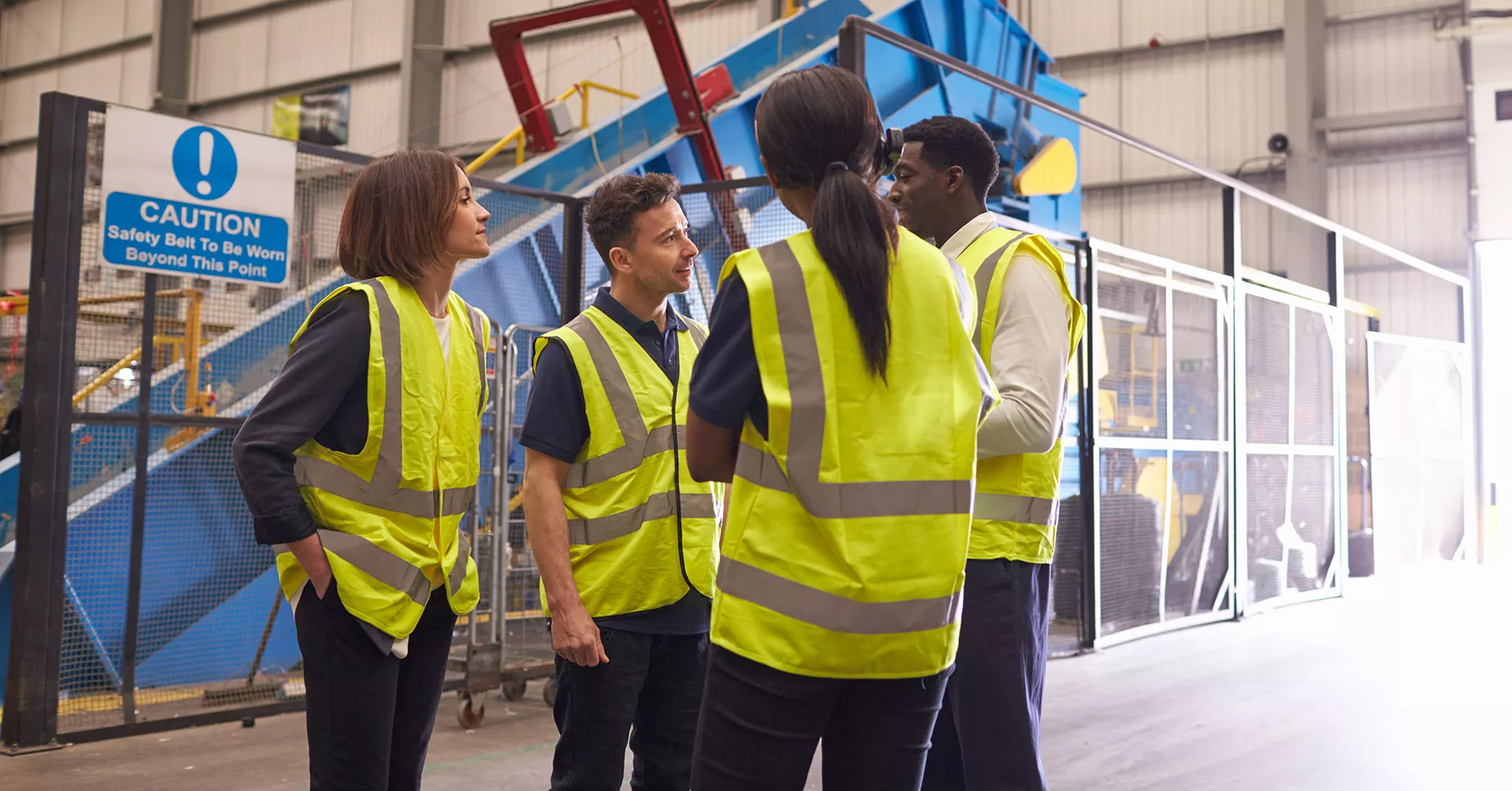
Leaving conversations about safety to quarterly meetings and occasional safety training means safety skills and awareness atrophy over time. Want a way to refresh critical concepts without losing everyone’s attention? We have you covered with safety-in-the-workplace topics.
These safety topics for work are designed for short safety talks, toolbox talks, safety meetings, and daily safety moments across industries, from offices and warehouses to construction sites and healthcare environments. Each topic can be delivered in 5–10 minutes and adapted to your organization’s specific hazards, compliance requirements, and safety culture.
Safety Topics for Work: Toolbox Talks, Safety Meetings, and Daily Safety Moments
No matter what kind of work you do, it’s easy to become complacent, especially if you’ve spent most of your days performing familiar tasks on repeat. It can be tempting to cut corners and forego best practices in the interest of time, productivity, and effort. If you find yourself going down this path away from safe work, be wary because skipping steps and ignoring rules could result in an avoidable emergency.
One way to prevent these lapses and complacency among your team is to present short safety topics regularly to remind everyone of proper procedures and prepare them for new hazards and variables they’ll encounter during the workday.
2026 Safety Calendar
Track your key safety milestones and meeting topics in one convenient calendar.
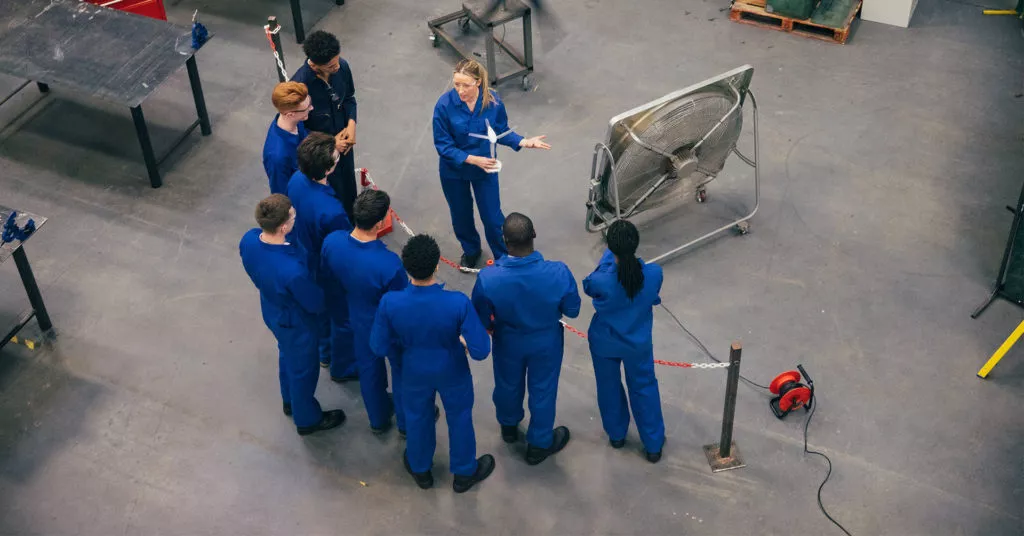
Workplace safety talks are short, digestible pre-work meetings on a specific safety topic that inform workers about what they will be doing that day. These talks are most effective when kept short, focused, and memorable so workers can easily apply the advice right away and recall it over the long term.
Organizations use safety talks to reinforce workplace safety topics such as hazard awareness, emergency preparedness, ergonomics, mental health, and incident prevention—without relying solely on formal training sessions.
Sometimes known as “safety toolbox talks,” “tailgate meetings,” “safety briefings,” or “safety moments,” safety talks can cover a wide range of topics as long as they’re related to employee health and safety (EHS).
Watch this video to learn the fundamentals of compelling safety talks, discover new topic ideas, and get facilitation tips.
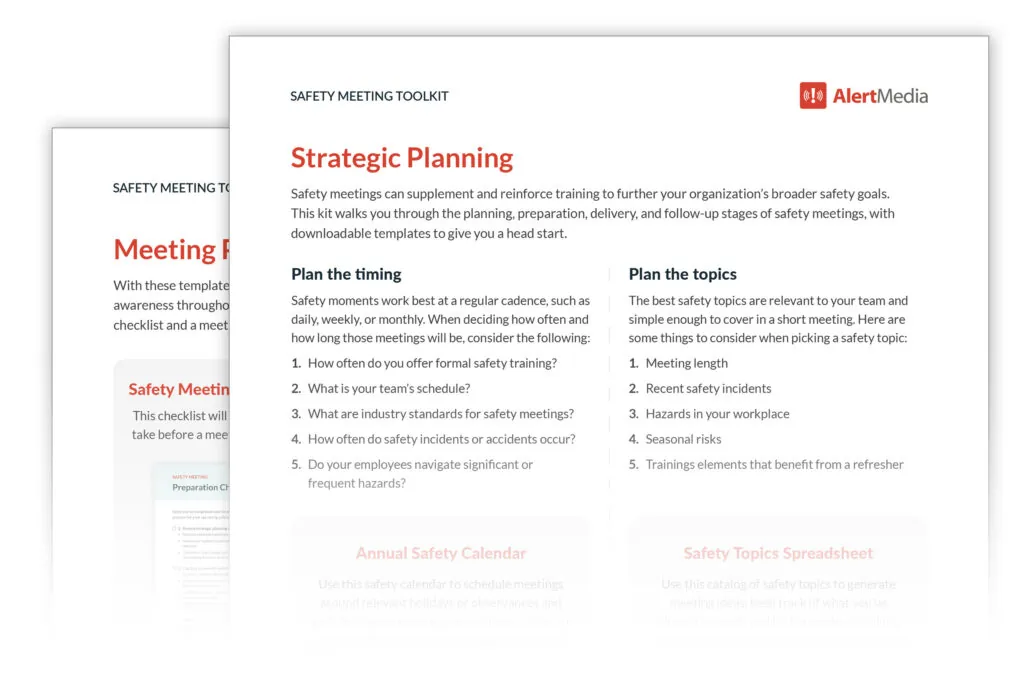
Pro Tip: Keep a running list of safety-in-the-workplace topics. With it, you can not only prepare for upcoming safety talks but also integrate those meeting topics with broader emergency planning and preparedness efforts and involve various stakeholders. You can use the Topics Sheet from the Safety Meeting Toolkit to keep track of the topics you’ve gone through and what to cover next. The Toolkit also includes downloadable training resources to help reinforce key concepts from each meeting.
Safety Topics for Work, Organized by Category
To help you quickly find relevant workplace safety topics for your next safety meeting or toolbox talk, we’ve grouped these topics into common categories such as external hazards, individual safety, safety administration, and general industry risks.
These workplace safety topics can be used in daily safety moments, weekly toolbox talks, monthly safety meetings, or seasonal training refreshers. To keep talks relevant and effective, rotate topics by role and location, prioritize seasonal risks, and use recent incidents or near misses as real-world examples. Choose topics based on the hazards people currently face, then reinforce them over time so safety guidance actually sticks.
A simple format for any safety talk (5–10 minutes):
State the risk: what could go wrong and why it matters
Share one best practice: the correct way to do it
Check understanding: ask 1–2 questions or invite a quick example
Assign a follow-up: one action (inspection, reminder, PPE check, or hazard/near-miss report) and confirm who owns the next step
How to pick the right topic:
By role or location: office, warehouse, field, healthcare, or remote teams
By season or conditions: heat, cold, storms, driving risks
By recent incidents: accidents, near misses, or emerging trends
Keep it effective:
Keep it short: one topic, one takeaway
Make it interactive: participation improves retention
Rotate topics: track what you’ve covered to avoid repetition
How can you make safety topics for work engaging and effective in safety meetings?
Safety leaders tasked with devising short safety meetings tend to focus entirely on the talk’s content, ignoring its form. They may even forget that it’s their responsibility to engage people so they’ll absorb the information and be ready to use it.
Consider ways to maintain safety engagement and interest in your content. This is partly about what not to do. For example, an uber-professional tone could backfire. Your safety meeting topics won’t do much good if your audience falls asleep two minutes in. It’s also about active strategies to involve people in the discussion and get them to buy into the significance of their everyday safety efforts. Supervisor involvement in safety talks not only reinforces the message but also shows leadership’s commitment to safety.
Ask questions
One of the main reasons people ignore meetings is that they believe they’re a waste of time because they won’t learn anything new. This can become a self-fulfilling prophecy; if they don’t think they’ll learn anything new, they’ll check out and miss the important information.
Counter this tendency by asking questions. When people realize they have an opportunity to speak their minds, they’re much more likely to become personally invested in the topic at hand. These questions shouldn’t put your frontline workers in the hot seat; they should allow them to give feedback.
Inject some humanity
When discussing safety practices, many speakers tend to adopt a very formal, clinical tone to convey the seriousness of the topic and avoid distractions. Unfortunately, this can lead to disengagement, making your presentation ineffective.
Visual aids, humor, and analogies can add color to these talks and keep your people awake and receptive to the safety talk topic.
Reward engagement
Consider formal incentives for safety, such as monthly recognition programs or bonus structures tied to safety performance. Try offering rewards for those who engage in the talks by asking poignant questions, helping others understand, or adding their own thoughts. Gift cards or other incentives work equally well.
51 Safety Meeting Topics for Work
The safety messages you incorporate in your safety talks and training sessions should be inspired by your work objectives and conditions. However, if you’re looking for some ideas to get you started, here are our suggestions.
Improper electrical distribution is a deadly hazard in the workplace. Electrocutions are one of the most common causes of injuries and fatalities on construction sites, and daisy-chained extension cords and power strips are a disturbingly common fire safety hazard. Promote fire prevention and avert workplace injuries by inspiring everyday accountability for safe electrical setup and operation.
2. Hot work safety
Heat stress prevention is key in many fields, especially those that require outdoor work during the summer months. It’s so important that OSHA is working on official regulations to require heat safety measures from many employers. Share heat safety tips with employees who work in the heat to keep people safe and maintain operational continuity.
3. Cold work safety
Cold weather can be deadly when preparedness efforts fall short. Share cold-weather safety tips with your team before a day of working in the cold, and set them up with a buddy system so all workers have someone who can look after them to prevent cold stress.
Pro Tip: We have a whole post dedicated to December and January safety topics. Check it out for more safety meeting ideas for the winter months!
4. Defensive driving
Workers who commute or drive for work can be faced with unpredictable dangers on the road. And distracted driving is a leading cause of motor vehicle accidents. It’s your duty to ensure employees’ safety while they’re on the road. Defensive driving skills are one of the best ways to ensure your team members get to their destinations safely. Emphasize the dangers of using phones, eating, or other distractions while driving. Encourage defensive driving techniques to reduce risks on the road.
5. Anti-phishing awareness
Phishing attacks—where bad actors send fake messages claiming to be someone else to gain access to restricted systems or resources—have increased year over year. These aren’t “hacks” in the traditional sense. They rely on basic social manipulation, not crafty coding or software vulnerabilities. Reminding workers how to spot phishing attacks can save your organization a lot of time, money, and trouble.
6. Active shooter awareness
While active shooter events are rare, they are becoming a greater strain on Americans’ mental health. Hold a safety meeting to go over your active shooter response plan, and reassure employees you’re looking out for their safety.
7. Work zone safety
Work zones, especially in construction or roadwork, present unique hazards like moving vehicles and heavy equipment. Ensure workers are visible with high-visibility clothing, follow proper signage, and stay alert to their surroundings. Regular safety talks can help reinforce work zone protocols.
8. Emergency preparedness for severe weather
Severe weather—such as hurricanes, tornadoes, blizzards, flooding, and other extreme weather events—can pose significant risks to workers. Use safety talks to review emergency plans, evacuation routes, and shelter-in-place procedures, and remind employees to promptly report weather-related hazards using the same reporting procedures as other workplace risks.
Encourage employees to report near misses related to environmental and weather conditions, such as almost slipping on ice, heat-related symptoms, or close calls during storms. These reports help teams investigate environmental incidents, identify trends, and implement follow-up actions—such as refining emergency plans, improving infrastructure, or adjusting work schedules—to reduce future risk and communicate changes back to employees.
Just as flight attendants remind passengers of the proper use of seatbelts, life jackets, and oxygen masks before every flight, you need to remind workers of the proper use of their PPE and safety gear so they’re more confident relying on it for everyday work and during an emergency. Common PPE—hard hats, safety glasses, respirators, fall protection harnesses, and high-visibility vests—could be the things that prevent serious injuries or death. Ensuring proper PPE use is not only critical for worker safety but also a core element of maintaining OSHA compliance.
10. Particulate matter safety
Depending on the job site, small bits of liquid or solid material can be suspended in the air, which can wreak havoc on human bodies if inhaled. Some of these materials, like asbestos, are particularly dangerous. Use a safety topic of the day to remind everyone about signs of hazardous substance exposure and why PPE is important in these situations.
11. Tool safety
Some power tools and hand tools, from nail guns to chainsaws, have a natural level of risk associated with their use. You can gather your team at the beginning of a workday to remind them of the safety protocols for a particular tool and reduce those risks.
12. Personal health
An employee’s health is usually impacted by their private life more than it is by their work environment. Taking time to encourage healthy sleep and exercise habits, as well as attending annual medical check-ups, can help keep your workforce in peak condition.
13. Office ergonomics and workstation setup
Office workers might assume they don’t face any workplace hazards, but ergonomics should not be underestimated. Poor posture, inconveniently sized equipment, and other ergonomic problems can lead to carpal tunnel syndrome, joint pain, and other safety concerns. And with the rise of remote work, ergonomic risks have extended beyond the office. Provide both in-office, hybrid, and remote workers with guidance on setting up a home workstation, including proper chair height, monitor height and positioning, keyboard placement, seating support, and break frequency to prevent musculoskeletal disorders and promote long-term health.
14. Proper lifting techniques
We’ve all been there—we go to pick something up and underestimate its weight. When workers bend at the waist to lift, they risk serious back injury. Prevent these avoidable injuries by teaching proper lifting techniques as a quick safety topic.
15. Safe use of lifting equipment
Improper use of lifting equipment, such as cranes or hoists, can lead to serious injuries or equipment failure. To prevent accidents and ensure a safer workplace, provide training on load limits, inspection procedures, and safe operation.
16. Mental health & well-being
Mental health and well-being have increasingly become areas of focus across demographics, and this holds true in the workplace. Worsened by the isolation, loneliness, and despair many felt during the height of the COVID pandemic, people’s mental health is at serious risk. Show your employees you care and are there to offer resources and support.
17. Hearing protection
Exposure to noise levels above 85 decibels (roughly the volume of an electric blender) can cause permanent damage to workers’ hearing. And while OSHA requires organizations to provide hearing protection equipment, a safety talk about why they’re necessary and how to use them properly ensures workers are prepared to prevent injuries.
18. Hearing loss
Prolonged exposure to loud noise can cause permanent hearing loss—even when damage isn’t immediately noticeable. Use this safety topic for work to explain the early warning signs of hearing impairment, reinforce noise-monitoring practices, and review when hearing protection is required under OSHA guidelines.
19. Substance abuse and impairment
Substance abuse and impairment significantly increase the risk of workplace incidents. Impairment isn’t limited to drugs or alcohol—it can also result from fatigue, prescription medications, untreated medical conditions, or extreme stress.
Use safety talks to help employees recognize signs of impairment in themselves or others and understand that these risks should be reported just like other safety hazards. Early reporting allows supervisors to intervene, provide support, and prevent accidents before they occur.
Reinforce that employees can access confidential support resources, such as Employee Assistance Programs (EAPs), counseling, or referral services. Emphasize a no-retaliation policy so workers feel safe raising concerns—whether about their own well-being or a potential safety risk they observe.
20. Hydration
No matter what kind of work you do, no matter where you do it, there’s always one thing your people absolutely need: water. Make sure everyone knows where they can find cool water and that they have the right (and the responsibility) to take regular breaks for water.
21. First aid refresher
First aid training is too detailed and intensive to cover in a 5-minute safety talk, but those few minutes are enough to strengthen first aid skills among your employees. Potential areas of focus include reminders of where all first-aid equipment is located, signs of a stroke, or an overview of the proper CPR compression technique.
22. Accessibility and inclusive safety
Creating a safer workplace means ensuring safety efforts are accessible to everyone, including employees with disabilities or those who require accommodations. This includes providing accessible training materials, such as captioned videos or large-print documents, and ensuring physical workspaces are designed with inclusivity in mind. By tailoring safety protocols to meet diverse needs and encouraging open communication about accommodations, you can ensure that all employees can fully participate in safety programs and remain protected on the job.
23. Fatigue management
Fatigue can impair judgment, reaction time, and productivity, increasing the risk of accidents. Educate workers on the importance of adequate sleep, taking breaks, and recognizing signs of fatigue. Implement policies to manage work hours and reduce fatigue-related risks.
24. Preventing repetitive strain injuries (RSIs)
Repetitive motions, such as typing or assembly line work, can lead to RSIs, including tendonitis and carpal tunnel syndrome. Teach workers about proper ergonomics, stretching exercises, and the importance of taking breaks to reduce the risk of RSIs.
25. Safe use of personal devices at work
With the rise of BYOD (Bring Your Own Device) policies, employees often use personal phones, tablets, or laptops for work. Address the risks of distracted driving, cybersecurity vulnerabilities, and ergonomic issues related to personal device use.
26. Respiratory protection
Respiratory protection is vital in environments with poor air quality or hazardous substances. Train workers on the proper use of respirators, fit testing, and maintenance. Regularly review your respiratory protection program to ensure compliance and effectiveness.
27. Preventing slips, trips, and falls
Slips, trips, and falls are among the most common workplace injuries. Practice good housekeeping and regularly inspect work areas for hazards, such as wet floors, uneven surfaces, or cluttered walkways. Ensure that all PPE and fall prevention equipment are in working order. Encourage workers to report potential risks and wear appropriate footwear to prevent accidents.
Safety Administration
“Part of being an effective emergency manager…is helping [workers] understand why it’s important to plan.”
Even if you have the best emergency notification system, good message templates, and an awesome reporting workflow, your hazard communication efforts will fall flat if employees aren’t reading the messages. Take some time to remind everyone how these notifications work, where they come from, and what to expect. You can also confirm all employees’ contact information as a follow-up action item. Additionally, ensure all safety documentation—including training logs, emergency procedures, and inspection checklists—is up-to-date and accessible to employees.
You can use the Follow-Up template from the Safety Meetings Toolkit to communicate after your safety talks.
The Employee Safety Report
Learn what your employees actually want when it comes to their safety at work and what that means for your business.
High-performing safety programs treat reporting and investigation as a continuous loop, not a one-time administrative task. Prompt reporting of accidents, unsafe conditions, and near misses is critical—not just for compliance, but for preventing future incidents. When hazards go unreported, the same risks can resurface and lead to more serious injuries over time.
Use safety talks to review how and when to report, including who to notify, what information to include, and where to submit reports (forms, apps, or internal systems). Make it clear what happens after a report is filed—how incidents are investigated, root causes identified, and corrective actions implemented.
Address common barriers to reporting, such as fear of blame, uncertainty about what qualifies as a reportable issue (including environmental or weather-related hazards), overly complex procedures, or concerns about reporting impairment-related risks. Reinforce a no-retaliation policy and encourage near-miss reporting, which provides early warning signs that help break the chain of recurring hazards and strengthen a culture of continuous safety improvement. Over time, consistent reporting and follow-up turn individual safety concerns into organization-wide risk reduction.
30. Importance of work stoppages
Some emergencies are made much worse by the “bystander effect.” When a worker feels they don’t have the authority to stop an unsafe activity, they’re unlikely to step in when something goes wrong. They might instead opt to wait for a supervisor to make the call—but during an emergency, seconds matter. Hold a meeting to ensure everyone knows they have the right to stop any dangerous work and will not be penalized for doing so.
31. Safety culture
Your organization’s safety culture is the aggregate of attitudes, behaviors, and practices regarding safety. It’s key to developing a safe, productive, and caring workplace, but it can only be accomplished with continuous effort. Morning safety talks can help keep your momentum on prioritizing safety first. A strong safety and security culture depends on transparent reporting, consistent follow-up, and visible action when hazards or near misses are raised—especially when employees see changes made as a result of their reports. Reporting and learning from environmental and weather-related incidents help organizations continuously improve emergency planning and build long-term resilience.
32. Workplace access protocol
Who’s allowed on the work site? Who isn’t? What about clients, vendors, and guests? Take a moment to remind your team about proper access control, such as not holding the door open. You can also use sign-in sheets to track who is on-site at any given time—critical for roll calls during evacuations and audits.
33. Labeling potential hazards
Labels for potential hazards, such as slippery floors or unexpected steps, can go a long way toward keeping everyone aware and reducing slip, trip, and fall accidents. Some workplaces may also have hazardous chemicals or areas unsafe to enter when equipment is on, and warning labels can promote situational awareness. Training employees in hazard identification helps them recognize and respond to risks proactively—whether it’s a spill, exposed wiring, or missing signage.
34. Lockout/tagout (LOTO) procedures
Lockout/tagout is a critical component of any occupational safety program, ensuring equipment is properly shut off and cannot be restarted during maintenance or repair. A strong LOTO process prevents accidental machine start-ups, protecting workers from serious injuries or fatalities. Reinforce the importance of following LOTO protocols to create a safer workplace.
35. Occupational safety programs
A comprehensive occupational safety program is the foundation of a safer workplace. Regularly review and update your program to address new risks, ensure regulatory compliance, and foster a culture of safety. Encourage employee participation and feedback to continuously improve safety measures.
36. Chemical safety and hazard communication
Proper handling and storage of chemicals are essential to prevent accidents and exposure. Reinforce the Hazard Communication Standard (29 CFR 1910.1200), including Safety Data Sheets (SDS), proper labeling, employee training requirements, and the use of PPE when working with hazardous materials. A strong hazard communication program is key to reducing risks.
37. Preventing workplace bullying and harassment
A safe workplace includes emotional and psychological safety. Address workplace bullying and harassment by promoting a culture of respect, providing reporting channels, and offering support to affected employees. A positive work environment enhances overall safety and well-being.
General Industry Safety
“If workers aren’t following specific protocols, very drastic things can happen not only to them but to their coworkers.”
No matter the environment and type of work, situational awareness is perhaps the single most significant habit that can keep employees safe. Hold a short safety talk to gauge how situationally aware your employees are. This evaluation will help you plan more in-depth training to guide them in increasing their awareness of the risks they may face.
39. Ladder safety
There’s a reason ladders are associated with bad luck: They’re a deceptively deadly tool we frequently rely on. Proper ladder setup, use, and oversight can avoid painful and costly mistakes.
40. Forklift safety
Working with heavy machinery, including forklifts, can be dangerous without the proper training. Safety talks about safe forklift driving and handling are critical for those working with or even near these tools.
41. Safe use of hand tools
Hand tools, such as hammers, screwdrivers, and wrenches, are ubiquitous in many workplaces but can cause injuries if used improperly. This topic could cover selecting the proper tool for the task, inspecting tools for damage or wear, and techniques to avoid strain or injury (e.g., using the right grip and avoiding excessive force).
42. Safe use of power tools
Power tools, such as drills, saws, and sanders, are essential in many industries but pose significant risks if used improperly. This topic could cover proper training and certification for power tool use, tool inspection for damage or defects, and safe operating techniques, including the use of guards and safety switches.
Workplace Violence Response Plan Template
Prevent acts of violence, fulfill your legal obligations, and improve workplace safety with this free template.
Workplace violence is increasingly common, particularly in service industries and healthcare. Talk with your employees about the types of workplace violence, warning signs, and prevention steps they can take, including how to identify and report potential violence through an open, non-punitive channel.
44. Emergency exits
Every indoor workspace should have clearly marked emergency exits as part of a fire evacuation plan. That plan requires you to regularly review these emergency exit routes with your team, especially if you’re working in a new, unfamiliar location or in case one or more exits become blocked in an emergency.
45. Heavy vehicle safety
Heavy vehicles—such as forklifts, trucks, cranes, and other heavy-duty machines—can cause damage to people and property. Make sure all workers are aware of the dangers and how to keep themselves and others out of harm’s way.
46. Safe handling of compressed gases
Compressed gases, such as oxygen, acetylene, or nitrogen, are common in many workplaces but can be extremely hazardous if mishandled. Train workers on proper storage, handling, and use of compressed gas cylinders, including securing them upright and checking for leaks.
47. Fire extinguisher use
Portable fire extinguishers are ubiquitous and extremely effective at protecting people and property from fire damage, but only if they’re used properly. When giving a short fire safety talk on correct fire extinguisher use, turn it into a game to see who has the best aim with the fire extinguisher.
48. Confined space awareness
Some confined spaces pose respiratory hazards, engulfment hazards, electrical dangers, or other factors that make them more dangerous than your average crawlspace. These are often restricted by posted signage. Make sure your team knows who is and isn’t permitted in these spaces and what the signage looks like. Trenching work, pipework, and other assignments are associated with these risks.
49. Carbon monoxide safety
Dubbed the “silent killer” because it’s undetectable by humans, carbon monoxide is deadly, and you must monitor for it, especially in the presence of flammable gases, exhaust, and heaters. Ensure your employees know the signs of carbon monoxide poisoning and how to double-check that CO monitors are working properly.
50. Air quality monitoring
Poor air quality can lead to respiratory issues, long-term health problems, and reduced productivity. Whether it’s dust, fumes, or chemical vapors, monitoring air quality is essential for maintaining a healthy work environment. Equip workers with the knowledge and tools to identify and report air quality concerns.
51. Stress management in the workplace
Chronic stress can lead to burnout, reduced productivity, and even physical health issues. Teach workers to recognize signs of stress in themselves and others, and provide resources like mindfulness techniques or Employee Assistance Programs (EAPs) to help them manage stress effectively.
Every Day Can Be a Safe Day
Carving out small chunks of time to regularly review digestible safety topics goes far beyond just preparing your employees for individual hazards. By making these short safety talks a familiar fixture of everyone’s days, you ingrain the idea that safety is always the number one priority. But it’s not safe for safety’s sake—it’s expressly to protect your business, its operations, and its people so everyone can work confidently, without disruptions.
2026 Safety Calendar
Track your key safety milestones and meeting topics in one convenient calendar.
AlertMedia’s content is driven by a team of seasoned safety, security, and global intelligence professionals with real-world experience supporting organizations during critical events. With backgrounds in crisis leadership, emergency communications, professional meteorology, and global security operations, our experts deliver practical, trusted insights. Through continuous monitoring and expanding capabilities in incident response, travel risk management, and social intelligence, AlertMedia helps organizations protect their people and stay resilient wherever they operate.
Please complete the form below to receive this resource.
Check Your Inbox!
The document you requested has been sent to your provided email address.
Like What You're Reading? Subscribe to Our Newsletter
Subscribe to The Signal by AlertMedia to get updated when we publish new content and receive actionable insights on what’s working right now in emergency preparedness.