
Critical events don’t wait for perfect plans. Learn how organizations act fast, stay operational, and protect people when conditions change by the minute.

Emergency Management Feb 17, 2026
Critical Event Response: A Practical Guide to Acting Fast and Staying Operational
Crisis Management Plan Template
Develop a plan tailored to your organization that ensures a timely, successful resolution to any critical event.
When you think about a business safety emergency, you might picture familiar scenarios. Trips and slips, inclement weather, and power outages are everyday issues most business leaders have dealt with at least once. Because they are familiar, these types of incident response scenarios are often top of mind when organizations assess risk and preparedness.
While those incidents remain relevant, they no longer reflect the full range of threats organizations face today. Critical events now unfold faster, cross organizational boundaries, and escalate in unpredictable ways.
The volume, complexity, and severity of incidents have increased. Multiple threat types can collide in real time, making situational awareness harder to maintain. Delays in crisis response then allow impacts to cascade.
This merging of threats has made converged security—the alignment of physical, digital, and operational risk response—increasingly necessary. Addressing these risks in isolation slows response and creates blind spots when speed matters most.
On The Employee Safety Podcast, Brendan Monahan, Head of U.S. Resilience and Crisis Management for a major global pharmaceutical company, explained why many organizations need to rethink traditional approaches to critical event management:
“The degree of complexity, the frequency of incidents occurring, and the severity with which they can have consequences, means that some of the approaches that we’ve used in the past need to be modified substantially.”
Unlike slow-moving emergencies with clear playbooks, today’s critical events often escalate rapidly. Response teams must make fast decisions with incomplete information. Whether the disruption stems from severe weather, a cyber incident, or an operational failure, success depends on how quickly leadership aligns, sets priorities, and coordinates action across functions.
The reality is simple. Modern threats leave little time for rigid plans or siloed reactions. Organizations that detect issues early through risk intelligence, maintain a shared operating picture, and respond quickly and clearly are better positioned to protect their people, operations, and reputation.
Download Our Crisis Management Plan Template
Develop a plan tailored to your organization that ensures a timely, successful resolution to any critical event.
“The degree of complexity, the frequency of incidents occurring, and the severity with which they can have consequences, means that some of the approaches that we’ve used in the past need to be modified substantially.”
What Is a Critical Event?
A critical event, sometimes called a critical incident, is an unexpected situation that threatens people, disrupts operations, and puts business continuity at risk. Of course, effective critical incident response depends less on how an event is labeled and more on how quickly it escalates and how well the organization can respond under pressure.
As crisis management leader Brendan Monahan explains, severity is not defined solely by incident type. What matters is how little time there is to make decisions, how quickly conditions change, and how many parts of the organization must act simultaneously. These moments test emergency management capabilities and team coordination.
Critical events rarely stay contained. They intensify as they unfold, creating pressure on response teams to adapt in real time. Leadership and response authority must be established quickly, especially when employees are on-site and conditions are evolving. Priorities often shift as new information emerges, which makes clear roles, escalation paths, and effective communication essential to maintaining control.
Common examples of critical events include:
- Natural disasters such as hurricanes, earthquakes, and wildfires
- Terrorism or civil unrest
- Cyberattacks and data breaches
- Workplace violence, including active shooter incidents
- Supply chain disruptions
- Workforce shortages
- Industrial accidents
- Pandemics and public health emergencies
Many critical events are also traumatic events that affect employee well-being and mental health. Support does not end when operations stabilize. Organizations may need to provide additional resources, referrals, or access to an employee assistance program (EAP) to support recovery. For some incidents, follow-up communication may include guidance shared through internal channels, social media, or educational formats, such as webinars, to reinforce expectations and resources.
Critical events also vary in scale. A routine disruption, such as a supply delay or system outage, can become critical when it triggers broader operational impacts or human consequences. How an organization responds in those moments directly affects risk exposure, recovery time, and its ability to protect people and sustain operations during and after the incident.
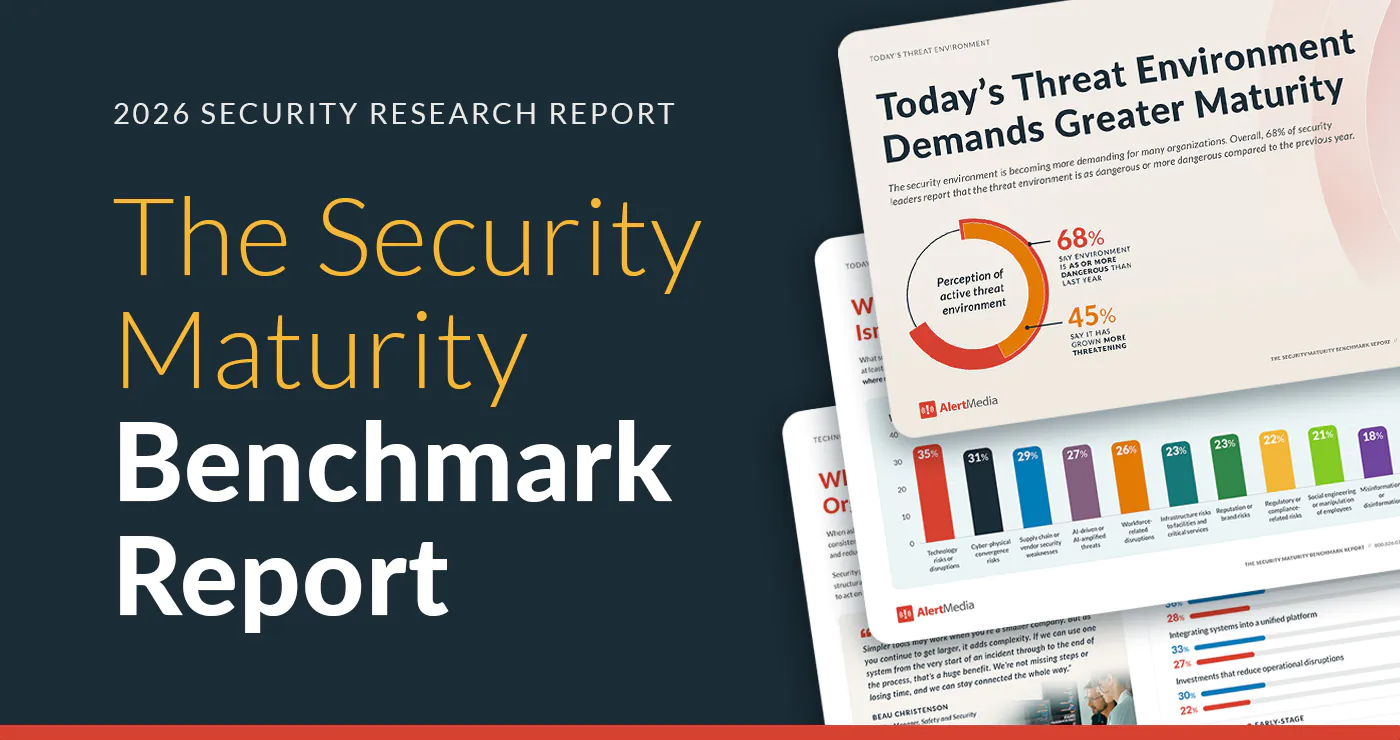
Discover What Resilient Security Programs Do Differently
We surveyed 501 leaders to find what separates reactive from ready. Download The Security Maturity Benchmark Report to see where your program stands.
Response Readiness Across Every Stage of a Crisis
Response readiness is the ability to make decisions early, coordinate action, and stay effective as conditions change. Every stage of a crisis introduces new pressure, but the organizations that perform best are not the ones with the most detailed plans. They are the ones who can answer basic questions quickly and act without hesitation.
Brendan Monahan emphasizes that crises rarely unfold in a straight line. They escalate, stall, and shift direction as new information emerges. Response readiness depends on having a structure that supports flexible decision-making.
Early-stage readiness: Recognizing and activating
In the early stage of a crisis, speed matters more than precision. Teams need to recognize that something is going wrong and move quickly to establish control.
Response-ready organizations focus on:
- Clear triggers for escalation
- Rapid activation of response roles
- Immediate clarity on who is in charge
Monahan points out that delays often stem from uncertainty, not from a lack of effort. If teams cannot quickly determine ownership and authority, response loses momentum before it begins.
Escalation-stage readiness: Coordinating under pressure
As incidents intensify, readiness shifts from activation to coordination. More people become involved. Impacts spread across functions. Decisions must be made with incomplete information.
At this stage, response readiness depends on:
- Defined roles that do not change mid-response
- Workflows that support fast information sharing
- Continuous communication across teams and locations
Monahan’s approach centers on simple, repeatable questions that anchor response as situations evolve: Who is in charge? What needs to be done? Who is doing what? When teams can consistently answer those questions, coordination improves even as pressure increases.
Download Our Crisis Management Plan Template
Decision authority and mitigation strategies
Decision authority is a defining factor in response readiness. Teams must be empowered to act without waiting for extended approval chains. Effective mitigation strategies account for this reality by decentralizing response and pushing authority closer to the incident.
When decision-making is clear and empowered:
- Disruptions are contained earlier
- Recovery begins faster
- Stabilization requires less effort and fewer resources
Readiness means accepting that early decisions may need to be adjusted later. Waiting for perfect information almost always creates worse outcomes.
Sustained response and adaptability
During prolonged incidents, readiness depends on flexibility. Teams need to reassess priorities, adjust workflows, and scale involvement as conditions change.
Response-ready organizations rely on:
- Clear escalation paths as impacts grow
- The ability to expand or contract response teams
- Ongoing reassessment of objectives
An emergency response plan supports this phase only if it reinforces adaptability. Plans that exist solely as documentation slow teams down. Plans that clarify roles, workflows, escalation thresholds, and communication expectations help teams stay aligned under pressure.
Response Readiness and the True Cost of Critical Events
Critical events carry real financial and operational costs, but the impact is often determined by how well an organization responds. Response readiness has direct consequences for downtime, recovery speed, and regulatory exposure.
Clear roles, strong workflows, and timely decisions help organizations contain disruption earlier and minimize downtime. Faster stabilization supports business continuity by limiting the spread of operational impacts and the duration of recovery. When responses are slow or poorly coordinated, even manageable incidents can escalate into prolonged outages and significant losses.
The financial impact of critical events is clear. Cyber incidents, for example, continue to grow more expensive as detection and containment take longer. Recent research shows the average cost of a data breach has reached $4.4 million, with delayed response allowing damage to spread across systems, customers, and operations. The same pattern appears in physical disruptions. In 2024, the United States experienced 27 weather and climate disasters with losses exceeding $1 billion each. These events often trigger cascading effects across supply chains, infrastructure, and workforce availability. Rapid coordination is essential to limiting this downtime.
Costs extend beyond immediate financial loss. Poor execution of responses can damage trust with customers and partners, raise concerns among investors, and weaken confidence in leadership and risk management practices. Reputational harm often lingers long after operations resume.
Regulatory consequences are closely tied to response quality as well. After an incident, regulators and stakeholders examine how decisions were made, how communication was handled, and whether escalation occurred appropriately. Gaps in incident reporting, delayed notifications, or unclear accountability can increase scrutiny and elevate compliance risk, even when the original event was unavoidable.
Ultimately, it is not just the event itself that drives cost. The speed, coordination, and effectiveness of the response often determine whether impacts are contained or allowed to escalate. Response readiness is not about predicting every scenario. It is about building the ability to make decisions, coordinate action, and adapt at every stage of a crisis.
Core Capabilities That Enable Effective Critical Event Response
Effective critical event response is not driven by a single plan or tool. It depends on a small set of capabilities that work together under pressure. When those capabilities are missing or disconnected, response slows, coordination breaks down, and incidents escalate faster than teams can manage.
At a high level, strong response capability rests on three things:
- Readiness before an incident begins
- Execution while conditions are changing
- Reinforcement through recovery and learning
Critical event readiness that supports action
Response readiness is not defined by how much planning has been completed. It is defined by how quickly an organization can move from recognition to action when an incident begins. The test of readiness is whether teams can activate, align, and make decisions without hesitation as conditions change.
At the moment a critical event starts, readiness depends on a small set of practical conditions. If any of these are missing, response slows before it even gets underway.
Response readiness requires:
- Early risk mitigation: Readiness includes the ability to recognize early warning signs and understand how threats are likely to escalate. A current business threat assessment supports risk mitigation by helping teams identify which signals matter and when to escalate response before impacts spread. This often includes improving infrastructure resilience and strengthening systems to limit cascading impacts
- Clear role ownership from the start: Teams must know who is in charge, who has decision authority, and who is responsible for execution. If roles and responsibilities are unclear, time is lost negotiating ownership while the situation escalates.
- Defined activation and escalation paths: Readiness means knowing when the response begins and how it expands. Emergency evacuation plans and crisis communication protocols should already be in place so teams can act without hesitation. Clear escalation also supports the business continuity plan by ensuring the right people are engaged before impacts spread.
- Workflows built for uncertainty: Early response rarely comes with complete information. Readiness depends on workflows that allow teams to act, reassess, and adjust rather than wait for perfect clarity.
- Communication that supports coordination: Teams need established ways to share updates, align priorities, and maintain a shared operating picture as conditions change.
- Decision authority close to the incident: Effective readiness pushes authority to the people closest to the situation, reducing delays caused by lengthy approval chains.
These elements work together. Clear roles enable faster activation. Defined escalation supports coordination as incidents intensify. Decision authority allows teams to move before disruption spreads.
An emergency response plan supports readiness only when it reinforces these conditions. Plans that focus on documentation, static scenarios, or rigid sequences tend to slow responses rather than enable them.
How these capabilities are executed under pressure
Foundational capabilities only matter if they hold up once an incident is underway. When conditions change quickly, response teams are forced to act with incomplete information, shifting priorities, and real operational constraints. This is where many response efforts fail. Plans exist, but teams struggle to translate them into action fast enough.
In his discussion, Brendan Monahan emphasized that an effective response under pressure depends on establishing clarity early. When formal plans break down, teams still need answers to basic questions: Who is in charge? What matters most right now? How do we coordinate action across roles and locations? Response succeeds when leadership, communication, and decision-making remain intact, even as systems, infrastructure, or assumptions fail.
That dynamic was visible during the Anchorage earthquake, a magnitude 7.1 event that caused widespread disruption across the city, including critical aviation infrastructure. The quake rendered the air traffic control tower and backup facilities unusable, forcing controllers to operate without their normal environment or tools.
Rather than pausing to locate an alternative plan, leadership was established immediately, and priorities were set around aircraft safety. Controllers adapted in real time, coordinating actions and adjusting procedures as conditions changed. The outcome was not driven by a flawless plan, but by clarity, coordination, and the ability to make decisions under pressure.
Technology plays a critical role in enabling this kind of execution, but only when it is integrated into response workflows rather than treated as a standalone solution. The following capabilities are most effective when incidents escalate and time is limited:
- Real-time threat intelligence platforms to surface emerging risks and active incidents as conditions evolve
- Emergency mass notification systems to deliver instructions and updates quickly across multiple channels
- Two-way communication tools to gather real-time input from employees, responders, and field teams
- Centralized incident management dashboards to maintain a shared operating picture across functions
- Automated activation workflows to reduce delays and speed escalation as incidents intensify
- Geospatial mapping tools to visualize impacted locations, assets, and personnel
- Response analytics tools to capture decisions and actions for post-incident review and improvement
Used together, these capabilities support the same principles that made the Anchorage response effective. They help establish leadership quickly, align teams around shared priorities, and keep communication flowing as conditions change. When systems fail or assumptions no longer hold, visibility and coordination become the primary stabilizers.
In similar scenarios, these technologies allow organizations to adapt without losing control. Leaders can assess conditions in real time. Response teams can coordinate action across locations. Decision-makers can adjust objectives as new information emerges. Most importantly, teams can continue operating even when parts of the environment are degraded or unavailable.
Learning from your critical event response
Response does not end when an incident is contained. Recovery and learning are where response capability is reinforced, weaknesses are exposed, and future performance is shaped. Organizations that skip this step often repeat the same mistakes under the next set of conditions.
After a critical event, teams need to examine what actually happened. That includes where response slowed, where communication broke down, and where decision-making became unclear. These issues are rarely visible during the incident itself. They surface only when teams step back and review actions in sequence.
After-action reviews and reports provide the structure for this work. They create a documented record of how the response unfolded, which decisions were made, and why. More importantly, they highlight where expectations did not match reality. Plans may have existed, but roles may not have been clear.
Escalation paths may have been defined, but activation may have been delayed. Communication tools may have been available, but information may not have reached the right people at the right time.
Effective after-action reviews focus on practical gaps, not blame. Common areas of breakdown include:
- Delays in recognizing escalation or activating a response
- Confusion around decision authority or leadership roles
- Communication failures between teams or locations
- Workflows that did not adapt as conditions changed
- Technology that was available but not integrated into the response
Documentation is critical here. Regulators, auditors, and internal stakeholders often expect clear evidence of how an incident was managed. After-action reports help demonstrate that the organization reviewed its response, identified gaps, and took steps to address them.
Learning only matters if it leads to change. Insights from after-action reports should inform updates to response workflows, training exercises, escalation thresholds, and communication practices. Over time, this cycle strengthens response performance. Teams recognize issues faster. Decisions improve. Coordination becomes more consistent under pressure.
Finding the Foundation of Long-Term Resilience
Clear roles, timely decisions, and coordinated action allow organizations to contain disruption early and stabilize operations more quickly. When response falters, incidents escalate, recovery slows, and operational risk increases.
These response dynamics also shape accountability during a critical event. Once an incident is underway, attention shifts quickly from what happened to how the organization responded. Decisions made under pressure become visible. So does the speed of escalation and the clarity of communication. Employees, customers, partners, and regulators all see the results.
Duty of care sits within that scrutiny. Organizations are expected to act in a reasonable and timely way to protect people and limit harm. Meeting that obligation depends on how effectively the response is activated. It also depends on how information is shared and how well teams coordinate as conditions change.
Resilience is not created by plans alone. It is built through execution under pressure and strengthened through review and learning after each incident.
Organizations that invest in response readiness and act decisively when it counts are better positioned to protect people, maintain operations, and adapt as complexity increases. In the end, resilience is not something you declare. It is earned through performance when it matters most.
FAQ
- What is a critical event in business? A critical event is an unexpected situation that threatens employee safety, disrupts operations, and puts business continuity at risk. These events often escalate quickly and require rapid decision-making, clear leadership, and coordinated action across teams.
- What is the difference between a critical event and a routine disruption? A routine disruption becomes critical when it escalates rapidly, impacts multiple business functions, or creates risk to people and operations. The difference is less about the incident type and more about how quickly conditions change and how much coordination is required to respond effectively.
- Why is response readiness important during a crisis? Response readiness determines how quickly an organization can recognize risk, activate leadership, and coordinate action. Strong readiness helps reduce downtime, limit financial and reputational damage, and support compliance by ensuring decisions are timely and well-documented.
- What capabilities are essential for effective critical event response? Effective response depends on early risk detection, clear decision authority, defined escalation paths, coordinated communication, adaptable workflows, and integrated technology such as mass notification systems and centralized incident management dashboards.
- How does poor response increase the cost of a critical event? When response is delayed or poorly coordinated, disruptions spread. Downtime increases. Regulatory scrutiny intensifies. Reputational damage grows. In many cases, the speed and clarity of response determine whether impacts are contained or escalate into long-term operational and financial losses.
- What should organizations do after a critical event? After stabilizing operations, organizations should conduct an after-action review. This process evaluates leadership decisions, communication effectiveness, escalation timing, and workflow gaps. Lessons learned should feed directly into updated plans, training exercises, and improved response protocols.
- How can technology improve crisis response? Technology improves crisis response by delivering real-time threat intelligence, enabling rapid multi-channel communication, supporting two-way updates from employees and field teams, maintaining a shared operating picture, and automating activation workflows to reduce delays during escalation.
Download Our Crisis Management Plan Template
Develop a plan tailored to your organization that ensures a timely, successful resolution to any critical event.

AlertMedia, Risk Intelligence and Response


![11 Steps to Creating an Effective Emergency Response Plan [+ Template]](https://www.alertmedia.com/wp-content/uploads/2023/10/Blog-Emergency-Response-Plan.webp)