By AlertMedia, Risk Intelligence and Response

Emergency Management Jun 26, 2026
What Is a Risk Intelligence Platform for Threat Detection?
Buyer’s Guide to Risk Intelligence & Response Platforms
Evaluate vendors, compare capabilities, and choose a solution that helps you detect threats earlier and respond faster.
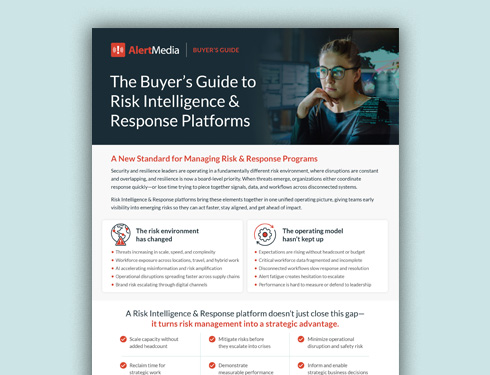
Table of Contents
- Why a Risk Intelligence Platform Matters
- Key Components of a Risk Intelligence Platform
- How a Risk Intelligence Platform Works
- Best Practices for Risk Intelligence and Threat Detection
- Common Challenges and How to Address Them
- How AlertMedia Approaches Risk Intelligence and Threat Detection
- AI Across the AlertMedia Platform
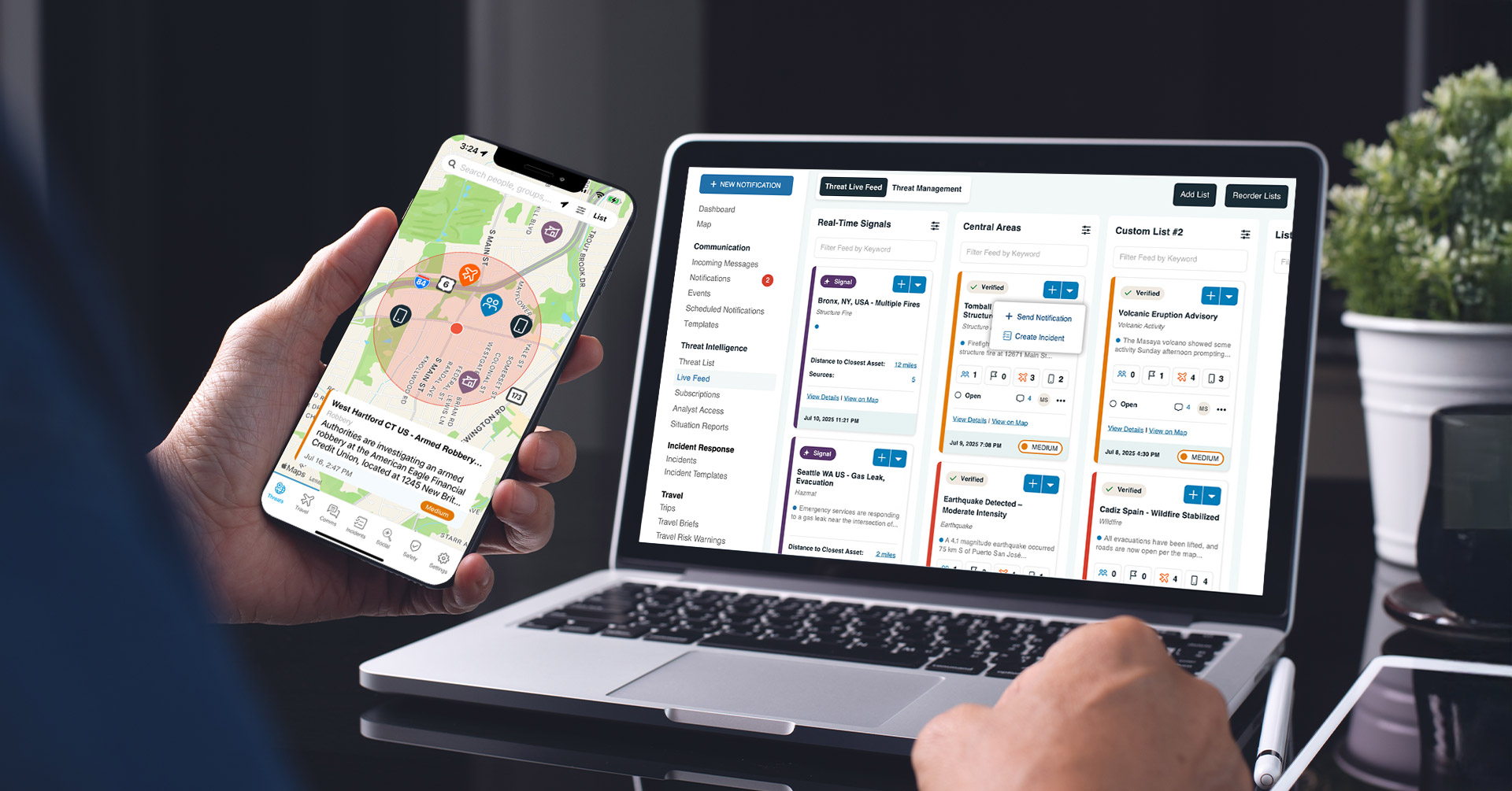
A risk intelligence platform for threat detection is a software system that continuously monitors physical threat data from multiple sources, analyzes that information to identify risks relevant to an organization’s people, locations, and operations, and enables security and resilience teams to assess impact and coordinate a response. Unlike reactive security tools that alert teams after an incident has occurred, a risk intelligence platform is designed to surface threats before they escalate—giving organizations time to act rather than just react. This page explains what a risk intelligence platform includes, how it works, why it matters, and what organizations should look for when evaluating one.
Why a Risk Intelligence Platform Matters
The cost of reactive security
Security teams operating without structured threat intelligence spend significant time finding and verifying information about developing situations—monitoring news feeds manually, tracking government advisories, and synthesizing information across disconnected sources. That process is slow, inconsistent, and proportional to team size. A risk intelligence platform automates the monitoring layer and filters the results by organizational relevance, so the team sees only what matters to them.
Faster, more confident response decisions
When a potential threat surfaces, the first question is always: Does this affect us? A risk intelligence platform answers that question with analyst-verified, location-specific intelligence—not raw signals that require additional verification before any action can be taken. Faster verification leads to faster activation decisions, and faster activation leads to better outcomes for the people and operations at risk.
Coverage that scales with the organization
An organization with 50 locations faces 50 distinct threat environments simultaneously. Manual monitoring across that footprint is impractical for any team. A risk intelligence platform scales monitoring to any number of locations and delivers the same intelligence quality across all of them—without requiring proportional growth in the team doing the monitoring.
A force multiplier for lean teams
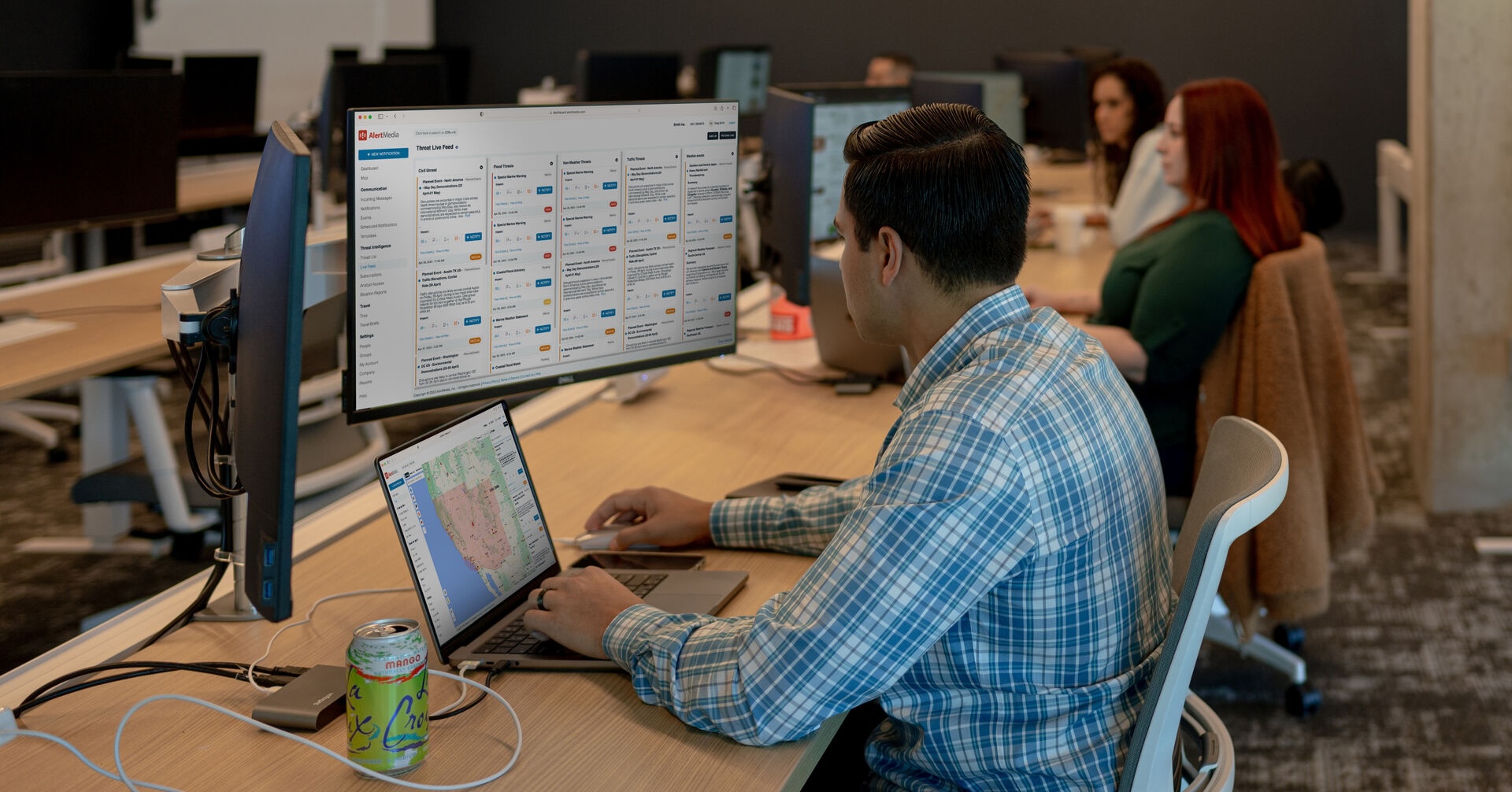
Most corporate security and operational resilience teams operate with limited headcount relative to the scope of what they’re protecting. A risk intelligence platform functions as an extension of the team: continuous monitoring, automated signal processing, and on-demand analyst access give a small team the operational coverage of a larger one.
Audit-ready documentation
For organizations in regulated industries—financial services, healthcare, energy—operational resilience programs carry documentation requirements. A risk intelligence platform that captures threat monitoring data, assessment records, and response actions creates the audit-ready documentation that governance and compliance functions need, without requiring manual record-keeping.
Key Components of an Enterprise Risk Intelligence Platform
A risk intelligence platform built for physical threat detection should include the following components. Evaluate each when comparing platforms:
| Component | What it means | Why it matters |
| Threat monitoring and detection | Continuous ingestion of signals from public sources—news, government advisories, social data, weather | Provides the raw material for intelligence; coverage breadth determines what the platform can detect |
| AI-powered analysis and automation | Machine learning and AI models that filter, classify, and prioritize raw signals at scale | Enables monitoring at a volume no human team can achieve manually; reduces raw noise before analyst review |
| Human-verified intelligence | Analyst review that confirms relevance, accuracy, and organizational context before intelligence reaches the team | Converts signals into decisions; analyst verification is what makes intelligence actionable rather than just informational |
| Real-time impact assessment | Visualization tools that map threats against an organization’s locations, people, and assets | Answers ‘Does this affect us?’ immediately—the most critical question in any developing situation |
| Integrated response and communication | Direct connection from the intelligence layer to notifications and incident response workflows | Eliminates the gap between knowing about a threat and being able to act on it; reduces time-to-response |
| On-demand analyst access | Direct connection to intelligence analysts for consultation during active situations or high-risk events | Provides expert judgment at the moment when the team needs context, not just data |
| Weather and environmental risk | Dedicated weather intelligence covering severe weather, localized environmental conditions, and impact forecasting | Weather is among the most common operational disruptors; dedicated meteorological modeling is materially better than general weather data |
| Reporting and documentation | Structured intelligence reports, incident documentation, and historical threat data | Supports governance, after-action review, and regulatory documentation for resilience programs |
How a Risk Intelligence Platform Works
Step 1: Monitor
The platform continuously ingests signals from tens of thousands of sources: news outlets, government advisories, social platforms, weather services, and proprietary intelligence feeds. Monitoring runs 24/7 across all geographic areas relevant to the organization’s footprint, so no significant development falls outside the monitoring window.
Step 2: Analyze and verify
AI models filter, classify, and deduplicate the raw signal volume—reducing noise before human review. Verified signals then go through analyst review: an intelligence analyst confirms the signal’s accuracy, assesses its organizational relevance, and determines whether it requires action. AI scales coverage; analyst verification is what makes each signal trustworthy enough to act on.
Step 3: Assess impact
Once a signal is verified, the platform maps it against the organization’s location data—facilities, workforce populations, traveler locations, supply chain nodes—to determine which assets and people are within the threat’s affected area. This impact assessment answers the critical question: Does this development affect us, and if so, where and how?
Step 4: Coordinate the response
Impact assessment drives response decisions: which teams need to be notified, what response protocols apply, who is responsible for each action. The platform should support assignment, escalation, and tracking of response actions without requiring the team to switch to a separate incident management system.
Step 5: Communicate
The intelligence and response layer connects to the communication layer—enabling notifications to affected staff, leadership briefings, and external communications through whatever channels the situation requires. In a well-integrated risk intelligence platform, the notification is triggered from within the same workflow as the threat assessment.
Step 6: Document and review
After an incident resolves, the platform captures what happened: what was detected, when, what assessment was made, what response was taken, and what the outcomes were. This documentation supports after-action review, program improvement, and regulatory reporting.
Best Practices for Risk Intelligence and Threat Detection
- Define a single source of verified threat intelligence before an incident happens—not during one.
- Map all organizational locations, workforce populations, and critical assets into the platform so impact assessment is immediate rather than manual.
- Use multiple channels for staff communications during incidents to ensure coverage across different devices and locations.
- Establish and document activation thresholds—what kind of threat, at what severity, triggers a response—so activation decisions are fast and consistent.
- Test response plans through tabletop exercises and drills using realistic scenarios drawn from the threat monitoring feed.
- Treat weather risk as a first-class threat category, not a secondary consideration—severe weather is among the most frequent triggers for operational disruption.
- Ensure analyst access is available around the clock, not just during business hours—most significant incidents don’t respect schedules.
- Document every incident, including near-misses, to build organizational intelligence over time and support governance reporting.
Common Challenges and How to Address Them
Challenge | Why it happens | How to address it |
| Alert fatigue overwhelms the security team | Platforms surface unfiltered signal volume without analyst verification | Choose a platform with human-analyst verification as a core component—analyst-reviewed intelligence reaches the team with noise already removed |
| Response plans live in documents, not workflows | Intelligence and response layers are disconnected systems | Integrate the intelligence platform with incident response and communication workflows so response activation is immediate once a threat is verified |
| Distributed teams fall outside coverage | Monitoring is location-based but workforce is dispersed across sites, traveling, or working remotely | Map all workforce populations—fixed locations, travelers, and remote workers—into the platform’s location database so impact assessment covers the full footprint |
| Tool sprawl creates blind spots and friction | Organizations use separate platforms for monitoring, communication, and incident management | Consolidate on a unified risk intelligence and response platform where intelligence, response, and communication share the same workflow and data layer |
How AlertMedia Approaches Risk Intelligence and Threat Detection
AlertMedia is the unified risk intelligence and response platform—the only platform that connects physical threat monitoring, analyst verification, visual impact assessment, emergency communication, and incident response in a single integrated system. Rather than piecing together separate tools for each function, AlertMedia gives security and resilience teams one platform where the full threat-detection-to-response workflow lives.
Platform need | How AlertMedia helps |
| Analyst-verified threat intelligence | AlertMedia’s Threat Intelligence delivers analyst-verified signals from AlertMedia’s Global Intelligence Team, staffed 24/7 |
| AI-vetted early warning | Real-Time Signals, AlertMedia’s add-on to Threat Intelligence, surfaces AI-vetted hyperlocal signals ahead of the full verification cycle |
| Real-time impact assessment | Visual Intelligence maps threats against organizational locations, workforce populations, and assets in real time |
| On-demand Analyst Access | AlertMedia’s Global Intelligence Team is available 24/7 for direct consultation—built into the Threat Intelligence platform as a premium add-on |
| Emergency communication | AlertMedia’s Emergency Communication delivers multichannel notifications to the right people the moment a verified threat requires action |
| Incident response and coordination | AlertMedia’s Incident Response connects the intelligence layer to structured response workflows, assignment tracking, and post-incident documentation |
AI across the AlertMedia platform
AI is built into every layer of AlertMedia’s platform—not as a single feature, but as the connective tissue that lets a small team operate at scale. Real-Time Signals uses an analyst-trained AI feed to surface hyperlocal early-warning signals. Social Intelligence applies proprietary AI models for sentiment analysis and narrative tracking. AI Assistant drafts and translates emergency notifications in seconds. The defining choice in how AlertMedia uses AI: AI scales the platform; AI paired with analyst verification is what makes the intelligence trustworthy enough to act on.
AlertMedia’s platform serves 3,500+ organizations across 150+ countries. Security teams report responding 25+ minutes faster to developing situations with analyst-verified intelligence, with platform value equivalent to adding approximately three additional security staff. AlertMedia holds SOC2 Type II, ISO 27001, GDPR, and CCPA certifications and earned the Gartner Peer Insights™ Customers’ Choice distinction.
Frequently Asked Questions
- What is a risk intelligence platform for threat detection? A risk intelligence platform for threat detection is a software system that continuously monitors physical threat data, analyzes signals for organizational relevance, verifies them through analyst review, and connects the intelligence to assessment and response workflows. It gives security and resilience teams early warning on developing threats—acts of violence, severe weather, civil unrest, geopolitical disruptions—before those threats escalate. The platform's job is to convert raw signal volume into verified, actionable intelligence the team can act on with confidence.
- How is a risk intelligence platform different from a SIEM? A SIEM (Security Information and Event Management) system monitors digital and network activity—logs, access events, software alerts—for cyber threats and compliance purposes. A risk intelligence platform monitors physical threats: developments in the external environment that affect an organization's people, facilities, and operations. They serve different threat categories with different data sources and different analyst expertise. In a mature security program, both are present—the SIEM covers the digital environment; the risk intelligence platform covers the physical environment.
- What should I look for when evaluating a risk intelligence platform? The most important dimensions to evaluate are: (1) analyst verification—does the platform include human-analyst review, or does it surface AI-aggregated signals without verification? (2) impact assessment—can the platform map threats to your specific locations and people? (3) integration—does the intelligence connect to your communication and response workflows, or does it require a manual handoff? (4) analyst access—is on-demand analyst consultation available when situations require expert judgment? (5) coverage—does the platform address the threat categories most relevant to your footprint, including weather, civil unrest, and geopolitical risk?
- Who uses a risk intelligence platform for threat detection? The primary users are Corporate Security leaders and Business Continuity / Operational Resilience leaders. Secondary users include Crisis Management and Emergency Response teams, EHS programs, and Facilities teams that need situational awareness during incidents. Risk intelligence platforms are used by organizations of all sizes but are most common in enterprises with multi-site footprints, global operations, or traveling workforces.
- How does a risk intelligence platform reduce the burden on lean security teams? A risk intelligence platform reduces manual monitoring burden by automating signal collection and applying AI classification before anything reaches the team. Analyst verification means the signals that do reach the team have already been confirmed as relevant—eliminating the triage step that consumes significant analyst time in manual monitoring workflows. On-demand analyst access extends the team's effective analytical capacity without requiring additional headcount. Together, these components give a small team the operational coverage of a much larger one.
- What role does AI play in a risk intelligence platform? AI plays two primary roles: scale and speed. At scale, AI models filter, classify, and prioritize the signal volume that no human team can monitor manually. At speed, AI-vetted early-warning layers surface hyperlocal signals faster than a full human-verification cycle—giving teams more lead time on developing situations. The key distinction is what happens after AI analysis: platforms that pair AI with analyst verification produce actionable intelligence. Platforms that stop at AI aggregation produce faster noise. AI scales the platform; AI paired with analyst verification is what makes the intelligence trustworthy enough to act on.
- What is the difference between risk intelligence and threat intelligence? In most enterprise security contexts, threat intelligence and risk intelligence describe the same general category: monitoring and analysis of external threats. AlertMedia uses 'Threat Intelligence' as the canonical product name and 'risk intelligence and response' as the approved category descriptor for the broader platform. When evaluating platforms, the more meaningful distinction is between physical threat intelligence (external environment, workforce safety, operational continuity) and cyber threat intelligence (network security, data protection)—these two disciplines have different data sources, different analyst expertise, and different response workflows.
Buyer’s Guide to Risk Intelligence & Response Platforms
Evaluate vendors, compare capabilities, and choose a solution that helps you detect threats earlier and respond faster.
AlertMedia, Risk Intelligence and Response