By AlertMedia, Risk Intelligence and Response

Emergency Management Jun 18, 2026
Risk Intelligence and Response Platform for Enterprise
Buyer’s Guide to Risk Intelligence & Response Platforms
Evaluate vendors, compare capabilities, and choose a solution that helps you detect threats earlier and respond faster.
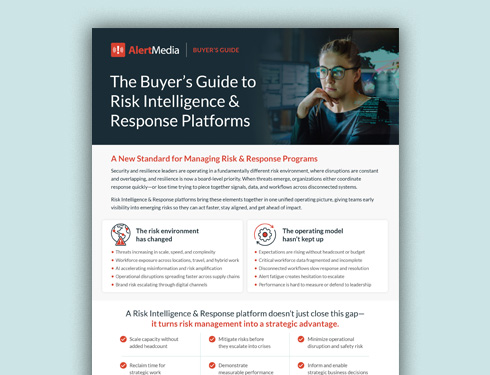
Table of Contents
- Why Enterprise Organizations Need a Unified Risk Intelligence and Response Platform
- Key Components of an Enterprise Risk Intelligence and Response Platform
- How a Risk Intelligence and Response Platform Works
- The Unified Platform vs. Fragmented Point Solutions
- How AlertMedia Approaches Risk Intelligence and Response for Enterprise
- AI Across the AlertMedia Platform
A risk intelligence and response platform for enterprise organizations is a unified software solution that connects three capabilities enterprise security and resilience teams need to work together: monitoring threats before they escalate, assessing impact on people and operations, and coordinating a structured response when an incident occurs. Unlike point solutions that require teams to stitch together separate notification tools, threat feeds, and incident trackers, a unified platform provides a continuous workflow—from detecting a signal to resolving the incident and documenting what happened. For organizations managing dispersed workforces, multiple locations, and cross-functional response teams, the platform replaces fragmented manual processes with a single source of truth.
Why Enterprise Organizations Need a Unified Risk Intelligence and Response Platform
The cost of fragmentation
Most enterprise security and business continuity teams have inherited a collection of disconnected tools—a notification system here, a threat feed there, a shared drive full of response plans. When an incident hits, the team is switching between platforms, chasing confirmation, and rebuilding context from scratch. The result is slower decisions and less coordinated outcomes.
Scale without adding headcount
Enterprise risk teams are being asked to do more with the same or fewer resources. A unified platform scales the team’s reach—monitoring more locations, tracking more threats, and coordinating more complex responses—without requiring additional staff to manage parallel systems. The right platform functions as a force multiplier, not just a software purchase.
Faster, more structured response
Speed matters most when the stakes are highest. Organizations that establish pre-built response plans and integrated communication workflows before an incident respond faster and more consistently than those improvising with disconnected tools. A unified platform makes that preparation executable—not just documented.
Cross-functional coordination at enterprise scale
Enterprise incidents rarely stay within a single department. A workplace incident involves security, HR, facilities, and legal simultaneously. A system outage touches IT, operations, and customer-facing teams at the same time. A platform built for enterprise scale ensures that each function has role-appropriate access, task ownership, and real-time visibility—without requiring specialized training or a separate login.
Audit-ready documentation and compliance
Enterprise organizations face regulatory requirements, insurance obligations, and internal audit standards that demand detailed incident records. A unified platform captures action logs, sent communications, and resolution timelines automatically—eliminating the manual reconstruction that follows every incident when teams operate in silos.
Key Components of an Enterprise Risk Intelligence and Response Platform
An enterprise-grade platform should include these capabilities working together as an integrated system—not as optional modules bolted onto a notification tool.
| Component | What It Means | Why It Matters |
| Threat monitoring and detection | Continuous ingestion of intelligence from open, social, and dark web sources, filtered to locations and topics that matter | Early warning enables proactive response—before an incident becomes a crisis |
| AI-powered analysis and automation | Machine learning models that filter noise, classify signals, and surface the threats most likely to require action | Reduces analyst burden and cuts the time from signal to informed decision |
| Human-verified intelligence | Analyst review of AI-surfaced signals before they reach the response team | Eliminates false positives; ensures the team acts on intelligence, not raw data |
| Geospatial impact assessment | Map-based visibility into what people, locations, and assets are inside the affected area | Enables targeted response—the right message to the right people, not a blanket alert to everyone |
| Employee and traveler safety monitoring | Location awareness for remote workers, lone workers, and traveling employees outside the office perimeter | Extends duty of care beyond fixed locations, where coverage gaps are most dangerous |
| Multichannel communication | SMS, email, voice, mobile app, desktop, and collaboration platform delivery in a single send | Ensures messages reach every employee regardless of where they are or what device they use |
| Incident response and coordination | Pre-built response plans with role-based task ownership, deployed from any device | Turns preparation into execution—structured coordination replaces improvised scramble |
| Post-incident reporting and documentation | Audit-ready exports of actions, communications, and resolution timelines | Supports after-action reviews, compliance reporting, and continuous improvement without manual reconstruction |
How a Risk Intelligence and Response Platform Works
1. Monitor
The platform continuously ingests intelligence from open-source, social, and fringe web sources—filtered by the locations, keywords, and topics your team defines. New signals surface in real time, reducing the manual monitoring burden on lean security teams.
2. Verify
AI models filter and classify incoming signals, reducing noise and flagging what matters most. For high-stakes intelligence, human analysts review AI-surfaced signals before they reach the response team—ensuring the information that triggers action is accurate, contextual, and worth acting on. AI scales the platform; AI paired with analyst verification is what makes the intelligence trustworthy enough to act on.
3. Assess impact
Geospatial tools map the affected area against your employee, location, and asset data. The platform identifies which people are inside the impact zone—including remote workers, travelers, and personnel at facilities not currently staffed. This step answers the question that matters most in the first minutes of an incident: who is affected and where.
4. Coordinate the response
Pre-built response plans deploy instantly with role-based task ownership across security, HR, IT, operations, and any other function in the response. A centralized incident page becomes the single source of truth—accessible from any device, with real-time task tracking and status updates visible to everyone involved.
5. Communicate
Targeted messages reach the right employees through the channels they use: SMS, email, voice, mobile app, desktop notifications, Teams, Slack, or WhatsApp—in their preferred language if needed. Two-way communication lets employees confirm safety, report conditions, and respond to requests, giving the response team real-time awareness of who is accounted for.
6. Resolve and report
Once the incident is contained, the platform generates an audit-ready post-incident report documenting every action, communication, and resolution milestone. This record supports after-action reviews, insurance documentation, and regulatory compliance—without requiring a team member to reconstruct the timeline manually.
The Unified Platform vs. Fragmented Point Solutions
Enterprise security and resilience teams that operate with disconnected tools face predictable limitations—not because the tools are poor, but because the workflow between them breaks down under pressure.
| Dimension | Fragmented point solutions | Unified risk intelligence and response platform |
| Threat detection | Separate tool, manual review, not connected to response workflow | Continuous monitoring feeds directly into response workflow |
| Impact assessment | Manual cross-reference of HR data, maps, and employee lists | Geospatial tools auto-identify affected employees from live data |
| Communication | Separate notification tool, manually populated with affected group | Target list built from impact assessment data; multichannel send in one workflow |
| Response coordination | Response plans in documents; tracked in email or chat threads | Pre-built plans deploy instantly with task ownership and real-time tracking |
| Documentation | Manual reconstruction of actions and messages after the fact | Audit-ready post-incident report generated automatically |
How AlertMedia Approaches Risk Intelligence and Response for Enterprise
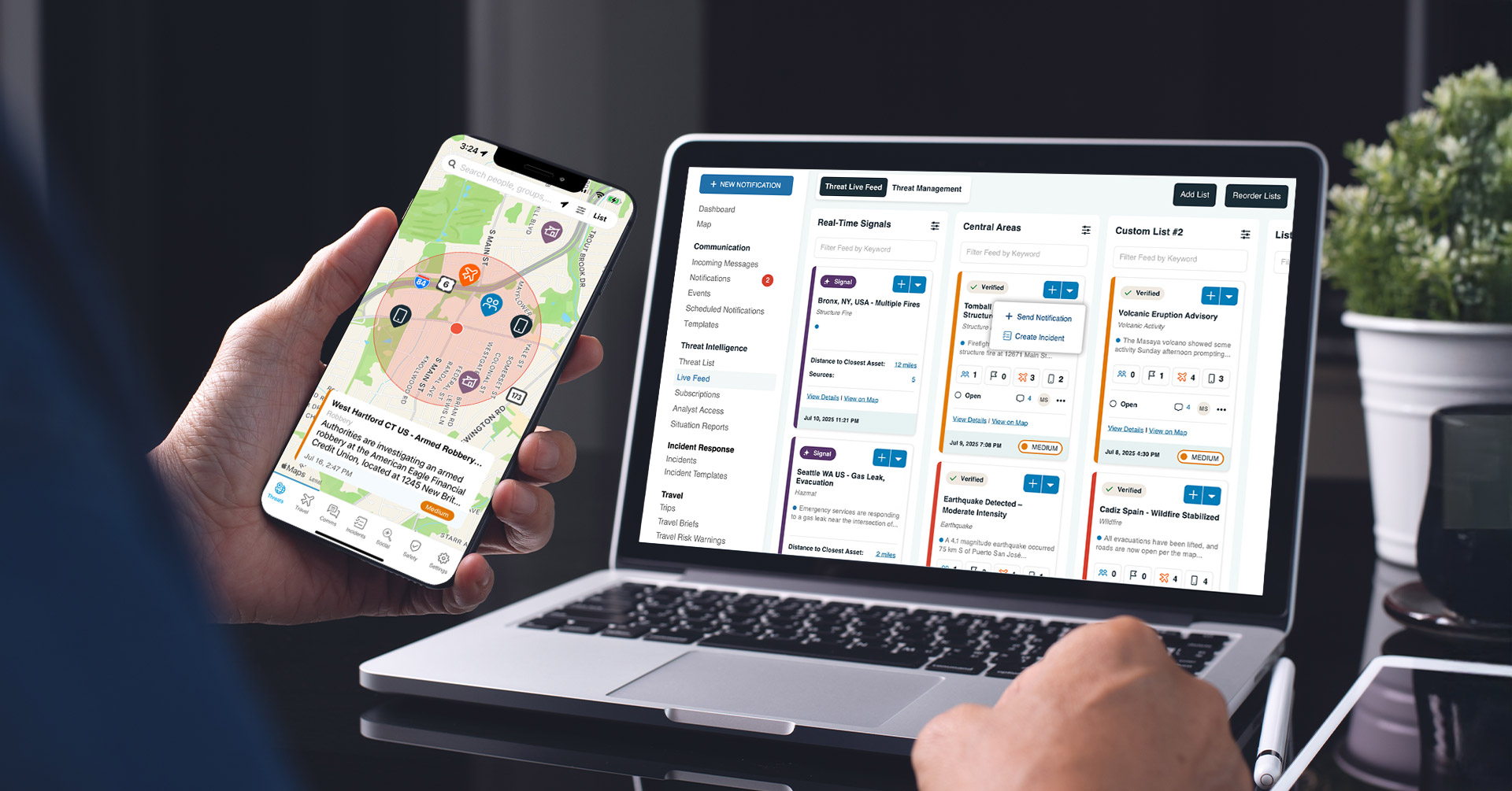
AlertMedia is the industry’s only unified risk intelligence and response platform—connecting monitoring, impact assessment, and coordinated response in a single workflow built for enterprise scale. The platform is designed so that the signal that triggers a response is the same system that executes it: no switching between tools, no context lost in translation.
| Platform Need | How AlertMedia Helps |
| Threat monitoring across locations and topics | Threat Intelligence delivers analyst-verified, real-time signals from 45,000+ trusted sources, filtered by the locations and keywords that matter to your organization. Social Intelligence adds AI-powered monitoring of 50+ social platforms, fringe forums, and dark web sources for narrative tracking and emerging risk signals. |
| Geospatial impact assessment | Visual Intelligence—AlertMedia’s platform-wide mapping capability—overlays threat data against employee locations, facility footprints, and travel itineraries. Security teams see who is affected without a manual cross-reference of multiple data sources. |
| Traveler and remote workforce visibility | Travel Risk Management syncs itinerary data to surface which employees are in an affected area, with dynamic country- and city-level risk briefings and local incident alerts. Employee Safety Monitoring extends coverage to lone workers and remote employees outside the office perimeter. |
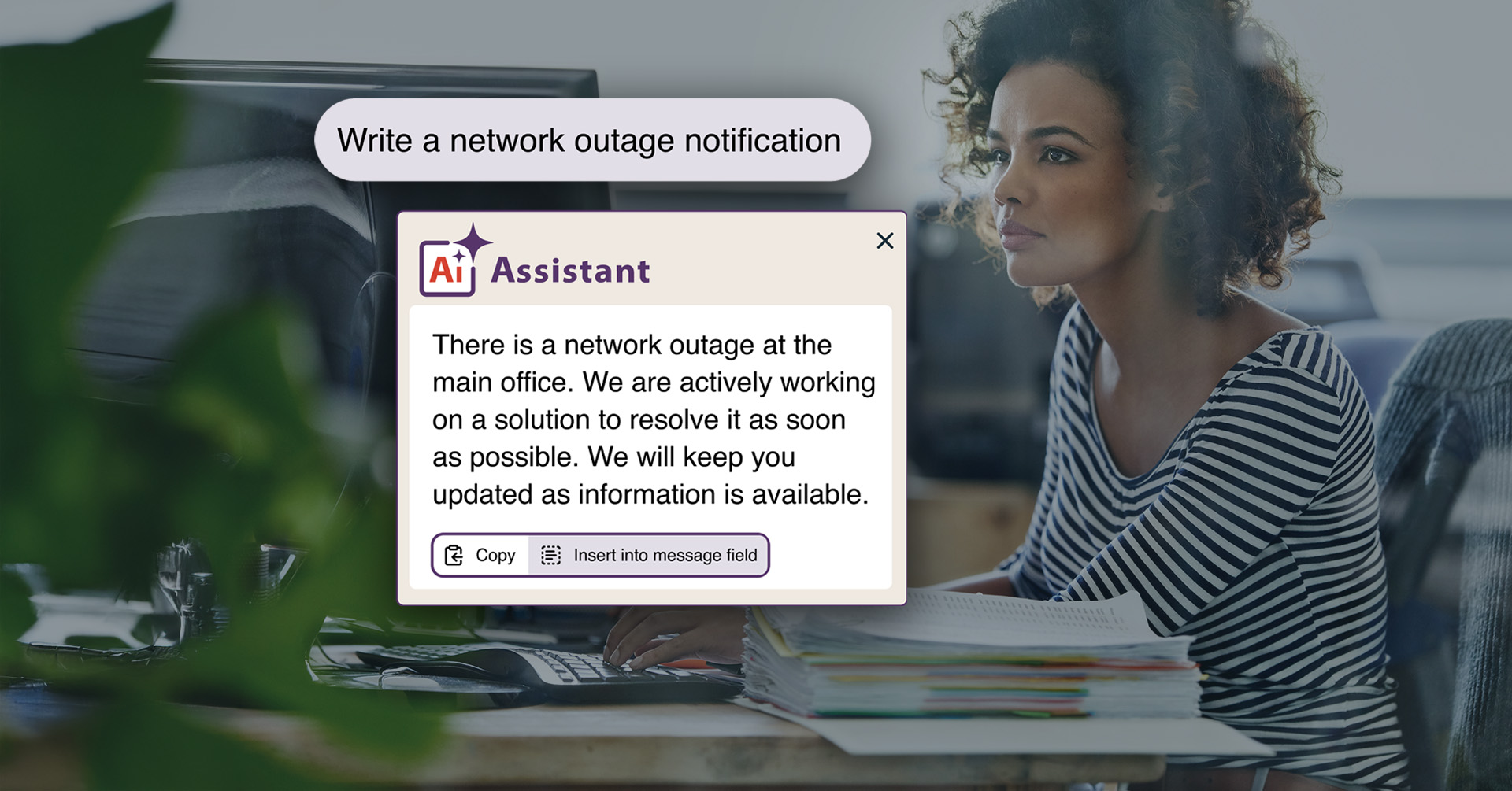
| Multichannel emergency communication | Emergency Communication reaches employees across SMS, email, voice, mobile app, desktop, Teams, Slack, and WhatsApp in a single send. AI Assistant drafts and refines notification messages in seconds; Automatic Message Translation delivers them in employees’ preferred languages. |
| Structured incident response and coordination | Incident Response deploys pre-built rapid deployment templates with custom task assignment accessible from any device. The FACTOR framework (Frame, Assess, Coordinate, Task & Track, Organize Communication, Reflect & Improve) gives teams a repeatable methodology, not an improvised playbook. |
| Post-incident reporting and compliance | Actionable post-incident reporting generates audit-ready exports of all actions, communications, and resolution timelines—ready for after-action reviews, insurance documentation, and regulatory compliance. |
Learn more about what risk intelligence and response platforms are and how they might benefit your organization by checking out our guide here.
“AlertMedia helps us get our crisis response team together quickly when there’s an incident so we can rapidly communicate important messages to thousands of people across email, text, phone, and more. That saves us a lot of time—it’s a labor-saving solution.” — Matt McMahan, Sr. Manager of Business Continuity, Texas Roadhouse
AI across the AlertMedia platform
AI is built into every layer of the platform—not as a single feature, but as the capability that lets a lean security team operate at enterprise scale. Social Intelligence uses 12 proprietary LLMs to analyze 10M+ daily records, powering sentiment analysis, narrative tracking, and AI-powered summaries. Real-Time Signals (a Threat Intelligence add-on) surfaces AI-Vetted Initial Reports—hyperlocal early-warning signals reviewed by analyst-trained AI before they reach the response team. AI Assistant in Emergency Communication drafts, refines, and translates notifications in seconds.
The defining choice in how AlertMedia uses AI: AI scales the platform; AI paired with analyst verification is what makes the intelligence trustworthy enough to act on.
Built for enterprise scale
AlertMedia serves 3,500+ customers, protects 15M+ employees across 150+ countries, and is certified SOC2 Type II, ISO 27001, GDPR, and CCPA compliant—purpose-built for the security and compliance requirements of enterprise organizations. Customers report responding 25+ minutes faster and training new administrators in approximately 20 minutes. Organizations already using Analyst Access describe a force-multiplier effect equivalent to adding approximately three additional security staff members—without the overhead.
For enterprise organizations switching from legacy platforms, AlertMedia’s ClearPath Migration Program provides a structured migration path—preserving configuration, training new administrators, and ensuring continuity through the transition.
Frequently Asked Questions
- What is a risk intelligence and response platform for enterprise? A risk intelligence and response platform for enterprise is a unified software system that connects threat monitoring, geospatial impact assessment, and structured incident response in a single workflow. Enterprise organizations use it to detect threats early, identify which employees and locations are affected, coordinate a multi-functional response, and communicate with impacted employees—all from one platform, without switching between separate tools.
- How is a risk intelligence and response platform different from a mass notification system? A mass notification system is designed for one task: sending messages to a large audience quickly. A risk intelligence and response platform does that—and more. It monitors threats before they require communication, identifies who is affected based on location data, deploys structured response plans with task ownership across departments, and documents the full incident for compliance and After-Action Review. Mass notification is one component of a risk intelligence and response platform, not a replacement for it.
- What capabilities should an enterprise risk intelligence and response platform include? Enterprise organizations should evaluate platforms on eight capabilities working together: continuous threat monitoring across open, social, and dark web sources; AI-powered analysis with human analyst verification; geospatial impact assessment tied to live employee and location data; traveler and remote workforce coverage; multichannel emergency communication; pre-built incident response plans with cross-functional task ownership; post-incident reporting for compliance; and SOC2, ISO 27001, and applicable data-privacy certifications for enterprise security requirements.
- Who uses a risk intelligence and response platform at the enterprise level? Primary users are corporate security and business continuity/operational resilience leaders—the two functions most directly responsible for protecting people, assets, and operations during an incident. Cross-functional participation comes from HR, IT, operations, facilities, and EHS—each with role-appropriate access and task ownership within the same platform. At the enterprise level, the platform is also used by GSOC teams, regional security managers, and executive protection leads.
- What role does AI play in a risk intelligence and response platform? AI plays a critical but bounded role. In practice, AI filters and classifies the volume of incoming threat signals that would otherwise overwhelm a small security team, powers narrative tracking across social and open-source sources, and drafts emergency notifications in seconds. What AI alone doesn't provide is verified accuracy—which is why the most effective platforms pair AI analysis with human analyst review before intelligence reaches the response team. AI scales the platform; analyst verification makes the intelligence trustworthy enough to act on.
- How does AlertMedia's risk intelligence and response platform work for enterprise teams? AlertMedia connects Threat Intelligence, Social Intelligence, Travel Risk Management, Employee Safety Monitoring, Emergency Communication, and Incident Response in a single platform. A threat detected in Threat Intelligence can trigger an Incident Response plan, which pushes targeted notifications through Emergency Communication to the affected employee population—identified by Visual Intelligence's geospatial mapping. Every action is tracked in real time on a centralized incident page and documented in a post-incident report. Enterprise teams manage this entire workflow from one interface, from any device.
- How does AlertMedia handle compliance and data security at enterprise scale? AlertMedia is certified SOC2 Type II and ISO 27001, and is compliant with GDPR and CCPA. Data is encrypted in transit and at rest. The platform supports single sign-on with automatic user provisioning and granular role-based access controls. Post-incident reports are generated automatically with full action logs, sent messages, and resolution timelines—providing the audit trail enterprise security and compliance teams require without manual reconstruction.
- What is the ClearPath Migration Program? The ClearPath Migration Program is AlertMedia's structured transition program for enterprise organizations switching from a legacy platform. It covers configuration migration, administrator training, and continuity through the transition—so organizations don't lose established workflows or require extended ramp time when moving to AlertMedia. ClearPath is designed specifically for enterprise implementations with complex configurations, large user populations, or multi-site deployments.
Buyer’s Guide to Risk Intelligence & Response Platforms
Evaluate vendors, compare capabilities, and choose a solution that helps you detect threats earlier and respond faster.

AlertMedia, Risk Intelligence and Response