By AlertMedia, Risk Intelligence and Response

Emergency Management Jun 25, 2026
Threat Intelligence for Healthcare Systems
Threat Intelligence Key Feature Guide
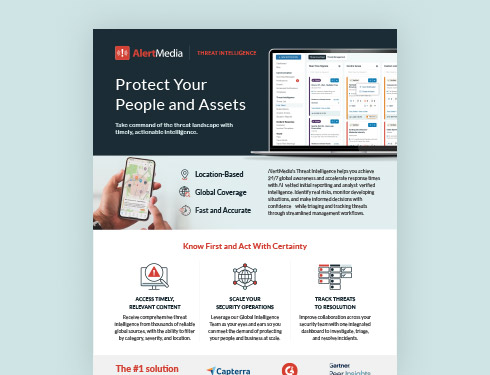
Gain instant clarity into emerging threats with analyst-verified intelligence and AI-driven early signals.
Healthcare organizations face a threat environment unlike any other industry. Multi-campus systems, around-the-clock operations, vulnerable populations, and public-facing facilities create a security challenge that requires continuous intelligence—not periodic reports or reactive monitoring. Threat intelligence for healthcare systems is the capability that gives security and resilience teams at hospitals, health systems, and multi-site outpatient organizations the situational awareness they need to protect staff, patients, and operations before threats escalate. AlertMedia’s Threat Intelligence delivers analyst-verified signals specific to your facilities, with the analyst access and response integration healthcare security teams need to act quickly.
The Threat Landscape Healthcare Security Teams Face
Acts of violence and campus safety
Healthcare facilities—particularly emergency departments, psychiatric units, and outpatient clinics—face elevated risk of acts of violence. Security teams need intelligence on developing situations in and around facilities, including incidents at nearby locations that may affect campus safety. Early warning gives security personnel and clinical staff time to implement protocols before a situation escalates.
Severe weather and operational continuity
Hospitals and health systems cannot suspend operations during severe weather events. Security and facilities teams need localized weather intelligence well ahead of impact windows to pre-position resources, activate continuity protocols, coordinate patient care logistics, and prepare communications for staff and patients. Dynamic Weather Forecasting from AlertMedia’s dedicated meteorologist team provides exactly this: localized, facility-specific weather risk at the operational timescale that healthcare preparedness requires.
Civil unrest and community events
Large health systems in urban centers often operate near locations where demonstrations, protests, or community events may develop unexpectedly. Intelligence on these situations—with early warning on trajectory and potential facility impact—allows security teams to adjust access controls, staff deployments, and communications proactively rather than reactively.
Multi-campus coordination across a sprawling footprint
Large health systems may operate dozens of hospital campuses, outpatient centers, urgent care locations, and specialty facilities across a wide geographic area. Monitoring threat conditions across that footprint manually is impractical for any security team. Analyst-verified threat intelligence mapped to facility locations gives health system security directors a complete operational picture without requiring proportional headcount growth.
How AlertMedia’s Threat Intelligence Serves Healthcare Security Teams
Analyst-verified intelligence, not just raw signals
AlertMedia’s Global Intelligence Team reviews every signal before it reaches the threat feed. For healthcare security teams that already manage high operational demands, analyst verification reduces alert fatigue—the team sees verified, relevant threats, not a volume of unfiltered signals requiring additional triage. What reaches the security director has already been confirmed as relevant to their locations and risk profile.
Facility-level coverage across the health system
Real-Time Impact Assessment visualizes the threat-to-location relationship on a map view, showing which campuses, outpatient facilities, or administrative buildings are within a developing situation’s affected area. For multi-site health systems, this is the difference between knowing a situation is happening somewhere and knowing exactly which facilities and workforce populations are at risk.
24/7 Analyst Access for a 24/7 operation
Healthcare doesn’t stop at 5 p.m. Neither does AlertMedia’s Global Intelligence Team. Security directors and on-call security managers have direct access to analysts around the clock—when an incident develops at 3 a.m., when a severe weather system accelerates, or when intelligence is needed before activating a system-wide communication. Analyst Access is a premium add-on built directly into the Threat Intelligence platform.
Integrated Response: From Threat to Staff Notification
Verified threats connect directly to AlertMedia’s Emergency Communication platform, enabling security teams to notify affected staff, clinical leaders, or the full health system workforce without switching platforms. Incident Response workflows allow coordination across security, facilities, clinical operations, and communications teams within a single integrated system.
The AlertMedia Approach to Healthcare Threat Intelligence
AlertMedia’s unified risk intelligence and response platform is designed for the multi-site, always-on nature of healthcare security. Threat Intelligence is not a standalone feed—it’s the intelligence layer of a platform that connects monitoring to assessment to response to communication in a single workflow, purpose-built for organizations that can’t afford response delays.
Healthcare security need | How AlertMedia helps |
| Acts of violence early warning | Analyst-verified signals on developing situations at and near healthcare facilities, with early warning ahead of full escalation |
| Multi-campus footprint monitoring | Real-Time Impact Assessment maps threat proximity across every campus, outpatient center, and administrative facility in the health system |
| Severe weather operational continuity | Dynamic Weather Forecasting provides localized, facility-specific weather risk from AlertMedia’s dedicated meteorologist team |
| 24/7 analyst support | Premium add-on Analyst Access connects healthcare security teams to AlertMedia’s Global Intelligence Team at any hour—reflecting the continuous nature of healthcare operations |
| Integrated staff notification | Verified threats connect directly to Emergency Communication—multi-channel notifications to staff across all facilities without platform switching |
AI across the platform
AI is integrated into AlertMedia’s Threat Intelligence through Real-Time Signals, the AI-vetted add-on that surfaces hyperlocal early-warning signals before the full analyst-verification cycle completes. For healthcare security teams monitoring a large, multi-campus footprint, this early-warning layer provides faster detection on developing situations—giving teams more lead time before activation decisions are required. AI scales the coverage; AlertMedia’s analysts verify the signals healthcare security directors act on.
AlertMedia serves 3,500+ organizations across 150+ countries. The platform holds SOC2 Type II, ISO 27001, GDPR, and CCPA certifications. AlertMedia earned the Gartner Peer Insights™ Customers’ Choice distinction.
Frequently Asked Questions
- What types of threats do healthcare systems need to monitor? Healthcare security teams monitor for acts of violence at and near facilities, severe weather events affecting operations and continuity, civil unrest that may impact campus access or staff safety, and geopolitical situations affecting international patients or staff. Large health systems with multiple campuses also monitor for localized incidents at specific facilities—a situation at one campus may require communication to the broader system and adjustments to patient routing or staff deployment.
- What types of threats do healthcare systems need to monitor? Threat intelligence supports healthcare campus safety by providing early warning on developing situations—acts of violence, civil unrest, environmental hazards—before they reach a level that requires reactive response. Analyst-verified intelligence gives security teams a confirmed picture of what is happening and where, while Real-Time Impact Assessment shows which specific campuses are within the affected area. Together, they give security directors the situational clarity to implement protective protocols proactively rather than reactively.
- Can AlertMedia's Threat Intelligence cover multi-site health systems? Yes. AlertMedia's Threat Intelligence is built for multi-location organizations. Health systems can map every campus, outpatient facility, urgent care center, and administrative location into the platform—and receive threat monitoring, impact assessment, and analyst-verified intelligence specific to each location. Real-Time Impact Assessment makes it possible to see, at a glance, which facilities in a large system are within the affected area of a developing situation.
- How does threat intelligence support care delivery continuity during disruptions? Threat intelligence supports care delivery continuity by giving operations and BC teams early warning on the disruptions most likely to affect clinical operations—severe weather, infrastructure events, and major incidents in the surrounding community. AlertMedia's Dynamic Weather Forecasting provides localized weather risk at the facility level, and analyst-verified intelligence on community events gives operations teams the lead time to activate contingency protocols, adjust patient routing, and prepare staff communications before disruption impacts are felt.
- What is the difference between threat intelligence and a physical security system for healthcare? Physical security systems—access control, video surveillance, intrusion detection—monitor conditions at and within a facility in real time. Threat intelligence monitors conditions outside the facility: developing situations in the surrounding community, geopolitical events with operational implications, severe weather systems approaching the area. Together, they provide complementary coverage: physical security systems protect the facility; threat intelligence gives security teams awareness of what's coming before it arrives.
Download Our Threat Intelligence Key Feature Guide
Gain instant clarity into emerging threats with analyst-verified intelligence and AI-driven early signals.
AlertMedia, Risk Intelligence and Response