A guide for Corporate Security, Business Continuity, and Operational Resilience leaders

Emergency Management May 22, 2026
What Is a Risk Intelligence and Response Platform?
Buyer’s Guide to Risk Intelligence & Response Platforms
Evaluate vendors, compare capabilities, and choose a solution that helps you detect threats earlier and respond faster.
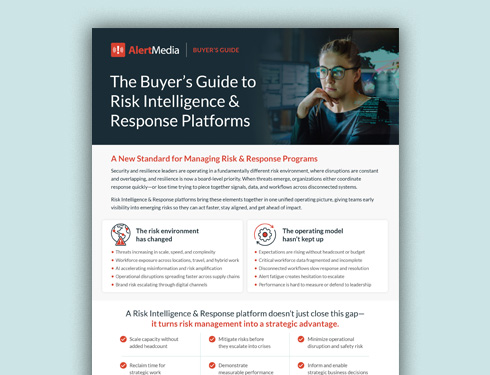
Table of Contents
A risk intelligence and response platform is a unified system that helps organizations monitor risks, assess their impact on people and operations, and respond—all in one place. It combines threat detection, employee location awareness, multichannel communication, and structured incident response so security and business continuity teams can act on what matters before it disrupts the business.
For Corporate Security, Business Continuity, and Operational Resilience leaders, a risk intelligence and response platform replaces a stack of disconnected tools with a single source of truth—turning raw signals into coordinated action. This page explains what such a platform includes, why it matters, how it works in practice, and what to look for when evaluating one.
Why a Risk Intelligence and Response Platform Matters
Organizations face an expanding range of risks—severe weather, workplace incidents, travel disruption, cyber events, supply chain breaks, and social and reputational threats. The teams responsible for managing those risks rarely grow at the same pace. A unified platform consolidates what used to require multiple tools and teams into a single, coordinated workflow.
Faster, more coordinated response
A unified risk intelligence and response platform removes the context-switching that slows traditional response. The right people see the right information at the right time, and action workflows are attached to that information. Teams move from detection to decision to action without losing time at the seams between tools.
Reduced operational disruption
Early warning, impact assessment, and pre-built response plans limit downtime when something happens. Organizations that can see a developing risk and execute against a known plan recover faster than organizations that improvise.
A force multiplier for lean teams
Security and business continuity teams rarely grow at the rate of the risks they manage. A unified platform extends what a small team can monitor and execute against—scaling coverage without adding headcount.
Stronger duty of care
Locating, alerting, and supporting employees during incidents is a legal and ethical obligation, especially for distributed workforces, travelers, and lone workers. A platform that does this consistently turns duty of care from a written policy into a practiced capability.
Audit-ready resilience
Documented response, action logs, and post-incident reports demonstrate to regulators, leadership, and customers that the organization can withstand and recover from disruption. A platform produces that evidence as a byproduct of the work, not as a separate compliance exercise.
Key Components of a Risk Intelligence and Response Platform
A complete platform includes eight core components. Evaluate any platform against this list before committing.
Component | What It Means | Why It Matters |
| Threat monitoring and detection | Continuous monitoring of public news, social media, fringe forums, the dark web, and internal data sources to identify emerging risks. | Without detection, response is reactive. Early signal is what makes proactive action possible. |
| AI-powered analysis and automation | Machine learning, large language models, and agentic AI work continuously to classify signals, surface sentiment and narratives, summarize themes, and assist with message drafting and translation. | No human team can monitor the volume of public, social, and dark-web data that matters today. AI is what makes the category operate at scale. |
| Human-verified intelligence | Expert analysts review and validate AI-surfaced signals before they reach security and operations teams. | AI without human judgment produces noise. AI, when paired with analyst verification, produces decisions. |
| Travel and traveler safety | Itinerary syncing, location awareness, and pre-trip risk assessments for employees traveling for business. | Distributed workforces and frequent travel make duty of care impossible without it. |
| Employee safety monitoring | Lone-worker and field-worker tools—discreet panic signaling, location, timed monitoring sessions. | Risk does not stay at headquarters. Safety tools have to reach where the work is being done. |
| Multichannel communication | Two-way notifications across SMS, email, voice, mobile app, desktop alerts, and chat platforms. | A single channel is a single point of failure. Reaching people requires meeting them where they are. |
| Incident response and coordination | Pre-built response plans, task assignment, cross-functional collaboration, and real-time tracking. | Documented plans only work if they are executable in the moment and have clear ownership. |
| Reporting and documentation | Audit-ready records of decisions, communications, and resolution timelines. | Lessons learned and compliance evidence both depend on a clean post-incident record. |
How a Risk Intelligence and Response Platform Works
A risk intelligence and response platform operates as a continuous loop rather than a one-time event. The same platform supports calm days and critical days—the difference is which capabilities are active in the moment.
1. Monitor
The platform continuously ingests data from public news, social platforms, fringe forums, dark web sources, weather feeds, internal alerts, and connected systems. Sensors are tuned to the locations, assets, and people that matter to the organization.
2. Verify
AI filters, deduplicates, classifies, and summarizes raw signals at a volume no human team could match. In the strongest platforms, human analysts then verify the AI-surfaced signals before they reach the response team. The combination—AI for scale, analysts for judgment—is what produces intelligence the team can act on without second-guessing.
3. Assess impact
When something happens, the platform answers two questions immediately: who is affected, and where. Map-based visualization, geofencing, and employee location data overlay the threat onto the people most at risk.
4. Coordinate the response
Pre-built response plans deploy with assigned ownership across security, business continuity, HR, IT, and other functions. A centralized incident view keeps everyone aligned on what is happening and what needs to happen next.
5. Communicate
Multichannel notifications reach affected employees with two-way confirmation. Templates and AI-assisted drafting speed up message composition; multilingual translation keeps a global workforce informed within a single workflow.
6. Resolve and report
Action logs, message logs, and resolution timelines feed audit-ready reports that support After-Action Reviews, compliance reporting, and continuous improvement. Every incident makes the next response better.
Best Practices for Risk Intelligence and Response
- Define a single source of truth for risk before an incident happens, not during one.
- Sync employee, traveler, and location data continuously so the platform knows where people are when it matters.
- Build pre-deployed response plans for common scenarios so the first thirty minutes of an incident are not spent improvising.
- Use multiple communication channels in parallel—relying on a single channel is a known failure mode during disruptions.
- Segment audiences by location, role, and risk profile so notifications reach the right people without overwhelming everyone else.
- Test response plans regularly through tabletop exercises and live drills, and update them after every test.
- Document and review every incident, even small ones—pattern recognition is how programs improve over time.
- Treat duty of care as a continuous program, not an annual compliance task.
Common Challenges and How to Address Them
Challenge | Why It Happens | How to Address It |
| Tool sprawl creates blind spots | Organizations layer point solutions over time—separate tools for threats, communications, traveler safety, incident management—and the seams between them leak signal. | Consolidate onto a platform where detection, decision, and action share the same data model. |
| Alert fatigue overwhelms security teams | Volume-based threat feeds without verification flood teams with noise; real signals get missed in the firehose. | Choose a platform with analyst-verified intelligence and customizable filtering by role, geography, and severity. |
| Response plans live in documents, not workflows | Plans sit in PDFs, SharePoint folders, or binders that are unreachable mid-incident. | Move plans into the platform as executable workflows with task ownership, tracking, and integrated communication. |
| Distributed and traveling employees fall outside coverage | Tools built for office headcounts struggle with field workers, remote employees, and frequent travelers. | Choose a platform with native employee safety monitoring and travel risk management built in—not bolted on. |
How AlertMedia Approaches Risk Intelligence and Response
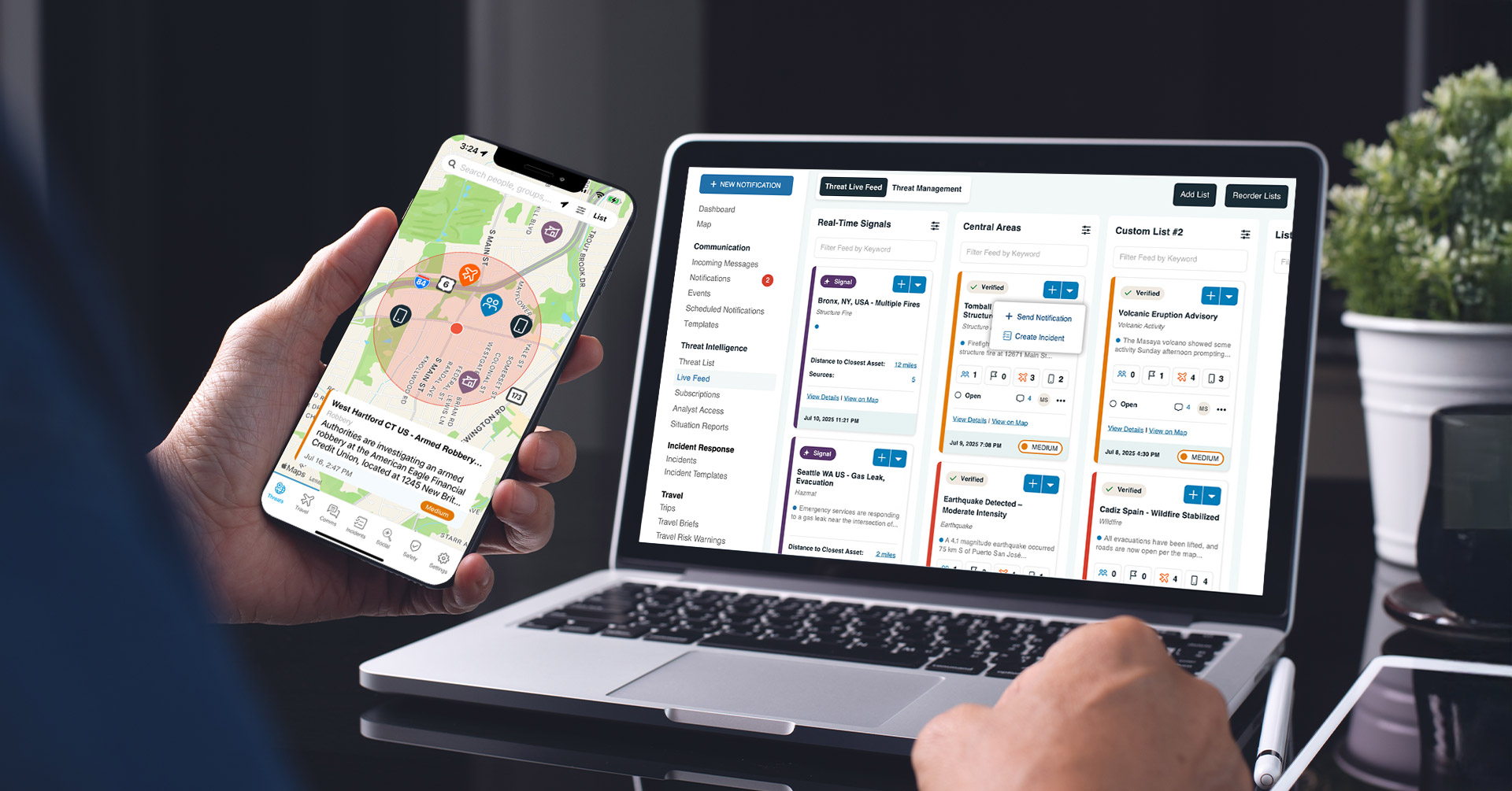
AlertMedia is the industry’s only unified risk intelligence and response platform—built so that detection, decision, and action share the same workflow, data, and map. The platform combines six integrated products with platform-wide intelligence capabilities and 24/7 access to AlertMedia’s Global Intelligence Team, so organizations can monitor risk, assess impact, and respond from one place.
Six integrated products handle the operational layer:
Platform Need | How AlertMedia Helps |
| Detect risks across mainstream, social, and dark-web sources | Social Intelligence monitors mentions of your brand, people, and assets across mainstream social media, digital forums, and the dark web—using agentic AI to track shifts in discourse and surface developing risks early. |
| Receive analyst-verified threat intelligence with built-in response workflows | Threat Intelligence delivers analyst-verified, real-time threat signals from tens of thousands of public sources, with triage workflows and 24/7 access to AlertMedia’s Global Intelligence Team. |
| Keep traveling employees safe and informed | Travel Risk Management gives security and HR teams 24/7 visibility into employee travel—with itinerary syncing, traveler tracking, expert-curated Travel Briefs, and localized threat alerts. |
| Protect lone, remote, and field workers | Employee Safety Monitoring turns every employee’s mobile phone into a discreet, powerful distress signal—backed by AlertMedia’s 24/7/365 monitoring team operating from Austin, Texas. |
| Communicate two-way across every channel | Emergency Communication sends the right message to the right people, on the right channels—across SMS, email, voice, mobile app, desktop, Teams, Slack, and WhatsApp—with read confirmations, surveys, and AI-assisted drafting. |
| Coordinate structured response across functions | Incident Response coordinates teams, mobilizes pre-built plans, and tracks response in real time—turning critical-incident chaos into structured execution from any device. |
AI across the platform
AI is built into every layer of the platform—not as a single feature, but as the connective tissue that lets a small team operate at scale.
- Agentic AI search in Social Intelligence builds complex multimedia and multilingual queries without Boolean expertise, monitoring 50+ social platforms, fringe forums, and dark-web sources.
- 12 proprietary LLMs analyze 10M+ daily records—including text, images, video, and podcasts—to surface sentiment, narratives, and people of interest before they become incidents.
- AI-Vetted Initial Reports via Real-Time Signals (an add-on to Threat Intelligence) surface hyperlocal early-warning signals from thousands of trusted sources through an analyst-trained AI feed.
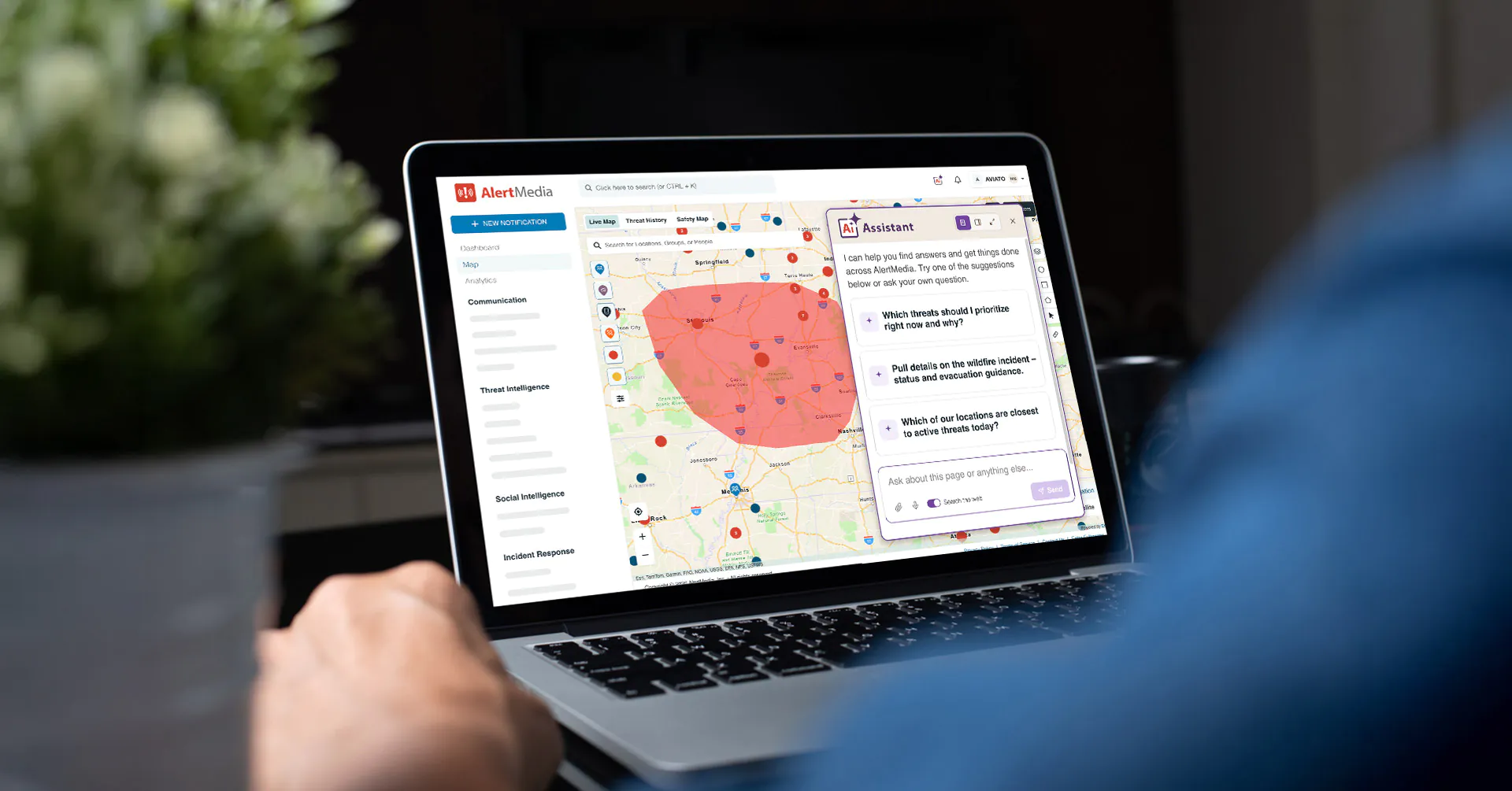
- AI Assistant drafts, refines, and translates emergency notifications in seconds—turning a blank screen into a sendable message in the moments that matter.
- AI-powered summaries across the platform replace hours of manual review with auto-generated theme analysis and recommendations.
The defining choice in how AlertMedia uses AI: AI scales the platform; AI paired with analyst verification is what makes the intelligence trustworthy enough to act on. AlertMedia’s Global Intelligence Team—staffed 24/7—verifies AI-surfaced threats before they reach customers. The result is the speed of AI with the judgment of human analysts in the loop, not AI alone.
Beyond the AI layer, two platform features amplify the entire system. Visual Intelligence provides map-based, geospatial visualization of threats, people, and assets across every product. Analyst Access—direct, 24/7 access to AlertMedia’s Global Intelligence Team—sits underneath every customer deployment.
Customers report responding 25+ minutes faster and training new admins in roughly 20 minutes, with the platform delivering value equivalent to adding the capacity of approximately three additional security staff. AlertMedia serves 3,500+ organizations across 150+ countries, and is named a Gartner Peer Insights™ Customers’ Choice in 2024–2025.
Frequently Asked Questions
- What is a risk intelligence and response platform? A risk intelligence and response platform is a unified system that combines threat detection, employee location awareness, multichannel communication, and structured incident response in one workflow. It helps Corporate Security, Business Continuity, and Operational Resilience teams monitor emerging risks, assess their impact on people and operations, and coordinate a response—without switching between disconnected tools.
- How is a risk intelligence and response platform different from standalone threat intelligence, mass notification, or incident management tools? Standalone tools each solve one slice of the problem. A risk intelligence and response platform connects those slices into a single data model and workflow, so a verified threat flows directly into impact assessment, response coordination, and multichannel communication without manual handoffs. The seams between point tools are where signal and time are lost; a platform removes those seams.
- What capabilities should a risk intelligence and response platform include? At minimum, a complete platform covers threat monitoring and detection, human-verified intelligence, travel and traveler safety, employee safety monitoring, multichannel communication, incident response and coordination, and audit-ready reporting. Map-based visualization that overlays threats onto people and assets is increasingly considered table stakes for the category.
- Who uses a risk intelligence and response platform? Primary users include Corporate Security leaders, Business Continuity and Operational Resilience teams, and Crisis Management functions. Secondary users include Environment, Health and Safety teams; Facilities; HR; and IT/Security partners. The common thread is responsibility for keeping people safe and the business operating when something disrupts either.
- How does a platform approach reduce the burden on lean security and BC teams? A unified platform scales coverage without scaling headcount. Verified intelligence reduces the volume of alerts a team has to triage. Pre-built response plans reduce the time spent improvising during an incident. Map-based impact assessment reduces the time spent correlating where the threat is and who is affected. Together, these elements function as a force multiplier—extending what a small team can monitor and execute against.
- What role does AI play in a risk intelligence and response platform? AI is the layer that lets a small team operate at scale. Machine learning and large language models classify, summarize, and surface signals across millions of records—public news, social platforms, fringe forums, dark-web sources, weather feeds, internal alerts—at a volume no human team could process directly. AI also assists with downstream work: drafting and translating emergency notifications, generating message summaries, and refining audience targeting.
The decisive question is not how much AI a platform uses, but whether the AI is paired with analyst verification. AI without verification produces a faster firehose; AI paired with human analysts produces intelligence the team can act on. In practice, that means looking for platforms where AI-surfaced signals are reviewed by human analysts before they reach the response team, and where AI capabilities span the workflow (monitoring, drafting, summarization, translation) rather than living in a single feature. - How does human-verified intelligence change what a platform can do? Verified intelligence is the difference between a feed and a decision. AI and OSINT aggregation produce a high volume of signal, much of it irrelevant to a specific organization. Human analysts filter for relevance, accuracy, and severity before the signal reaches the response team—so the team's attention is spent on real threats, not noise. Verified intelligence also makes downstream automation (geofencing, audience targeting, response plan triggers) safer to rely on.
- How does AlertMedia’s risk intelligence and response platform work? AlertMedia combines six integrated products—Social Intelligence, Threat Intelligence, Travel Risk Management, Employee Safety Monitoring, Emergency Communication, and Incident Response—on a single platform, with platform-wide Visual Intelligence and AI Assistant capabilities and 24/7 access to AlertMedia’s Global Intelligence Team. Threats detected anywhere on the platform flow into impact assessment, response coordination, and multichannel notification without leaving the workflow.
- What is the difference between risk intelligence and response and emergency mass notification? Emergency mass notification is one capability inside a risk intelligence and response platform—the multichannel communication layer. A risk intelligence and response platform extends well beyond notification to include detection, verification, impact assessment, traveler and lone-worker safety, structured response coordination, and reporting. Notification is the message layer; the platform is the system that decides what message to send, to whom, and what to do next.
Buyer’s Guide to Risk Intelligence & Response Platforms
Evaluate vendors, compare capabilities, and choose a solution that helps you detect threats earlier and respond faster.
AlertMedia, Risk Intelligence and Response