
Navigating the many threats of today’s global risk landscape requires a thorough understanding of the threats you may face, so you can better plan for how to stay resilient through disruptions.

Emergency Management Jan 30, 2026
Understanding the Global Risk Landscape: Insights for 2026 and Beyond
2026 Threat Outlook Report
Explore the top threats that impacted organizations in 2025 and how these events will shape the workplace in 2026.

The global risk landscape entering 2026 is louder, faster, and more difficult to decipher than ever before. Advances in artificial intelligence, rising geopolitical volatility, widespread social unrest, intensifying climate events, and rapidly evolving technology are no longer isolated challenges. Instead, they are increasingly interconnected—amplifying one another and compressing the time organizations have to respond.
What once felt speculative can now ignite a real-world crisis in hours. A false rumor can mobilize crowds, a cyber incident can disrupt physical operations, and a regional disaster can ripple through global supply chains. In this environment, organizations can no longer afford to wait for perfect information before acting. Success now depends on the ability to separate credible signals from overwhelming noise and to respond decisively amid uncertainty. Tools like social media threat monitoring for security have become a critical capability for identifying early warning signals
Below, we examine the most significant forces shaping the global risk landscape in 2026—and what organizations must do to stay ahead.
2026 Threat Outlook Report
Explore the top threats that impacted organizations in 2025 and how these events will shape the workplace in 2026.
What Is the Risk Landscape?
The risk landscape refers to the ever-evolving set of internal and external threats and uncertainties that can impact an organization’s ability to achieve its objectives. A view of the threat landscape can be localized to one business location or broadly applied to threats worldwide—known as the global risk landscape.
These threats may stem from operational risks, strategic risks, technological risks, regulatory risks, environmental risks, geopolitical risks, and reputational risks, among others. The global risk landscape is shaped by market changes, emerging technologies, societal shifts, climate change, and more.
Many organizations address these overlapping exposures through enterprise risk management, which provides a structured framework for identifying, prioritizing, and mitigating risks across the business.
Critical Risks in 2026
The risk landscape of 2026 is likely to see many of the same threats to business operations and employee safety as in previous years. For example, severe weather, cyber attacks, supply chain disruptions, and other familiar risks will likely feature heavily.
However, incidents throughout 2024 and 2025, such as wars in the Middle East and Europe, economic uncertainty, and accelerating climate change, have created unique threat situations that necessitate preparation from businesses in any industry. These conditions increase the likelihood of cascading risks, where a single incident triggers widespread operational, financial, and safety impacts.
Here are a few ways these main threat factors are creating critical risks for global companies in the coming year and beyond.
“If you are paying attention to the trends, you can plan for the trends. Businesses need to prioritize based on what is most pressing or upcoming, and this means continuously evaluating current events to adjust your top priorities.”
—Sara Pratley, SVP of Global Intelligence at AlertMedia
—Sara Pratley, SVP of Global Intelligence at AlertMedia
Global Political Volatility
Political instability has become a baseline condition for global operations. Business leaders reported that policy uncertainty disrupted planning in 2025, driven by elections, regulatory swings, trade restrictions, and prolonged conflicts.
In 2026, organizations must prepare for:
- High-stakes elections and leadership turnover across multiple regions
- Retreat from multilateral cooperation and weakening global institutions
- Tighter border controls and visa restrictions slowing cross-border movement
- Persistent conflicts that strain energy markets, trade routes, and logistics
For global organizations, geopolitical monitoring can no longer be episodic. It must be embedded into business continuity and resilience planning, with playbooks that assume friction—not stability—as the norm.
Demonstrations & Social Unrest
Protest activity has evolved into a persistent, structural risk. In 2025, mass demonstrations erupted worldwide across issues ranging from immigration and housing costs to foreign policy and labor conditions. In many cases, protests spread rapidly across borders, amplified by online misinformation, disinformation, and coordinated narratives. Understanding how social media misinformation accelerates these dynamics—and reaching employees with verified information before false narratives take hold—has become a core component of business continuity planning.
In 2026, unrest is expected to remain:
- More frequent and less predictable
- Increasingly multi-location and cross-border
- More disruptive to travel, facilities, and supply chains
Embedding geopolitical monitoring into business continuity planning helps organizations anticipate disruptions and adapt faster as conditions change.
In an environment defined by noise and uncertainty, resilience depends on the ability to identify credible signals and act decisively before disruption fully unfolds.
Climate and extreme weather
Climate-driven disasters are escalating in both frequency and severity. In 2025, floods, heatwaves, and wildfires claimed hundreds of lives across multiple continents, while atmospheric CO₂ levels reached new record highs. 2026 is expected to contend for the warmest year ever recorded.
Yet the greatest danger often lies not in the hazard itself, but in communication breakdowns. Delayed alerts, failed siren systems, and inconsistent messaging during recent disasters exposed critical gaps between warning and action. In some cases, misinformation and conspiracy theories spread faster than official guidance, undermining public trust and compliance.
AI tools have further complicated the landscape, occasionally generating incorrect or premature information during fast-moving events. As trust in official sources erodes, organizations face a dual challenge: protecting people from environmental hazards while countering false narratives that can turn manageable risks into compounding crises.
In 2026, staying ahead of informational risk will be just as important as tracking environmental threats.
Get Expert Advice on the Threats to Expect in 2026
Emerging Technology Disruptions
Rapid technological advancement continues to reshape the risk landscape. At the same time, the infrastructure supporting innovation is under strain. AI-optimized data centers are driving unprecedented demand for electricity and water, even as grids and utilities face pressure from climate extremes. Drone-related incidents have disrupted airports, stadiums, prisons, and emergency response efforts, while regulatory uncertainty threatens to complicate adoption further.
Looking ahead, emerging risks such as quantum computing could eventually undermine today’s encryption standards—yet few organizations have strategies in place to prepare.
Technology remains a powerful enabler of resilience, but without parallel investment in preparedness, it can also magnify disruption.
Pro Tip: An enterprise security risk management (ESRM) approach can help identify, assess, and reduce security risks, allowing you to manage threats efficiently while staying on track with your goals.
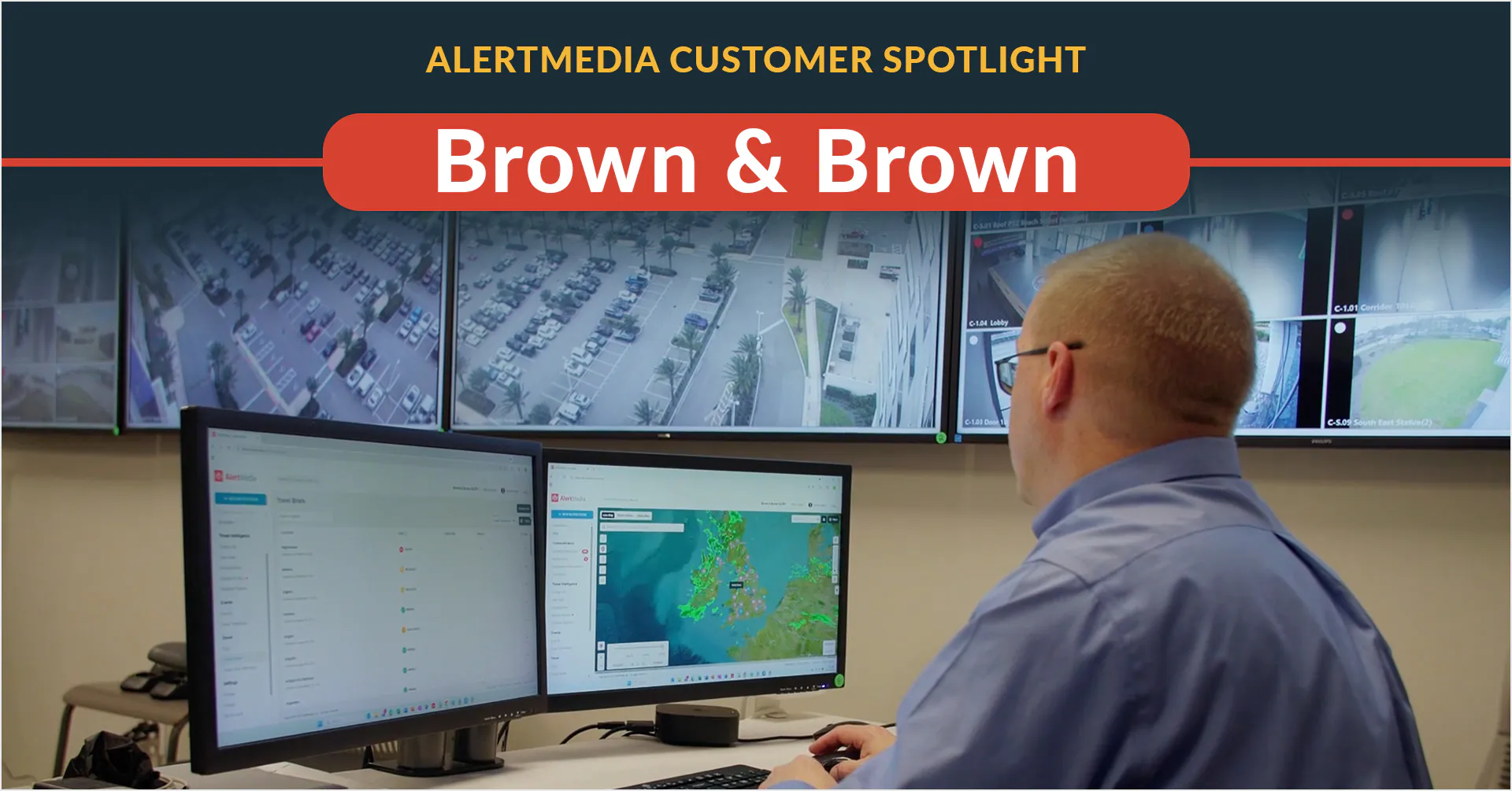
See how Brown & Brown protects 23,000 teammates and travelers worldwide with one integrated platform.
“During Hurricane Helene, there were conversations about climate havens, or areas where people thought they were safe from certain natural disasters. These havens are no longer really exempt. Climate change has shifted the seasons and locations of severe weather so nowhere is truly safe.”
—Sara Pratley, SVP of Global Intelligence at AlertMedia
Preparing for the Global Risk Landscape Ahead
In a world defined by noise, speed, and convergence, preparedness—not prediction—will separate resilient organizations from vulnerable ones. The most successful teams in 2026 will not wait for full confirmation before acting. Instead, they will rely on structured decision-making frameworks that allow them to respond at partial confidence while maintaining trust.
Key priorities include:
- Expanding intelligence collection beyond mainstream sources
- Stress-testing crisis communications against misinformation scenarios
- Preparing for multi-city and cross-border disruptions
- Hardening identity and financial workflows against synthetic fraud
- Building resilience into critical dependencies like utilities, cloud services, and staffing
The global risk landscape will only grow more complex. Organizations that can cut through the noise, act decisively amid uncertainty, and communicate with credibility will be best positioned to protect their people and maintain continuity in 2026 and beyond.
“The need to ‘do more with less’ demands smart partnerships. When you have a small team, build out your connections and lean on your network. Build partnerships internally with teams who can help or have expertise and connect with other security people in your industry at other businesses to share insights and best practices.”
—Sara Pratley, SVP of Global intelligence at AlertMedia
—Sara Pratley, SVP of Global intelligence at AlertMedia
Moving Forward in a Volatile World
Understanding the global risk landscape now requires more than monitoring isolated threats. In 2026, synthetic information, geopolitical instability, climate-driven disruption, and emerging technologies increasingly converge—compressing decision timelines and obscuring credible signals. Leaders must assume disruption as a constant and recognize that waiting for complete certainty can amplify risk rather than reduce it.
Organizations best positioned to navigate this volatility take a proactive, adaptive approach. By embedding risk priorities into strategic planning, continuously refreshing threat intelligence across trusted and alternative sources, and coordinating across security, communications, and operations teams, leaders can act decisively amid uncertainty. This readiness enables organizations to protect their people, sustain operations, and maintain trust in an environment defined by rapid change and complexity.
FAQ
- What is the global risk landscape? The global risk landscape refers to the evolving set of interconnected threats and uncertainties that can impact organizations worldwide. These risks include geopolitical instability, climate change, technological disruption, social unrest, cyber threats, regulatory shifts, and reputational challenges. Increasingly, these risks influence one another, creating compounding effects.
- Why is the global risk landscape becoming more complex in 2026? The global risk landscape in 2026 is more complex due to the convergence of fast-moving forces such as geopolitical volatility, extreme weather events, artificial intelligence, misinformation, and global supply chain interdependence. These risks now emerge and escalate faster than in the past, leaving organizations with less time to assess and respond.
- How does geopolitical instability affect the global risk landscape? Geopolitical instability affects the global risk landscape by disrupting trade routes, energy supplies, workforce mobility, and regulatory environments. Elections, armed conflicts, sanctions, and weakening international institutions increase uncertainty and complicate long-term planning for organizations operating across regions.
- What role does social unrest play in the global risk landscape? Social unrest has become a persistent feature of the global risk landscape. Protests and demonstrations are occurring more frequently, spreading faster across borders, and increasingly disrupting travel, facilities, and supply chains. Online misinformation and coordinated narratives often intensify these disruptions.
- How is climate change reshaping the global risk landscape? Climate change is reshaping the global risk landscape by increasing the frequency and severity of extreme weather events such as floods, heatwaves, hurricanes, and wildfires. Beyond physical damage, these events expose communication failures, misinformation risks, and operational dependencies that can amplify disruption.
- Why is misinformation a growing risk in the global risk landscape? Misinformation is a growing risk because false or misleading information can spread faster than verified guidance during crises. AI-generated content, social media amplification, and declining trust in official sources can undermine response efforts and turn manageable situations into cascading crises.
- How does emerging technology impact the global risk landscape? Emerging technologies shape the global risk landscape by both strengthening resilience and introducing new vulnerabilities. Advances in AI, drones, and cloud infrastructure improve efficiency, but they also strain utilities, create regulatory uncertainty, and increase exposure to cyber, data integrity, and infrastructure risks.
- How should organizations prepare for the global risk landscape in 2026? Organizations should focus on preparedness rather than prediction. Key steps include expanding intelligence sources, stress-testing crisis communications, planning for multi-location disruptions, strengthening identity and financial controls, and embedding risk awareness into strategic decision-making.
- Why is real-time intelligence critical to navigating the global risk landscape? Real-time intelligence is essential because the global risk landscape evolves rapidly and often without clear warning. Timely, credible insights enable organizations to act decisively under partial information, reducing exposure when waiting for full confirmation could increase risk.
- How can organizations build resilience in an uncertain global risk landscape? Resilience is built through adaptable planning, cross-functional coordination, and trusted communication. Organizations that align security, operations, and communications teams—and invest in reliable intelligence and partnerships—are better equipped to maintain continuity amid disruption.
- What industries are most affected by the global risk landscape? All industries are impacted, but organizations with global operations, critical infrastructure, large workforces, or complex supply chains—such as energy, manufacturing, healthcare, transportation, and technology—often face greater exposure to cascading and cross-border risks.
2026 Threat Outlook Report
Explore the top threats that impacted organizations in 2025 and how these events will shape the workplace in 2026.

AlertMedia, Risk Intelligence and Response