By AlertMedia, Risk Intelligence and Response
Emergency Management Oct 21, 2026
Threat Intelligence Platform With Real-Time Global Threat Map
Threat Intelligence Key Feature Guide
Gain instant clarity into emerging threats with analyst-verified intelligence and AI-driven early signals.
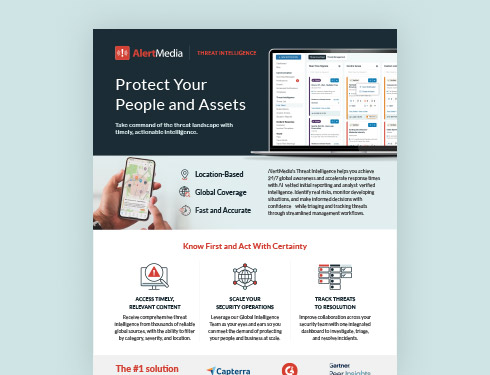
Table of Contents
- Why a Global Threat Map Matters for Multi-Location Security Teams
- What to Look for in a Threat Intelligence Platform With a Real-Time Global Threat Map
- The AlertMedia Approach: Real-Time Impact Assessment and Visual Intelligence
- Automated Threat Intelligence Platform With Geospatial and Social Media Monitoring
- See AlertMedia's Real-Time Global Threat Map in Action
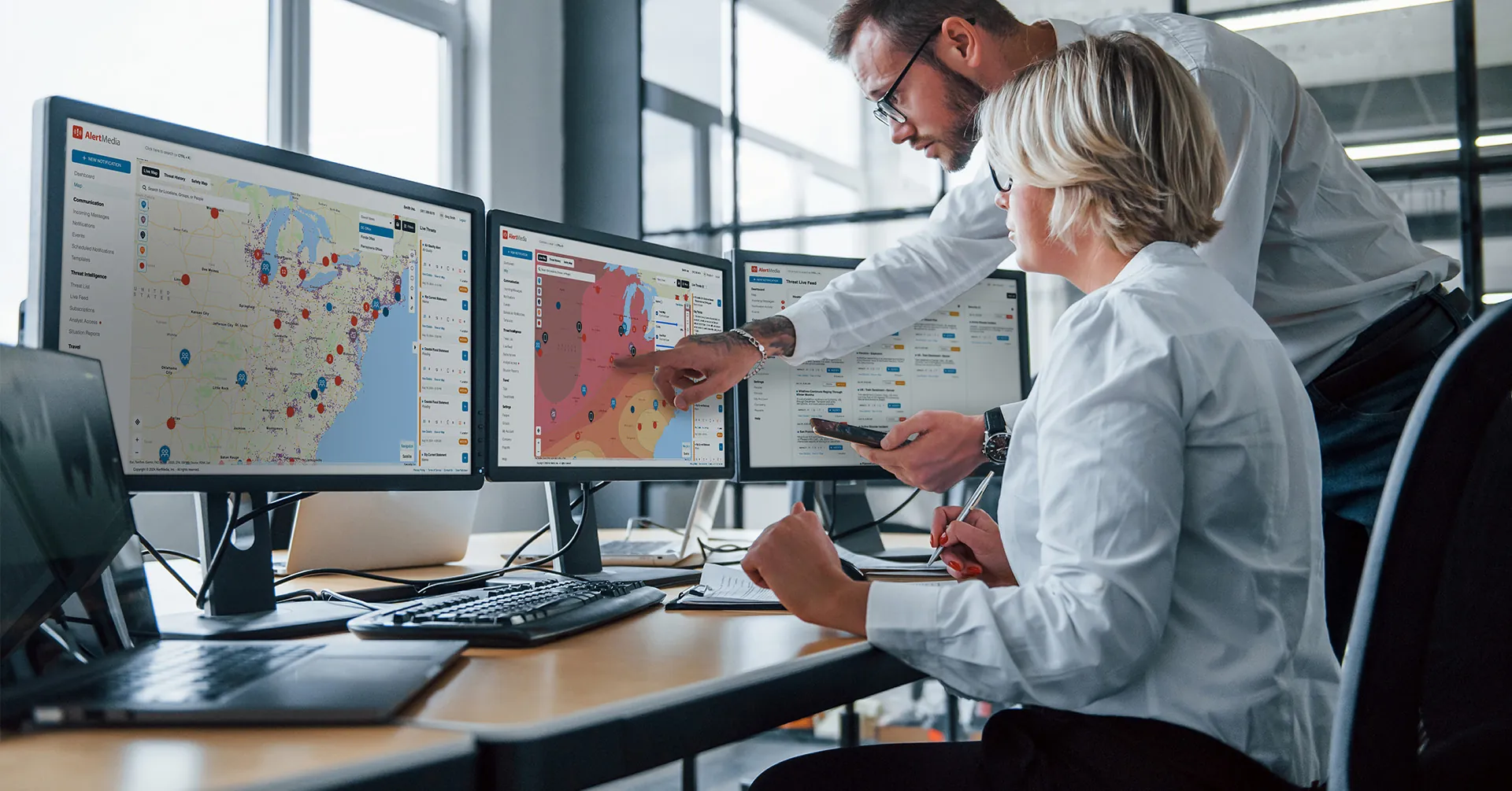
A threat intelligence platform with a real-time global threat map shows security and operations teams not just what threats exist, but where they are relative to the people, facilities, and assets that matter to a specific organization, updated as conditions change rather than as a static list of alerts. For teams managing distributed facilities or global operations, a map view answers the question a text-based feed can’t: who is actually affected, and how close is the threat to them right now. This page covers what to look for in a threat intelligence platform with a real-time global threat map, and how AlertMedia’s unified Risk Intelligence and Response platform delivers it. It also explains how an automated threat intelligence platform with geospatial and social media monitoring brings location context and online signals together on one platform.
Why a Global Threat Map Matters for Multi-Location Security Teams
A list of threats is only useful if a team can quickly tell which ones matter to them. That gets harder as an organization’s footprint grows.
- A text-based threat feed reports what’s happening, but not where it sits relative to your offices, warehouses, retail locations, or traveling employees.
- Security and operations teams overseeing hundreds of locations or global operations can’t manually cross-reference every alert against a list of addresses.
- Weather risk, physical security threats, and civil unrest each tend to live in separate tools, making it hard to see the full picture in one place.
- Without a shared visual reference, briefing leadership on “what’s happening and who’s affected” takes longer than it should during a live situation.
This challenge shows up for any organization with a distributed footprint: multiple offices, warehouses, retail locations, manufacturing sites, or a workforce that travels. A real-time global threat map is what turns a list of threats into an answer to the question that actually matters: where is the threat, and who is affected?
What to Look for in a Threat Intelligence Platform With a Real-Time Global Threat Map
- A map that shows threats alongside your own people, assets, and locations, not just pins on a generic world map.
- Analyst verification behind what’s on the map, so the team is looking at confirmed threats, not an unfiltered raw feed.
- Weather risk layered into the same view as physical and security threats, instead of a separate weather tool.
- A fast, AI-vetted early-warning layer for situations that move quickly, paired with the slower, more rigorous analyst-verified layer.
- A direct path from what the map shows to coordinated action, not just a static visualization.
- Social media monitoring alongside geospatial threat data, so online signals are not left in a separate silo.
The table below compares a raw threat feed to a platform built around a real-time, verified global threat map.
| Capability | Raw Threat Feed | AlertMedia’s Real-Time Global Threat Map |
| Threat display | A list of alerts with limited geographic context. | Real-Time Impact Assessment visualizes threats directly against your people, assets, and locations on a live map. |
| Verification | Unverified, high-volume feed with no filtering. | AlertMedia’s Global Intelligence Team analyst-verifies threats before they surface on the map. |
| Weather | A separate tool or source for weather risk. | Dynamic Weather Forecasting from a dedicated meteorologist team layers directly onto the same map view. |
| Speed vs. rigor | Fast feeds sacrifice verification; verified feeds sacrifice speed. | Real-Time Signals adds an AI-vetted early-warning layer while human-verified intelligence catches up, so teams get both. |
| Path to action | A map or feed with no built-in response path. | Visual Intelligence connects directly into Incident Response and Emergency Communication, so a verified threat can move straight into a coordinated response. |
“AlertMedia takes the legwork out of monitoring and vetting relevant threat signals — so we can focus on preparing for any threats, rather than reacting to them.” — Vice President of Operations, Thales Group
The AlertMedia Approach: Real-Time Impact Assessment and Visual Intelligence
AlertMedia’s Threat Intelligence platform is built around Visual Intelligence, the mapping capability that underlies AlertMedia’s map-based features across the platform. Real-Time Impact Assessment uses Visual Intelligence to visualize the relationship between a threat and the people, assets, and locations it could affect, updated in real time as the situation develops. Every threat on the map has already been vetted by AlertMedia’s Global Intelligence Team, staffed 24/7, so security teams are looking at confirmed intelligence rather than an unfiltered firehose.
For situations that move faster than the human-verification cycle, Real-Time Signals adds an AI-vetted layer of hyperlocal early-warning signals from thousands of trusted sources, always as an enhancement to Threat Intelligence rather than a separate offering. Dynamic Weather Forecasting from a dedicated meteorologist team layers geospatial weather risk onto the same map, so a hurricane track and a civil unrest alert can be assessed side by side. And because Visual Intelligence connects to Incident Response, a verified threat on the map can move directly into a coordinated response without switching tools.
More than 3,500 organizations in over 150 countries rely on AlertMedia, and for security teams managing coverage across many locations, AlertMedia’s analyst support and automation deliver value equivalent to adding approximately three additional security staff, without adding headcount—with 45K+ trusted intel sources and 1.5B+ unique intel data points that feed this coverage. AlertMedia has also been named a Gartner Peer Insights™ Customers’ Choice.
Automated Threat Intelligence Platform With Geospatial and Social Media Monitoring
An automated threat intelligence platform with geospatial and social media monitoring combines three things: a map that shows where verified threats sit relative to your people and assets, monitoring of online conversations that may point to emerging risks, and automation that reduces manual work without removing analyst verification. Together, they help a lean team cover more locations and sources and move from awareness to action faster.
| Layer | What it covers | How AlertMedia delivers it |
|---|---|---|
| Geospatial monitoring | Where threats sit relative to your people, assets, and locations. | Visual Intelligence and Real-Time Impact Assessment show verified threats against your sites on a live map, with Dynamic Weather Forecasting and geofences. |
| Social media monitoring | Online conversations that may signal emerging risks. | Social Intelligence monitors more than 65 social platforms, fringe forums, and dark web sources, using AI Query Builder, Sentiment Analysis, and alert subscriptions. |
| Automation | Repetitive work that software can do so analysts can focus on judgment. | Real-Time Signals, an add-on to Threat Intelligence, provides an AI-vetted early-warning feed, and Threat Management Workflows route threats to the right people, with custom alerts by role and location. |
| Response | Turning intelligence into coordinated action. | Incident Response and Emergency Communication connect verified threats to tasks and targeted messages. |
In AlertMedia, these views complement one another. Threat Intelligence and Visual Intelligence show verified threats against your locations, while Social Intelligence provides its own area for monitoring and investigating online activity. Teams use both and can move findings from either into Incident Response and Emergency Communication.
Automation here means the platform does the repetitive work—scanning sources, building searches, grouping signals, and routing threats—while AlertMedia’s Global Intelligence Team verifies the intelligence that reaches your team. AI scales the platform; AI paired with analyst verification is what makes the intelligence trustworthy enough to act on.
Global Threat Map FAQs
- What is a threat intelligence platform with a real-time global threat map? A threat intelligence platform with a real-time global threat map is software that shows verified threats visually, in relation to an organization's own people, assets, and locations, updating as conditions change rather than presenting threats only as a list.
- How is a global threat map different from a raw threat feed? A raw threat feed lists alerts with limited context about who is actually affected. A global threat map, like AlertMedia's Real-Time Impact Assessment, shows analyst-verified threats directly against your specific locations, people, and assets, so teams can see exposure at a glance instead of cross-referencing addresses manually.
- Can a real-time threat map include weather risk alongside physical and security threats? Yes. AlertMedia's Dynamic Weather Forecasting, from a dedicated meteorologist team, layers geospatial weather risk onto the same map view as physical security and civil threats, so teams can assess both together.
- Does a global threat map work for organizations with many locations or global operations? Yes. Visual Intelligence is built to show threats against people and assets across hundreds of locations or global footprints in a single view, which is where a map delivers the most value over a text-based list.
- How does Real-Time Signals fit into a global threat map? Real-Time Signals is an AI-vetted add-on to Threat Intelligence that surfaces hyperlocal early-warning signals faster than the human-verification cycle, giving teams an early view on the map while AlertMedia's Global Intelligence Team completes analyst verification.
- What is an automated threat intelligence platform with geospatial and social media monitoring? An automated threat intelligence platform with geospatial and social media monitoring shows verified threats on a map against your people and assets, monitors online conversations for emerging risks, and automates repetitive work while analysts verify the intelligence. It helps lean teams cover more locations and sources.
- Does AlertMedia monitor social media as part of threat intelligence? Yes. AlertMedia Social Intelligence monitors social platforms, fringe forums, and dark web sources, and complements Threat Intelligence, which delivers analyst-verified threat coverage. Teams use both and can move findings into Incident Response and Emergency Communication.
- How does automation work alongside analyst verification? Automation handles repetitive work such as scanning sources, building searches, grouping signals, and routing threats. AlertMedia's Global Intelligence Team verifies the intelligence that reaches your team, and Real-Time Signals adds an AI-vetted early-warning layer while verification catches up.
- How do geospatial and social media monitoring work together on one platform? Visual Intelligence and Threat Intelligence show where verified threats sit relative to your people and assets, and Social Intelligence shows what people are saying online. Each appears in its own part of the platform, and findings from either can lead into the same response workflows.
See AlertMedia’s Real-Time Global Threat Map in Action
A list of threats tells a security team what’s happening. A map tells them who’s affected. AlertMedia’s Visual Intelligence puts verified threats, weather risk, and your own people and assets on the same live view, connected directly to a coordinated response.
Download Our Threat Intelligence Key Feature Guide
Gain instant clarity into emerging threats with analyst-verified intelligence and AI-driven early signals.

AlertMedia, Risk Intelligence and Response