

Best Emergency Communication Systems for 2026
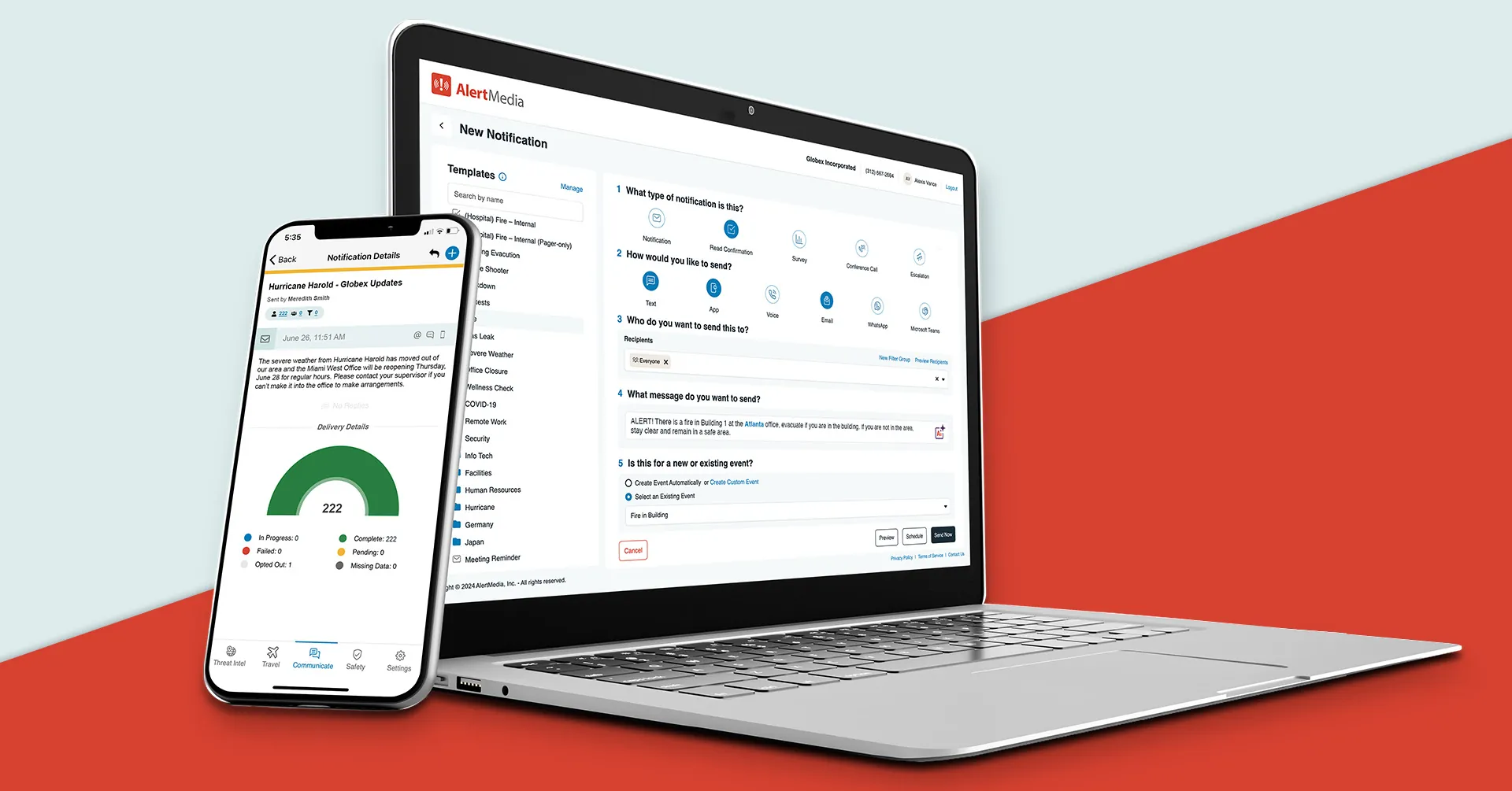
When an emergency unfolds, communication must be immediate, accurate, and far-reaching. Organizations can’t afford delays, gaps, or uncertainty when people’s safety and business continuity are at stake. In 2026, emergency communication systems have become essential infrastructure—helping teams navigate severe weather, cyberattacks, security incidents, facility disruptions, and global workforce risks with confidence.
This guide explains what emergency communication systems are, who uses them, and how to evaluate leading providers in 2026 so you can choose the right solution for your organization.
What Is an Emergency Communication System?
An emergency communication system is a platform that enables organizations to rapidly notify employees, collect real-time responses, and coordinate action during critical events. These systems support two-way communication, multichannel delivery, and integrations that help teams execute their response plans under pressure—going well beyond simple one-way broadcasting.
Common capabilities include:
- SMS, voice, email, push notifications, Teams, Slack, WhatsApp, desktop alerts, and digital signage
- Two-way communication: confirmations, surveys, free-text responses
- Integrations with HRIS, Active Directory, IT systems, and collaboration tools
- Automation and prebuilt workflows to accelerate response
- Global reach with multilingual support
- Reporting, audit logs, and compliance features
Emergency communication systems ensure organizations can reach the right people quickly and manage the full lifecycle of a critical incident—from detection to resolution.
Who Uses These Systems?
Emergency communication systems support organizations across a wide range of industries—each with unique safety, operational, and compliance needs:
- Enterprises use them to protect global and hybrid workforces, coordinate response during disruptions, and maintain business continuity.
- Healthcare organizations rely on them to manage critical incidents, communicate with clinical teams, and ensure continuity of patient care.
- Schools and universities use them to distribute campus-wide alerts, coordinate lockdowns, and strengthen student and staff safety.
- Manufacturing and industrial operations depend on them for plant-wide notifications, hazard alerts, equipment failures, and shift coordination.
- Logistics, retail, and consumer-facing industries use them to communicate with dispersed teams, manage facility incidents, and maintain operational uptime.
- Government agencies and public institutions use them to disseminate emergency information, coordinate response teams, and meet regulatory requirements.
Across all industries, the goal is consistent: to ensure urgent information reaches the right people instantly, allowing organizations to respond quickly, reduce confusion, and protect both people and operations.
The Business Case for Emergency Communication Systems
Emergency communication platforms often prove their value in a single event. Whether preventing downtime, reducing confusion, or supporting compliance, they contribute directly to organizational resilience.
Key benefits include:
- Faster response times, reducing operational disruption and preserving revenue
- Lower legal and compliance risk, supporting standards like SOC 2, ISO 27001, HIPAA, and GDPR
- Improved audit readiness, with detailed logs and reporting
- Higher employee trust, reinforcing a culture of safety and preparedness
- Reduced administrative burden, replacing manual processes with automated workflows
When communication is seamless, organizations can mitigate risks more effectively and avoid the cascading impacts of poor information flow.
Core Capabilities Corporate Buyers Need
When evaluating a system, organizations should prioritize capabilities that guarantee speed, reliability, and usability during crises.
Essential features include:
- Multichannel delivery across SMS, voice, email, chat apps, push, desktop, and signage
- Two-way communication for confirmations, surveys, free text response, status updates, and field intelligence
- Audience segmentation based on location, role, or dynamic group membership
- Automated data syncing with HR systems, Active Directory, and scheduling tools
- Global reach with proven international deliverability and language translation
- Integrations with HR, IT, Microsoft Teams, Slack, WhatsApp, and threat intelligence sources
- High throughput and redundancy for reliable message delivery at scale
- Mobile apps for admins and employees
- Security and compliance (SOC 2 Type II, ISO 27001:2022, GDPR, HIPAA)
- Ease of use, enabling fast, accurate communication under pressure
A system should not only deliver alerts—it should streamline workflows, reduce errors, and scale with your organization.
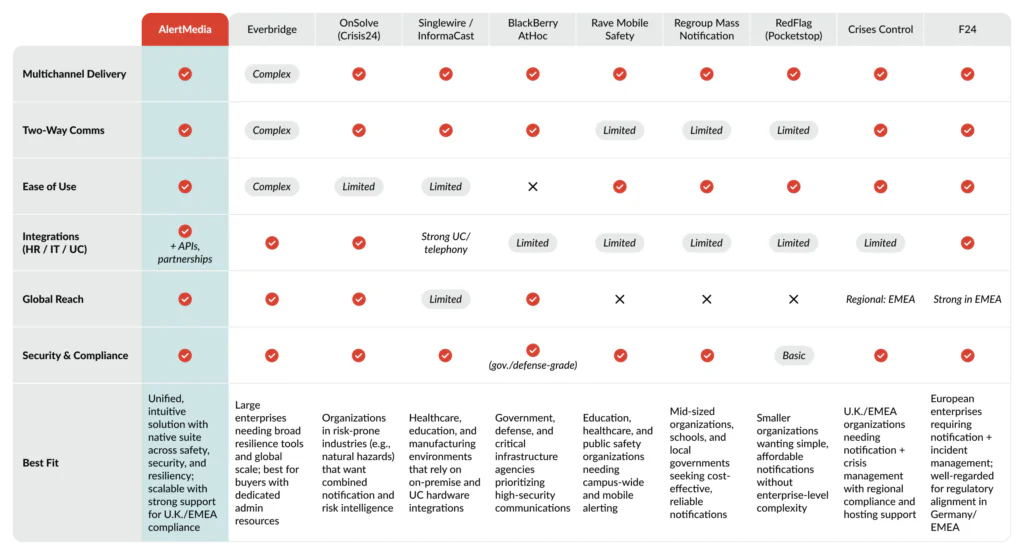
Comparison Overview of Leading Emergency Communication Systems
Organizations evaluating emergency communication systems in 2026 will find that providers generally fall into two tiers, reflecting differences in scale, capabilities, global readiness, and depth of emergency-specific functionality.
Tier 1: Core providers
These are the most established platforms in the category, offering enterprise-grade communication capabilities, global infrastructure, and advanced integrations that support complex incident response needs. They are well-suited for mid-market and large enterprises that require reliable communication across distributed teams, high-risk environments, and regulated industries.
- AlertMedia — Modern, unified platform for emergency communication, incident management, risk intelligence, travel risk management, and employee safety monitoring; known for ease of use, fast deployments, substantial global reach, and two-way communication capabilities.
- Everbridge — Offers a wide range of products, compiled through acquisition. Known for global scale, though often considered complex and resource-intensive to configure and maintain.
- OnSolve (Crisis24) — Combines emergency communication with risk intelligence and severe weather alerting, with a focus on natural hazard response and situational awareness.
- Singlewire / InformaCast — Primarily used in healthcare, education, and industrial environments; strong integrations with IP phones, UC systems, and on-premise hardware for in-building and hybrid alerting.
- BlackBerry AtHoc — Trusted in defense, government, and critical infrastructure sectors for secure, compliance-heavy use cases requiring strict controls and high-security communication.
Tier 2: Specialized and regional providers
These platforms address more focused needs, making them strong fits for mid-market organizations balancing capability and budget, as well as buyers seeking vendors with deep regional expertise or sector-specific strengths.
- Rave Mobile Safety — Frequently adopted in higher education, healthcare, and public safety; specializes in campus-wide alerting, panic buttons, and mobile safety applications.
- Regroup Mass Notification — Often used by schools, municipalities, and mid-sized organizations needing reliable notifications without complex integrations.
- RedFlag (Pocketstop) — Known for being a simple tool designed for smaller organizations that need basic multichannel notifications.
- Crises Control — U.K.-based provider offering emergency notification and light incident-management features, with an emphasis on regional compliance, data hosting, and EMEA footprint.
- F24 — European provider combining emergency notification and incident management; well-regarded for regulatory alignment in Germany and across EMEA, though broader global capabilities vary.
Overall, each vendor aligns with different organizational needs. The following sections provide deeper insight into their strengths, limitations, and best-fit scenarios to help buyers evaluate the right emergency communication system for their environment.
Top 5 Emergency Communication Systems in 2026
Our evaluation draws on analyst research, customer reviews, and market data to provide an objective assessment of the leading emergency communication systems available today. We’ve organized providers into two tiers to help buyers quickly understand which solutions meet the needs of organizations with varying levels of complexity.
Tier 1: Core providers
Tier 1 vendors represent the most comprehensive emergency communication platforms. These tools offer the scale, automation, and global readiness that mid-market and enterprise organizations require to communicate effectively during high-risk events. They are designed to support diverse use cases, from fast-moving incident response to complex, multi-department crisis coordination.
Below, we break down each Tier 1 provider’s strengths, limitations, and ideal use cases.
AlertMedia
How does AlertMedia support emergency communications?
AlertMedia is widely recognized for its clean, intuitive interface that enables organizations to communicate quickly and confidently during emergencies. Its multichannel delivery—covering SMS, voice, email, mobile push, desktop alerts, and integrations with tools like Microsoft Teams and Slack—helps ensure messages reach people on every device they rely on. Customers consistently praise AlertMedia for its rapid deployment, high deliverability rates, mobile app quality, and standout customer support. Beyond communication, AlertMedia Analytics helps teams measure program performance and surface trends across incidents and engagement, making it easier to demonstrate impact to leadership and continuously improve response strategy over time.
Unlike legacy systems built from stitched-together acquisitions, AlertMedia offers Emergency Communication, Social Intelligence, AI and Human-Vetted Threat Intelligence, Travel Risk Management, Incident Response, and Employee Safety Monitoring as part of one integrated risk intelligence and response platform. This unified architecture enables organizations to consolidate tools, streamline workflows, and reduce administrative complexity. Its global infrastructure, uptime track record, and ongoing investment in innovation make it a robust option for multinational businesses or organizations that require reliable communication across dispersed workforces.
Everbridge
How does Everbridge support emergency communications?
Everbridge is one of the most established providers in the resilience and safety technology landscape. Its Critical Event Management suite spans emergency communication, public warning, digital operations, and IT incident response, making it appealing to organizations with intricate requirements or regulatory obligations. The company’s footprint among large enterprises and public-sector agencies reflects its breadth of features and global scale.
However, Everbridge is frequently described as complex to configure and maintain. Many buyers note that the platform requires significant training, dedicated administrators, and higher services investments compared to other providers. While powerful, its cost structure and implementation timelines may be challenging for organizations looking for fast adoption or a more streamlined experience.
OnSolve (Crisis24)
How does OnSolve support emergency communications?
Now operating under the Crisis24 umbrella, OnSolve merges emergency communication with risk intelligence, severe weather monitoring, and situational awareness tools. This makes the platform an attractive choice for industries such as logistics, energy, and manufacturing that are exposed to natural hazards or external threats. Its hazard-driven automation capabilities deliver timely alerts and help organizations prepare for fast-moving events.
Because OnSolve’s feature set has grown through multiple acquisitions, some customers report a less unified experience across modules. Third-party reviews also indicate that usability, support, and deployment timelines can vary depending on the product combination implemented. While strong for weather-driven or hazard-centric use cases, some organizations may find the platform less cohesive than cloud-native alternatives.
Singlewire / InformaCast
How does Singlewire support emergency communications?
Singlewire’s InformaCast platform is intended for environments where on-premises or in-building communication is essential. Its deep integrations with IP phones, overhead paging systems, intercoms, and digital signage make it a strong fit for hospitals, universities, and industrial facilities that rely on physical infrastructure for emergency messaging. The platform supports hybrid deployments and offers a wide range of device-level integrations.
That said, InformaCast’s strengths are most pronounced in campus-based or facility-centric environments. Organizations with globally distributed or mobile-first workforces may find the platform less adaptable for enterprise-wide emergency communications that require international scalability or a broader set of digital channels.
BlackBerry AtHoc
How does AtHoc support emergency communications?
BlackBerry AtHoc has long been a trusted provider for defense, federal government, and critical infrastructure organizations. The platform is built with a strong compliance and security orientation, offering controlled workflows, high-assurance communication, and certifications suited to heavily regulated environments. Its reputation for reliability in mission-critical scenarios has made it a preferred choice for agencies that cannot compromise on security.
However, AtHoc’s government-first design often results in a steeper learning curve and more rigid workflows for commercial buyers. Users commonly report that its interface feels dated compared to modern, cloud-native solutions and that configuration flexibility can be limited for organizations seeking ease of use and rapid administration.
Other Notable Emergency Communication Systems
Tier 2: Specialized and regional providers
Tier 2 vendors play an important role in the emergency communication landscape, particularly for organizations seeking solutions tailored to specific industries, budgets, or regional requirements. Many of these platforms are strong fits for smaller organizations balancing capability and cost, while others offer deep expertise in regions such as the U.K. or broader EMEA.
Although these providers generally offer a narrower scope than Tier 1 vendors—with fewer advanced features like integrated threat intelligence, travel risk management, or unified incident response—they can still deliver meaningful value when aligned with the right use case.
The following profiles highlight where each provider excels and where organizations may encounter limitations compared to broader, enterprise-focused systems.
Rave Mobile Safety
Best for organizations in education, healthcare, and public safety. Rave is well-known for its mobile safety apps, panic button features, and campus-wide alerting tools, making it a good match for institutions with concentrated populations and life-safety requirements. While Rave delivers reliable communication in these environments, it does not offer the global scale, integrations, or multi-solution ecosystem available from Tier 1 platforms.
Regroup Mass Notification
Best for schools, municipalities, and organizations seeking budget-friendly emergency communication solutions without robust risk intelligence or incident management capabilities. Regroup focuses on delivering straightforward, reliable alerts without the full set of capabilities offered by enterprise-grade systems. It is a cost-effective option for organizations that need dependable notifications but do not require advanced automation, integrations, or extended crisis-management capabilities.
RedFlag (Pocketstop)
Best for smaller organizations needing simple, affordable emergency communication. RedFlag provides basic multichannel alerts and employee communication features in an easy-to-use package. It is well-suited for teams with limited administrative resources or straightforward communication needs. However, it lacks the scalability, data integrations, and broader incident response features offered by more robust platforms.
Crises Control
Best for U.K. and EMEA organizations prioritizing regional compliance and data hosting. Crises Control delivers emergency notification and light crisis management functionality, including geo-fencing, mobile apps, and templated workflows. Its emphasis on regional data protection makes it appealing to organizations operating within strict U.K./EU regulatory environments. Outside Europe, adoption is more limited, and the platform may not provide the global infrastructure required by multinational enterprises.
F24
Best for European enterprises that require both emergency notification and incident management. Headquartered in Germany, F24 offers a broad crisis communication suite with strong alignment to European regulatory requirements. It is a solid choice for organizations operating primarily within EMEA. However, it does not include broader capabilities such as integrated risk intelligence or global communication reach offered by Tier 1 platforms, and its brand awareness remains more concentrated in Europe.
How Do You Choose the Right System?
With many strong solutions on the market, selecting the right platform ultimately comes down to aligning features with your organization’s size, risk profile, and operational structure. As you compare vendors, keep the following considerations in mind:
- Ease of use: During an emergency, simplicity is essential. Look for a platform that allows any authorized user to send notifications quickly and confidently, without relying on specialists.
- Scalability and coverage: Ensure the system can support your entire workforce—from local teams to global operations—with consistent performance across all channels.
- Reliability and throughput: Delivery speed matters. Prioritize vendors with proven uptime, redundant infrastructure, and strong performance during high-volume events.
- Integrations: Confirm the platform connects smoothly with your HRIS, Active Directory, IT systems, and collaboration tools (e.g., Teams, Slack). These connections help automate data accuracy and streamline response.
- Security and compliance: Verify alignment with frameworks such as SOC 2, ISO 27001, GDPR, and HIPAA (if applicable). This is especially crucial for organizations operating in regulated industries or across multiple regions.
- Support and onboarding: Strong customer success and responsive support teams can make a meaningful difference—particularly when implementing a new system or navigating a critical event.
The best system will scale with your organization’s needs while remaining intuitive enough to use effectively during fast-moving, high-pressure situations.
Common Deployment & Implementation Challenges
Even with a strong platform, successful adoption requires a thoughtful rollout. Many organizations encounter challenges such as:
- Data accuracy: Outdated employee information or incomplete contact details can undermine communication efforts. Regular synchronization with HR systems is essential.
- Systems integration: Connecting with tools such as HRIS, ITSM, or facility systems requires careful planning, testing, and cross-functional coordination.
- User adoption: Employees may ignore or misunderstand alerts if training is inconsistent or if notifications are not clearly differentiated from routine messages.
- Admin readiness: Administrators must feel confident sending alerts quickly and correctly. Without proper training, hesitation or errors can slow response times.
- Routine testing: Regular drills validate that the system works as intended and build employee familiarity—both of which are vital during real emergencies.
Addressing these challenges early helps organizations unlock the full value of their emergency communication system, whether supporting a regional team or coordinating incidents across a global enterprise.
Frequently Asked Questions
What’s the difference between an emergency communication system and an emergency alert system?
Governments or public agencies typically use emergency alert systems to broadcast one-way alerts to residents during large-scale emergencies. Emergency communication systems, on the other hand, are built for organizations to communicate directly with employees, contractors, and stakeholders. They support two-way communication, automated workflows, integrations with HR and IT systems, and detailed reporting—making them far better suited for enterprise incident response and coordination during complex or evolving events.
Are emergency communication systems used for more than life-safety incidents?
Yes. Many organizations also rely on these systems for operational disruptions, IT outages, facility closures, staffing coordination, weather-related delays, and other routine updates that benefit from fast, consistent communication. This day-to-day utility strengthens overall resilience and ensures employees remain familiar with the platform.
How secure are emergency communication systems?
Leading providers adhere to standards such as SOC 2 Type II, ISO 27001, GDPR, and—in some industries—HIPAA or other sector-specific regulations. These frameworks ensure sensitive employee and operational data is protected. Organizations operating globally should also confirm a vendor’s data residency options and regional hosting capabilities.
How do these systems support regional compliance requirements, such as GDPR or U.K. data protection rules?
Most enterprise-grade platforms offer features and contractual controls to meet regional data privacy standards. This may include local data centers, EU/U.K. data processing agreements, and configurable retention settings. It’s essential to confirm that the vendor’s hosting and compliance model aligns with your geographic footprint.
What factors influence pricing?
Pricing is typically based on the number of users, the capabilities included (e.g., two-way communication, integrations, threat intelligence), and, in some cases, message volume or add-on modules. Mid-market organizations often prioritize core capabilities with reasonable operating costs, while enterprises evaluate total cost of ownership across global teams, integrations, and support models.
How do I get leadership buy-in?
Focus on both the safety and operational advantages. Emergency communication systems reduce downtime, support regulatory compliance, enable faster incident response, and demonstrate clear duty of care. For mid-market organizations, efficiency gains and reduced administrative burden are persuasive. For enterprises, risk mitigation and global continuity tend to resonate most with executive stakeholders.