

Best Emergency Mass Notification Systems for Business in 2026
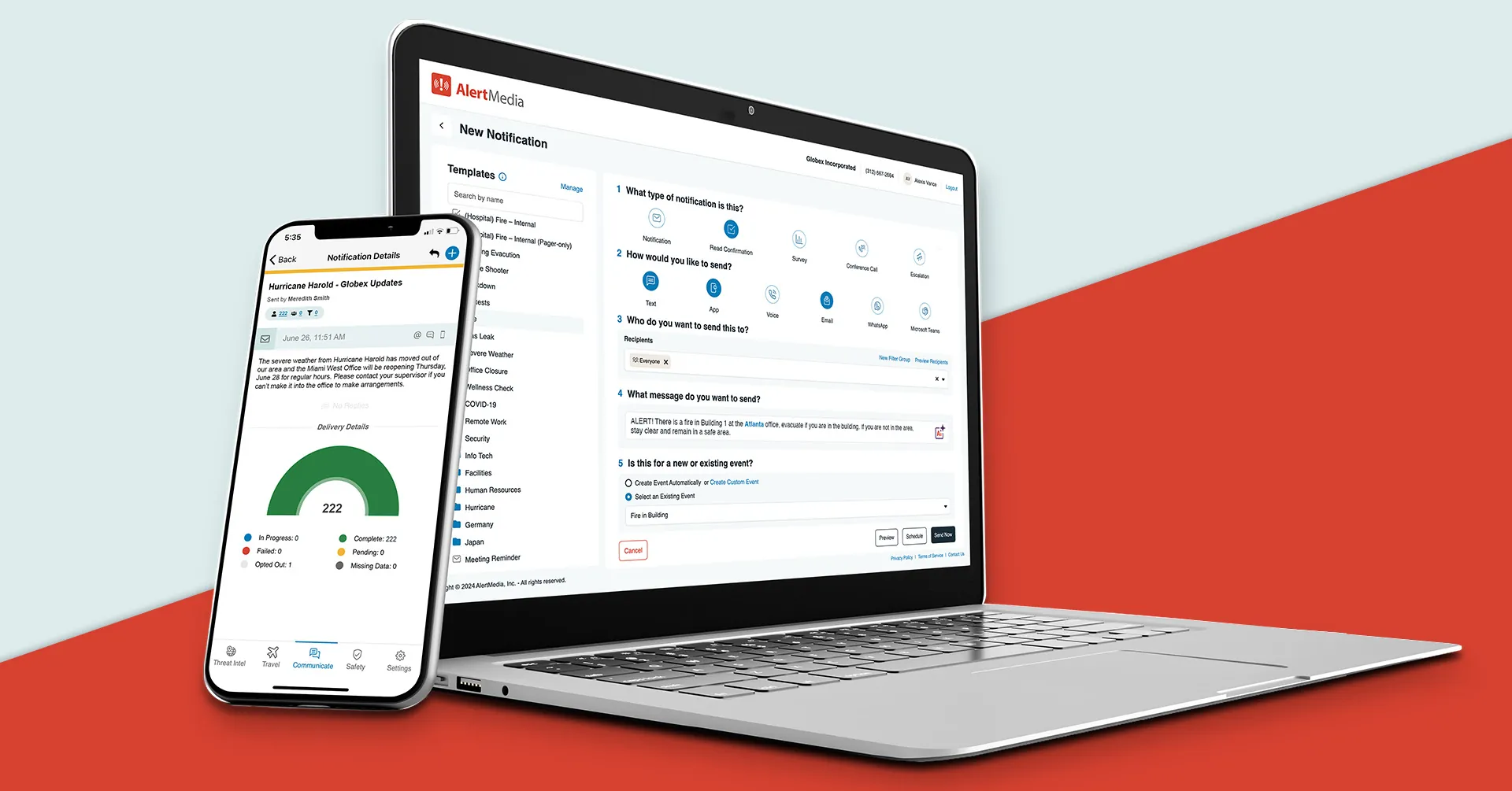
An emergency mass notification system (EMNS) enables organizations to send urgent alerts to large groups of people across multiple channels simultaneously, ensuring critical information reaches employees during crises, disruptions, or urgent operational events. For enterprise organizations and growing businesses alike, selecting the right emergency mass notification system is essential for protecting employees, maintaining operations, and minimizing risk.
What Is an Emergency Mass Notification System?
An emergency mass notification system is a centralized platform that allows organizations to send urgent alerts and time-sensitive updates to large groups of people across multiple communication channels simultaneously.
Also referred to as an emergency messaging and notification system, these platforms are designed to ensure fast, reliable delivery of critical communications during events such as:
- Severe weather incidents
- Workplace violence or security threats
- IT outages or cyber incidents
- Natural disasters
- Facility closures
- Business continuity events
Modern EMNS software goes beyond basic one-way alerts. Today’s systems support multichannel communication, automation, two-way messaging, integrations, and reporting—helping organizations coordinate response efforts and confirm employee safety in real time.
Who uses these systems?
A plan isn’t actionable if you can’t reach the right people fast. Emergency mass notification systems serve organizations across every sector where the cost of delayed communication during a crisis is higher than the cost of the platform itself.
- Corporate security and business continuity teams use them as the execution layer for emergency response plans—sending pre-authorized alerts the moment a threat is confirmed, without relying on manual chains of command that break under pressure.
- Critical infrastructure operators in utilities, energy, and water management use them to alert field crews, control room staff, and executive teams simultaneously when an incident threatens operations or public safety.
- Financial institutions and regulated enterprises use them to satisfy duty-of-care requirements, coordinate responses to active threats or service outages, and maintain the audit trails that regulators and insurers require.
- Multi-site retail, hospitality, and service organizations depend on them to reach hundreds of locations quickly—whether for a security incident at a single site or a system-wide weather or operational disruption.
- Logistics and transportation companies use them to communicate with field workers, drivers, and distribution center staff who aren’t behind a desk and can’t be reached through standard office communication tools.
- Healthcare systems and hospital networks rely on them for code activations, active threat protocols, rapid staff mobilization, and real-time safety confirmation during incidents that require immediate coordinated response.
Across all these contexts, the stakes are the same: when an emergency occurs, the difference between reaching people in seconds and in minutes can define the outcome.
The Business Case for Emergency Mass Notification
The ROI of an emergency mass notification system is most clearly understood through the cost of the alternative: a security incident that escalates because employees weren’t warned in time, an evacuation that fails accountability checks, or a regulatory audit that surfaces documentation gaps in your incident response record.
- Accelerate incident containment: Faster notification shortens the window between threat identification and employee response—reducing the risk of harm, escalation, and prolonged disruption.
- Establish accountability during evacuations: Two-way check-in and safety confirmation let emergency managers know who has responded and who still needs to be reached—replacing headcounts with real-time data.
- Support regulatory and legal defensibility: Timestamped delivery logs and documented employee responses demonstrate that the organization fulfilled its duty of care—critical during OSHA investigations, insurance claims, and litigation.
- Reduce uncoordinated response: When everyone receives the same message at the same time, it eliminates the information asymmetry that causes employees to act on rumors, take unsafe actions, or fail to follow protocol.
- Preserve business continuity: Organizations that communicate clearly during incidents return to normal operations faster—because employees know what to do, where to go, and when it’s safe to resume.
Capabilities are table stakes; execution is the differentiator. The business case for an EMNS ultimately comes down to whether your organization can act on its emergency plans—not just document them.
What Core Capabilities Do Corporate Buyers Need?
Emergency notification puts different demands on a platform than routine communication. The following capabilities are non-negotiable for organizations that need their system to perform under real incident conditions—not just in demonstrations.
- Pre-built emergency scenario templates: Ready-to-send messages for evacuation, shelter-in-place, active threat, severe weather, and other common scenarios—so administrators aren’t writing communications from scratch while an event is unfolding
- Threat monitoring and automated triggers: Integration with weather services, security intelligence feeds, and other event data sources that can initiate alerts automatically when monitored thresholds are crossed
- Two-way safety confirmation: The ability to collect employee acknowledgment, check-in responses, and location status during an active event—not just confirm that a message was delivered
- Delivery redundancy across channels: Automatic failover when a primary channel—SMS, voice, email, push—is unavailable or congested, ensuring messages find an alternate path to every recipient
- Geographic targeting: Precise alerting to employees in a specific building, floor, campus zone, or affected geographic area, without triggering unnecessary notifications across the entire organization
- After-hours and personal device reach: The ability to alert employees on personal phones and home devices when an incident occurs outside business hours or before employees have arrived on-site
- Visitor and contractor notification: Extending emergency alerts beyond the core employee directory to anyone currently on-site, including third-party workers and guests who may not appear in the HRIS
- Physical security system integration: Connections to access control, mass paging, building management, and incident response platforms that turn an alert system into part of a unified emergency response infrastructure
- Emergency escalation workflows: Automated escalation when a message goes unacknowledged—critical for evacuation accountability or any scenario where non-response is itself a risk indicator
- Mobile administration: The ability to trigger and manage emergency notifications from a phone, without access to a desktop or corporate network, since administrators may themselves be managing an active incident
- Role-based sending controls: Clear authorization structures that define who can send which alert types under which conditions—preventing both unauthorized sends and hesitation when authorization is unclear
- Post-incident audit documentation: Complete records of message content, delivery timestamps, channel performance, and employee responses—formatted for OSHA reporting, insurance review, and after-action analysis
Comparison Overview of Leading Mass Communication Systems
Organizations evaluating emergency mass notification systems will find that providers vary considerably in how they perform during an actual incident. Tier 1 vendors offer enterprise-grade reliability, depth, and integration—built to support organizations with serious emergency response requirements. Tier 2 vendors serve more focused markets or use cases.
Tier 1: Core Providers
Full-featured platforms with the reach, delivery reliability, and integration depth that organizations with genuine emergency communication requirements demand. Suitable for enterprises of all sizes where notification failure during a real incident is not an acceptable outcome.
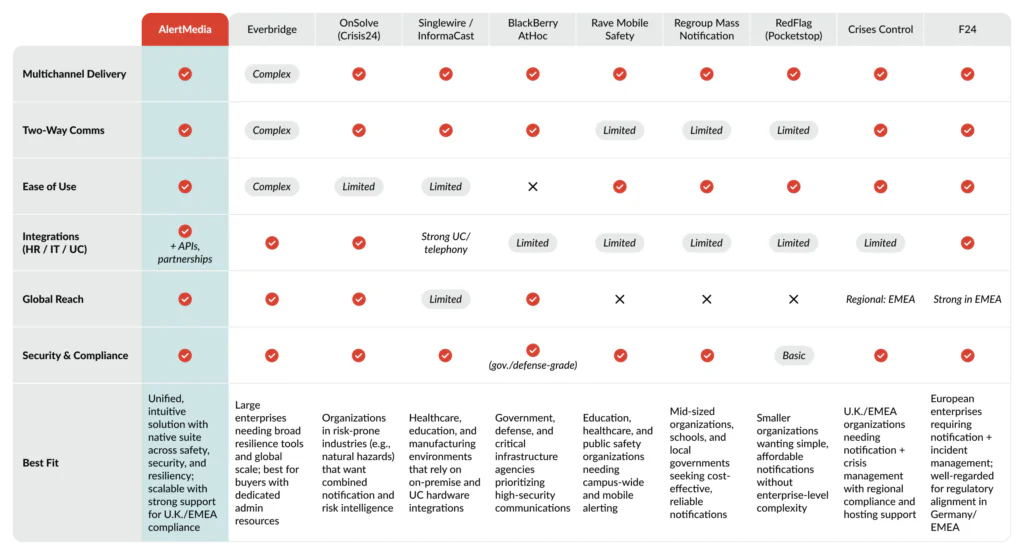
- AlertMedia — Purpose-built for speed and reliability under pressure: automated threat-triggered alerts, two-way employee safety confirmation, and a unified platform that covers the full emergency response lifecycle
- Everbridge — Enterprise CEM suite with deep incident orchestration and global reach; commonly used by large organizations with formal business continuity programs and dedicated program staff
- OnSolve (Crisis24) — Combines emergency notification with AI-driven risk intelligence; strong fit for organizations monitoring natural hazards and geopolitical threats across international operations
- Singlewire / InformaCast — Specializes in on-premises emergency alerting through IP phones, overhead speakers, digital signage, and building systems; widely deployed in campus and facility-centric environments
- BlackBerry AtHoc — Defense and government-heritage platform built for high-security, compliance-heavy environments; supports air-gapped deployments and interoperability with agency communication networks
Tier 2: Specialized and Regional Providers
Capable platforms with a more defined scope—strong fits for specific verticals, geographies, or organizations whose emergency notification requirements are narrower or whose budget constrains enterprise options.
- Rave Mobile Safety — Established in public safety, higher education, and municipal emergency management; offers E911 integration and community alerting alongside enterprise notification
- Regroup Mass Notification — Accessible, cost-effective alerting for schools, local governments, and mid-sized organizations; straightforward multi-channel delivery without enterprise-grade depth
- RedFlag (Pocketstop) — Practical employee alerting tool for mid-market organizations; fast to deploy with a focus on simplicity over advanced emergency management workflows
- Crises Control — U.K.-based platform combining emergency notification with task-based incident management; designed with European compliance requirements and regional data hosting in mind
- F24 — EMEA-focused provider with emergency alerting and incident management capabilities; strong in regulated German and European markets with local regulatory alignment
The following sections examine each Tier 1 provider in depth, followed by profiles of the Tier 2 platforms.
Top 5 Mass Notification Systems in 2026
Our evaluation draws from analyst reports, technology review sites, and customer feedback to provide an objective assessment of the leading emergency mass notification systems available today.
Tier 1: Core providers
Tier 1 vendors represent the most established mass communication platforms. They offer the scale, integrations, and reliability that larger and more complex organizations often require—and are designed to support diverse use cases, from global multinationals managing cross-border coordination to mid-market organizations that want enterprise-grade capability with a faster path to value.
Below, we highlight each Tier 1 provider’s strengths, limitations, and best-fit scenarios.
AlertMedia
How does AlertMedia support mass communication?
AlertMedia is known for its intuitive, user-friendly platform that makes it straightforward for any organization to communicate quickly in a disruption, while also delivering the depth and customization that more complex environments require. Its multichannel delivery—SMS, voice, email, push notifications, desktop alerts, and integrations with Microsoft Teams and Slack—ensures messages reach employees wherever they are. Customers frequently cite ease of deployment, fast time-to-value, consistent delivery reliability, responsive support, a strong mobile experience, and rapid product innovation as standout strengths.
Unlike providers that assemble capabilities through acquisitions, AlertMedia delivers mass communication, risk intelligence, incident management, travel risk management, and employee safety monitoring as a single, unified platform. This integrated approach gives organizations the flexibility to adopt the platform for urgent alerting alone or expand into a more comprehensive communication and safety suite. For HR and people operations teams, AlertMedia’s contact management—which dynamically syncs with HRIS and directory systems—keeps recipient groups accurate without manual effort. For organizations with employees across regions or time zones, the platform’s global infrastructure and local compliance capabilities provide a scalable foundation. Teams that need a more tailored integration environment will find flexible APIs and partnership options to extend the platform alongside existing tools. AlertMedia Analytics turns that same delivery and response data into post-incident reporting—surfacing acknowledgment rates, time-to-response, and channel performance so teams can document program effectiveness and identify gaps before the next incident.
Everbridge
How does Everbridge support mass communication?
Everbridge is one of the largest players in the critical event management space, with global reach and a broad suite of products built largely through acquisitions. It provides extensive functionality—including mass notification, IT incident response, and public warning systems—making it attractive to the public sector and multinational organizations with complex requirements and dedicated program staff.
The platform is feature-rich but often considered demanding to deploy and maintain. Customers note that it can require significant administrator training and internal resourcing to operate effectively. Pricing is generally higher than many alternatives—including service costs and gated features—which can be a material consideration for organizations evaluating total cost of ownership alongside platform capability.
OnSolve (Crisis24)
How does OnSolve support mass communication?
Now part of Crisis24, OnSolve combines mass notification with risk intelligence and incident management, providing organizations with both threat monitoring and a structured way to communicate when conditions change. Its emphasis on AI-driven monitoring makes it appealing for industries exposed to natural hazards or organizations with employees traveling internationally.
Because OnSolve’s capabilities were acquired, some users report a less unified experience across modules. Third-party reviews note that usability and support quality can vary, deployments may take longer than more streamlined alternatives, and deliverability has been inconsistent for larger audience sends. Organizations evaluating this platform should verify product roadmap continuity and service model details directly with the vendor.
Singlewire / InformaCast
How does Singlewire support mass communication?
Singlewire’s InformaCast platform is best known for its strength in on-premises and hybrid deployments, particularly in healthcare, education, and manufacturing. It integrates with physical infrastructure—IP phones, speakers, digital signage—allowing organizations to broadcast across both device-based and digital channels from a single system.
InformaCast is often tied to Cisco phone environments and hardware integrations, which can limit flexibility for cloud-first enterprises or organizations with distributed remote workforces that rely primarily on mobile alerting. Its capabilities are well-suited for campus-style environments but may not scale as seamlessly for organizations where reach depends primarily on mobile devices and personal communication channels.
BlackBerry AtHoc
How does AtHoc support mass communication?
BlackBerry AtHoc has long been trusted by government, defense, and critical infrastructure organizations. It emphasizes secure communication, compliance, and high-availability reliability, with certifications that support environments where data sovereignty and security architecture are primary requirements rather than secondary considerations.
Its government-heritage design can make the interface and workflow model more demanding for commercial enterprise teams without comparable compliance drivers. Organizations primarily seeking a modern, cloud-native mass communication system—particularly those with HR-led or operations-led buying centers—may find more accessible, faster-to-deploy alternatives better suited to their use case.
Other Notable Mass Communication Systems
Tier 2: Specialized and regional providers
Tier 2 vendors play an important role in the mass communication landscape, particularly for organizations seeking more targeted solutions. Many are well-suited for smaller organizations, balancing budget and capability, while others focus on regional expertise or specific vertical markets. Though their platforms may offer a narrower scope than Tier 1 providers, they can deliver meaningful value in the right context.
Rave Mobile Safety
Best for education, healthcare, and public safety organizations. Rave offers mobile safety apps, campus-wide alerting, and panic button features, making it a strong fit for institutions where life safety is a primary driver. Its 911 connectivity and community alerting tools are less common in purely enterprise-focused platforms; commercial buyers should evaluate whether those public safety features align with their organizational requirements or represent scope they don’t need.
Regroup Mass Notification
Best for schools and local governments seeking a straightforward, cost-effective notification system. Regroup emphasizes reliable alert delivery through web-based administration and multi-channel coverage, accessible to organizations moving away from manual notification processes. It lacks the robust HR integrations, risk intelligence, and incident management capabilities offered by enterprise-grade platforms.
RedFlag (Pocketstop)
Best for smaller organizations requiring simple, affordable mass communication. RedFlag delivers multichannel alerts and employee communication tools with an interface designed for non-technical administrators and rapid deployment. It lacks the scalability, advanced contact management, and enterprise integrations of larger competitors, but offers a straightforward path for teams with focused notification needs.
Crises Control
Best for U.K. and EMEA organizations seeking notification and basic crisis management features in one platform. Crises Control provides mobile apps, geo-fencing, and incident task workflows with an emphasis on supporting regional compliance and data hosting requirements. Adoption is growing gradually outside Europe; buyers in other regions should verify the availability of support infrastructure and local delivery coverage before shortlisting.
F24
Best for European enterprises needing mass alerting and incident management with strong local regulatory alignment. Based in Germany, F24 serves organizations across EMEA with a broader crisis communication suite and is particularly recognized for GDPR compliance and support for regional regulatory requirements. Brand awareness outside EMEA is limited, and buyers should evaluate support capabilities and delivery performance for their specific geography before committing.
How Do You Choose the Right Mass Communication System?
With so many options available, finding the right system comes down to aligning features with your organization’s priorities—and being honest about how the platform will actually be used when pressure is high and time is short. Keep these considerations in mind:
- Ease of use: In a disruption, every second matters. Choose a platform that allows any authorized administrator to quickly launch a message without training refreshers or complex navigation.
- Scalability and reach: Ensure the system can reliably deliver messages at your scale—whether you’re supporting a global workforce or regional operations—and verify performance under network stress.
- Contact data accuracy: The system is only as reliable as its recipient lists. Dynamic integration with your HRIS or directory is more dependable than manual list maintenance that gradually falls behind.
- Two-way communication: Broadcast-only tools have a ceiling. Platforms that support response collection and acknowledgment tracking are measurably more useful for check-ins, accountability, and extended incidents.
- Integrations: Confirm the system connects with your existing HR, IT, and collaboration tools to streamline workflows and reduce duplicate data management.
- Compliance and security: Ensure the vendor meets standards such as SOC 2, ISO, and GDPR—especially important for organizations operating in regulated industries or across multiple regions.
- Support and training: A provider’s customer service can be just as important as the technology—particularly during onboarding and when real incidents require immediate answers.
The right system should scale to your organization’s size and structure, while remaining simple enough for your team to use confidently under pressure.
Common Deployment & Implementation Challenges
Even a well-chosen mass communication system won’t perform as expected without careful rollout and sustained adoption. Organizations most commonly encounter:
- Data accuracy: Outdated or incomplete employee contact records can prevent messages from reaching the right people. HR system integration—not manual lists—is the most reliable long-term solution.
- Systems integration: Connecting the platform to HR systems, identity providers, and collaboration tools requires planning, testing, and often more time than initially anticipated.
- Alert fatigue: Overuse of low-priority communications can desensitize employees, reducing response rates when genuine urgency requires action.
- Training administrators: Teams must be comfortable launching messages under pressure—without hesitation or errors. Regular drills are essential, not optional, to build that confidence.
- Governance gaps: Organizations that don’t define who can send messages, under what conditions, and through which approval paths often experience inconsistent use during real events.
Addressing these challenges early—ideally before go-live—helps ensure your investment delivers on its promise of speed, reliability, and organizational trust, whether you’re a growing mid-market organization or a global enterprise.
Frequently Asked Questions
What’s the difference between a mass communication system and a mass notification system?
The terms overlap significantly, but their scopes differ. Mass notification typically refers to outbound alerts triggered by specific emergencies or incidents—such as severe weather, evacuations, or security events. Mass communication systems encompass that functionality and extend further: operational workforce messaging, HR communications, wellness check-ins, IT outage notifications, and routine coordination that benefits from reliable, multi-channel reach. Enterprise buyers increasingly prefer platforms that handle both use cases in a single system, reducing tool sprawl and keeping contact data up to date.
Is critical event management the same as mass communication?
Not exactly. Critical event management (CEM) is a broader discipline that encompasses threat monitoring, situational assessment, response coordination, and post-incident review—with mass communication as one component. Some vendors market themselves as CEM platforms, meaning they include alerting alongside incident management, travel risk, and intelligence tools. Organizations primarily focused on employee alerting and operational communication may find a purpose-built mass communication platform more appropriate than a full CEM suite, depending on program complexity and the resources available to manage it.
How do you prevent alert fatigue when using a mass communication system?
Alert fatigue is driven by volume and relevance, not the platform itself. Organizations that use mass communication channels for routine low-priority announcements—content that could travel through email or Slack—risk conditioning employees to ignore alerts over time. Effective deployments establish clear governance around what types of messages warrant a mass send, maintain consistent messaging standards, and reserve high-urgency channels for communications that genuinely require immediate attention. Audience segmentation also helps: individuals only receive the alerts relevant to their location, role, or circumstance.
Do employees need to download an app to receive mass communications?
No—and this is an important resilience consideration. SMS and voice calls reach any phone without an app installed, which is why multi-channel platforms with SMS as a baseline channel are more reliable than those that rely heavily on push notifications. That said, mobile apps provide valuable capabilities for two-way communication, safety monitoring, and location-aware alerting that SMS cannot replicate. Enterprise platforms typically use both SMS and voice for guaranteed reach, and apps for richer interaction. The critical question to ask vendors is what percentage of your employees need an app installed for the platform to function as designed.
How long does implementation typically take?
Implementation timelines vary significantly depending on platform complexity and organizational readiness. Some platforms designed for operational simplicity can be live within days; others with deeper enterprise integrations may take weeks to months. The most common delays involve contact data migration, HRIS integration, SSO configuration, and internal alignment on governance—specifically, who can send alerts and under what conditions. Buyers should request specific timeline expectations from vendors and confirm what level of professional services support is included in the contract, particularly for integration-heavy environments.
Can mass communication systems integrate with Microsoft Teams or Slack?
Yes—many enterprise platforms offer native integrations with Teams and Slack, either for sending alerts directly into channels or for triggering notifications from within those tools. However, relying on Teams or Slack as primary alert channels carries risk: these platforms depend on network connectivity and active user sessions, which may fail during exactly the incidents that demand fast communication. The most reliable implementations use these integrations as supplementary channels alongside SMS, voice, and email—not as the primary delivery mechanism.
Who typically owns a mass communication system internally?
Ownership varies by organization and often reflects how the platform was originally purchased. In security- or risk-focused organizations, corporate security or business continuity typically holds primary ownership. In HR-led or operationally driven environments, people operations, facilities, or IT may control the platform. The most effective deployments define a primary owner responsible for governance and contact data maintenance, grant tiered access to department-level administrators for appropriate use cases, and establish clear protocols for who can send which types of messages under which conditions.