
A security maturity assessment shows you where your security program stands today, where gaps could leave your organization exposed, and which improvements should come next.
Safety and Security Aug 27, 2026
How to Conduct a Security Maturity Assessment (And What to Do With the Results)
Security Maturity Assessment
Know where your security program stands right now and what to focus on next.
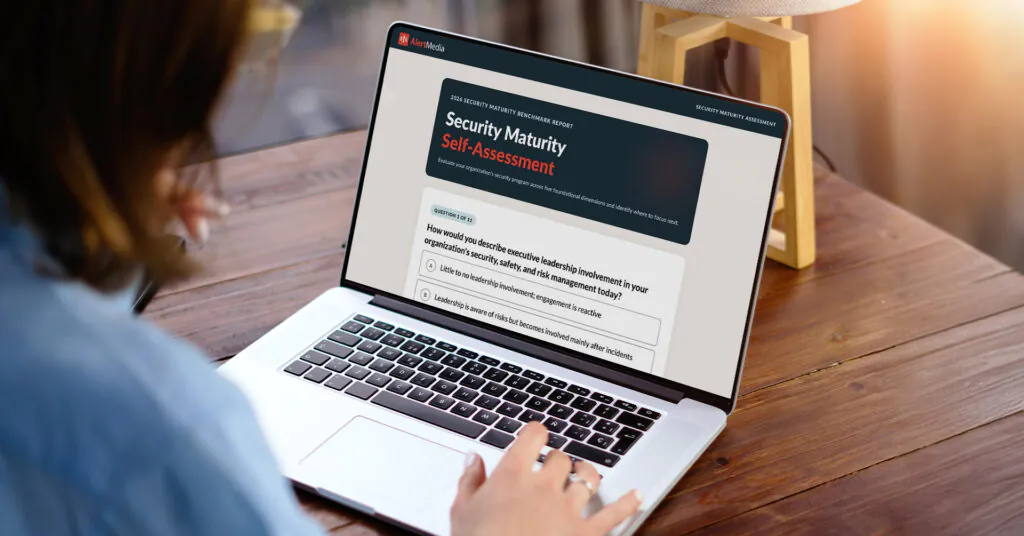
It’s not enough to believe your security program is prepared. You need to know how well it will perform under pressure. That’s a gap highlighted in AlertMedia’s 2026 Security Maturity Benchmark Report. Ninety-two percent of organizations have experienced at least one direct operational consequence related to security readiness. On top of that, 95% identified at least one emerging risk they believe their organization is underestimating or not discussing enough.
A security maturity assessment provides a structured way to uncover weaknesses before an incident occurs. By establishing a baseline across leadership, staffing, processes, technology, and measurement, you can assess where your organization stands today using a standardized security maturity model.
The assessment itself, however, is only the beginning. Its real value comes from turning those findings into a prioritized roadmap for building a more proactive and resilient security program.
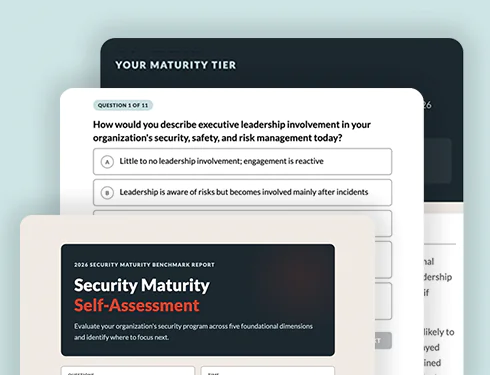
Security Maturity Self-Assessment
Know where your program stands right now and what to focus on next.
What Is a Security Maturity Assessment?
A lot goes into organizational security. People, processes, technology, governance, and measurement practices must work together as a unified system. A security maturity assessment is a structured evaluation of how effectively your organization has developed and coordinated its capabilities and where there is room for improvement.
Unlike a traditional risk or physical security assessment, the primary goal isn’t to identify individual threats or vulnerabilities. Instead, a maturity assessment examines the capabilities your organization has built to anticipate, prepare for, respond to, and learn from threats.
What about cybersecurity maturity assessments?
Cybersecurity maturity is one component of the broader risk picture. A cybersecurity maturity model typically focuses on how effectively an organization protects its information systems, networks, and data, while an organizational security maturity model examines the wider capabilities needed to manage security risks across the business.
Cybersecurity assessments may cover governance and data protection alongside technical capabilities such as firewalls, multi-factor authentication, vulnerability scanning, penetration testing, patch management, and security information and event management (SIEM). Organizations can evaluate these capabilities against established cybersecurity frameworks and standards. The National Institute of Standards and Technology (NIST) Cybersecurity Framework, for example, provides outcomes organizations can use to understand, assess, prioritize, and communicate cybersecurity risk. The Center for Internet Security (CIS) Controls provides prioritized safeguards to reduce common cyber risks, while ISO/IEC 27001 establishes requirements for an information security management system.
Industry and regulatory requirements may add another layer to these assessments. Organizations handling protected health information may evaluate safeguards against HIPAA requirements, organizations processing personal data may consider GDPR obligations, and defense contractors may assess their cybersecurity practices against CMMC requirements.
Evaluating security maturity beyond cyber controls
A broader security maturity assessment considers how these cybersecurity capabilities fit within the organization’s overall risk management. Security maturity assessment questions include:
- Does leadership support a strong security culture?
- Do teams have sufficient resources?
- Does resource allocation reflect organizational priorities?
- Do incident response processes work in practice?
- Do security tools support coordinated action?
- Does security performance connect to business objectives?
For this reason, security maturity assessments complement cybersecurity frameworks rather than replace them. A cybersecurity framework can help determine whether specific controls are sufficiently mature, while a broader assessment can reveal whether the people, processes, technology, and leadership structures surrounding those controls support effective security outcomes.
Corporate security maturity assessments are also distinct from audits. The Security Executive Council describes its corporate security maturity surveys as self-assessment tools rather than audits. Organizations can use the results to identify capability gaps, inform investment and resource allocation decisions, and determine what is required to reach their desired level of maturity.
What a Security Maturity Assessment Evaluate
Most security maturity models, including AlertMedia’s, evaluate enterprise security programs across several interconnected dimensions. Together, these areas reveal whether your program and security controls primarily react to incidents as they occur—or have developed the capabilities to anticipate, prepare for, and respond to emerging threats.
| Leadership oversight | Staffing structure | Incident response processes | Technology integration | Performance measurement |
 Evaluates how effectively senior leaders support security priorities, provide strategic direction, and connect security controls to broader business objectives |  Assesses whether your security team has the roles, expertise, resources, and organizational structure needed to meet current and future security demands |  Examines whether documented incident management plans enable teams to prepare for, respond to, and recover from security incidents effectively |  Measures how effectively security technologies support coordinated workflows, communication, situational awareness, and incident response across the organization |  Assesses whether your organization tracks meaningful security metrics and uses those insights to evaluate performance, demonstrate value, and guide continuous improvement |
1. Leadership and executive engagement
Start by looking at the role leadership plays in your security program. How involved are executives in setting priorities, reviewing performance, and making decisions about security risk?
In an Early-Stage organization, executive involvement may be limited, with leaders becoming directly engaged primarily after an incident or as part of an executive protection plan. As your program matures, that involvement should become more consistent and strategic. At the Optimized level, formal executive sponsorship establishes clear ownership and accountability for security controls.
As you assess leadership oversight, consider questions such as:
- Who owns security risk assessment at the executive level?
- How often does leadership review security performance?
- Are security priorities incorporated into broader business planning?
- Does leadership understand and help define your organization’s risk tolerance?
- Can you connect security investments to outcomes leadership cares about, such as business continuity, compliance, cost avoidance, workforce protection, and reputation?
Pay attention to how your security team and executive leadership define success as well. If your team primarily measures incidents and response activity while executives focus on operational or financial outcomes, the disconnect may extend beyond governance. You may also need better ways to measure security performance and communicate its value to the business.
2. Staffing and team structure
Next, look at whether your team has the capacity and expertise to handle both immediate security demands and the proactive work required to strengthen your program over time.
For many security teams, finding that balance is difficult. AlertMedia’s 2026 report found that 64% of security leaders are being asked to do more with fewer resources, while 59% say their teams are understaffed. The pressure is particularly acute for less mature programs, with 75% of Early-Stage organizations reporting understaffing compared with 44% of Optimized organizations.
When resources are stretched thin, day-to-day incidents can easily take priority over threat intelligence, preparedness planning, continuous monitoring, and other proactive work that could reduce future risk. Your risk assessment should help you determine not only whether you have enough people, but whether those people have the time and expertise to cover the capabilities your organization needs.
Rather than measuring your team against an arbitrary headcount target, map your roles and responsibilities to your security functions. Where does ownership sit today? What happens when the person responsible for a critical function is unavailable? Which responsibilities are routinely pushed aside because more immediate demands take precedence?
Look for single points of failure, responsibilities without a clear owner, and areas where daily incident demands repeatedly displace proactive work. As your program matures, capabilities such as threat intelligence, continuous monitoring, preparedness planning, executive protection, and incident coordination may also require more specialized or dedicated ownership.
This approach gives you a clearer picture of where staffing gaps create operational risk and provides evidence you can use to make the case for additional resources, greater specialization, or changes to your team structure
3. Processes and incident readiness
A documented incident response plan is an important starting point, but your security maturity assessment needs to determine whether people can execute it when an incident occurs. Strong incident response and recovery depend on well-defined security processes that teams understand, practice, and improve over time.
AlertMedia’s 2026 report shows a clear progression in how organizations put their response processes into practice:
- 43% continuously test, refine, and measure their incident response processes against defined performance benchmarks.
- 36% have documented processes that they regularly practice and review.
- 21% still rely on processes that are informal or inconsistently applied.
The gap becomes even more apparent when you compare security maturity levels. Eighty-nine percent of Optimized organizations continuously test and refine their processes against benchmarks, compared with just 8% of Early-Stage organizations.
To understand where your organization falls on that spectrum, look beyond whether procedures exist and examine how they work in practice. Do employees know what to do when an incident occurs? Are decision-making responsibilities clear? Have you tested handoffs between teams? Can you quickly reach affected employees? Do exercises and after-action reviews result in measurable changes to your processes?
This is also where your assessment connects with enterprise security risk management. Effective incident response depends on understanding cyber risk in the context of the broader organization and coordinating the people responsible for managing those risks.
Scenario-based exercises involving security, HR, IT, communications, operations, facilities, and executive stakeholders can expose dependencies and gaps that aren’t apparent when teams evaluate their plans in isolation. After each exercise or real-world incident, document what worked, identify what needs to change, and assign owners to corrective actions in your action plan.
4. Technology integration
A mature technology environment isn’t defined by the number of security tools you own. What matters is whether those tools work together well enough to give your team visibility, share critical information, and support a coordinated response.
Early-Stage programs often depend on fragmented tools and manual workflows. Strategic organizations typically have higher rates of technology adoption but may still require teams to switch between systems or coordinate information manually. At the Optimized level, technology becomes more centralized and automated, allowing information to reach the right people with less manual intervention.
That distinction matters because adding another point solution won’t necessarily solve an integration problem. As part of your baseline assessment, map how information moves through your existing technology environment. Look for places where your team has to manually transfer information, switch between systems, reconcile conflicting data, or repeat work during detection, escalation, communication, and resolution.
For organizations with a security operations center, pay particular attention to how effectively information flows into and out of the SOC. Analysts may have strong tools for detecting and investigating threats, but that information also needs to reach HR, IT, facilities, communications, executives, and other stakeholders when an incident affects the broader organization. A technically sophisticated SOC can still encounter delays if critical information must be manually transferred between disconnected systems or teams.
Ask whether your technology provides the people making decisions with the information they need, when they need it. Can your team move from detecting a threat to understanding who or what is affected? Can they quickly escalate it to the appropriate decision-makers? Can they communicate with affected employees and track the response without piecing together information from multiple systems?
The goal isn’t to produce an inventory of products. It’s to identify where technology supports a faster, more coordinated response and where dis-integrated systems create friction, delays, or visibility gaps.
5. Measurement and performance
Finally, examine what you measure and, just as importantly, who those metrics are intended to serve.
Security teams often focus on operational measures such as threat detection, prevention, technology effectiveness, and response times. Those metrics help you understand how well individual security functions perform. Executive stakeholders, however, may need a different view. They are more likely to evaluate security in terms of business outcomes such as downtime, financial exposure, compliance, workforce safety, and cost efficiency.
A mature measurement practice connects the two. Early-Stage programs may track only basic metrics or collect data inconsistently. Strategic programs establish repeatable operational measures and monitor performance over time. Optimized organizations go further by connecting security KPIs and service-level expectations to business outcomes.
As part of your assessment, determine whether you have measurable KPIs for both preparedness and response and whether those metrics provide information that leadership can actually use to make decisions. Depending on your program, that might include:
- Incident detection and response times
- Employee acknowledgment rates during emergency communications
- Exercise participation and performance
- Completion of corrective actions identified during after-action reviews
- Downtime or operational disruption caused by security incidents
- Compliance performance
- Financial exposure and cost avoidance
Don’t limit measurement to what happens after an incident. Leading indicators can help you understand how prepared your organization is before something goes wrong. For example, training completion rates, employee reporting behavior, and knowledge gaps can help you evaluate physical security awareness and identify where employees may need additional guidance to recognize and respond to potential threats.
The goal is to build a set of metrics that tells you both how your security program is performing today and whether it is becoming more prepared over time. When you can connect operational performance to continuity, workforce safety, financial impact, and other business priorities, your metrics become useful evidence for decisions about security strategy and investment.
How to Conduct a Security Maturity Assessment
Once you’ve defined what you’re evaluating, you can begin the assessment itself. The goal is to establish an accurate picture of your current state, identify meaningful gaps, and determine where to focus your efforts next.
In an episode of The Employee Safety Podcast, Chad Bosquez, Head of Physical Security at Chime, discussed the importance of regularly assessing your security program as new risks, technologies, and organizational needs emerge.
Get his full insights below, then follow these steps to conduct your own security maturity assessment.
Start with leadership conversations
Begin by understanding what the organization expects from security.
Talk with executive stakeholders about the business objectives the security function supports, the risks they consider most significant, and what an acceptable level of risk looks like. One way to start that conversation is with a simple question: What keeps you up at night?
That’s an approach Chad Bosquez uses when setting security priorities. He asks executives what concerns them most from a physical security perspective, including whether they feel safe entering the office, working onsite, and traveling. Their answers help him understand where leadership sees risk and what they expect the security program to address.
Take the conversation further by asking what they would consider a successful response to a major incident. Is the priority avoiding downtime? Protecting employees? Maintaining customer confidence? Meeting compliance requirements? Reducing financial exposure?
Stakeholder input provides context for the rest of the assessment and helps you evaluate maturity relative to the capabilities your organization actually needs.
Leadership conversations can also surface risks that haven’t made their way into formal security planning. With 95% of security leaders identifying at least one under-discussed emerging risk in AlertMedia’s benchmark research, these conversations provide an important opportunity to identify potential blind spots.
Map your current state across the five dimensions
Next, document your current capabilities across leadership, staffing, processes, technology, and measurement. At this stage, focus on what you can demonstrate about your program today.
Evidence matters. If your organization conducts regular exercises, review when the last one occurred, who participated, what gaps emerged, and what changed afterward. If a process is documented, determine whether employees consistently follow it. If you have continuous monitoring capabilities, establish who monitors them, when they’re monitored, and what happens when the system identifies a threat.
Apply the same scrutiny to leadership and staffing. Look for recurring security reviews, documented accountability, budget participation, and security KPIs included in leadership reporting. Review whether critical responsibilities have clear owners and whether your team has sufficient capacity to perform them consistently.
This type of review can also help you uncover the operational gaps that deserve attention. Bosquez, for example, uses his regular assessments at Chime to examine current challenges, identify gaps, and consider changes that could improve security operations.
Once you’ve gathered the evidence, use a consistent maturity scale to establish a baseline for each dimension. AlertMedia’s model divides security programs into three tiers:
- Early-Stage: Reactive executive engagement, lean teams, inconsistent processes, fragmented technology, and basic performance tracking.
- Strategic: Stronger leadership participation, dedicated security personnel, documented procedures, partial technology integration, and consistent operational measurement.
- Optimized: Formal executive accountability, specialized teams, continuously tested processes, integrated technology, and measurement tied to organizational outcomes.
Your results may vary considerably across the five dimensions. For example, a program with Optimized technology and Early-Stage processes may need to focus on how people use existing systems rather than investing in additional technology. A program with strong processes but limited staffing may have a very different set of priorities.
Those differences are exactly what your baseline should reveal. They show you where maturity is uneven and give you a starting point for deciding which improvements will have the greatest impact.
Identify gaps, not just problems
A list of things your security team would like to improve won’t give you a useful gap analysis. You need to define the gap between the capabilities you have today and those your organization needs, based on its risks, responsibilities, and business objectives.
For each gap you identify, document:
| Current state | What capabilities exist today, and how well does it perform? |
| Desired state | What level of capability does your organization need? |
| Evidence | What data, observations, or assessment findings support your conclusion? |
| Risk | What operational or business impact could the gap create? |
| Dependency | What people, processes, technology, or resources are required to close it? |
Be specific about the capabilities that are missing or underdeveloped. For example, “We need more security analysts” describes a resource request. “We have no dedicated owner for threat monitoring outside business hours, creating an eight-hour visibility gap” defines the capability gap, when it occurs, and the risk it creates.
That level of detail also makes the next step easier. You can compare gaps based on their potential impact, urgency, and the resources required to address them, giving you a stronger basis for deciding what should take priority.
Benchmark your performance against peers
Once you understand your current maturity level, compare your results with those of organizations facing similar security challenges. Benchmark data gives you context for interpreting your scores and setting realistic priorities.
For example, your assessment might show that incident response processes need improvement. Knowing that 89% of Optimized programs continuously test and refine their processes against defined benchmarks gives you a clearer picture of what a more mature capability looks like.
Bosquez recommends looking beyond formal benchmark data as well. He encourages security leaders to connect with peers and learn how other organizations approach similar challenges, whether those organizations have 1,800 or 18,000 employees. Those conversations can give you practical context for evaluating your own capabilities and identifying approaches worth considering.
Use those comparisons to inform your assessment while keeping your own risk profile, responsibilities, and operational requirements at the center of your decisions. A common industry challenge may still require immediate attention in your organization, while a capability that’s standard among peers may carry less importance for your particular risk profile.
Benchmarking gives you another point of reference for deciding where your program stands and where improvement will have the greatest impact.
Build a roadmap from your people, processes, and technology
Turn your assessment findings into a prioritized roadmap for improving your security program. Start with the gaps that create the greatest risk, then consider how improvements across your people, processes, and technology can support progress in other areas.
For example, strengthening the people side of your program through formal executive sponsorship can make it easier to secure resources, while clear roles and responsibilities establish ownership for incident exercises and corrective actions. Improving processes can help teams respond more consistently and turn lessons from exercises into measurable improvements. Better technology integration can give those teams the visibility and data they need to coordinate response and strengthen performance measurement.
AlertMedia’s research reinforces these connections. Progress across the five maturity dimensions is cumulative, with stronger capabilities in one area helping support advancement in others. Your roadmap should account for those dependencies when determining what to address first.
For each priority, establish:
| Owner | Who is accountable for moving it forward? |
| Actions | What specifically needs to change? |
| Target date | When should the improvement be completed? |
| Success measure | How will you know the change worked? |
| Review cadence | When will you evaluate progress? |
Keep the roadmap manageable by focusing first on the improvements across people, processes, and technology that will have the greatest impact on your security posture. Then use future assessments to measure progress, identify remaining gaps, and set the next round of priorities.
This creates a continuous improvement cycle in which each assessment gives you evidence to guide the next stage of your security program.
How often should you assess security maturity?
A six-month assessment cycle can provide a useful starting point for keeping your security maturity baseline up to date.
Chad Bosquez, Head of Physical Security at Chime, told The Employee Safety Podcast that he assesses his program about every six months, using those reviews to identify new challenges, gaps, and technologies that could improve operations.
Your assessment schedule should also reflect changes within your organization. Major incidents, acquisitions, rapid growth, leadership changes, new workplace models, or significant technology implementations can all prompt a reassessment of affected capabilities sooner. These interim reviews can focus on the areas most affected by the change, while a regular comprehensive assessment provides a consistent baseline for measuring progress over time.
What to Do With Your Security Maturity Assessment Results
Your assessment gives you a baseline. Now use it to decide where to focus your resources and demonstrate why those priorities matter to the business.
Translate your most significant gaps into their potential impact on security convergence. An untested incident response process could increase response times or disrupt business continuity. Fragmented technology could delay communication or create visibility gaps. Limited staffing could leave critical functions without adequate coverage.
Then prioritize improvements based on risk, impact, and dependency. Early-Stage organizations may need to establish clearer ownership and core processes, while Strategic programs may focus on testing, integration, and measurement. Optimized programs can continue refining automation, cross-functional preparedness, and their approach to emerging risks.
Keep your original results as a baseline and return to them during future assessments. Comparing results over time will show where investments are improving security performance and where additional attention is still needed.
Know Where Your Program Stands With the Security Maturity Self-Assessment
Assess Your Security Controls and Maturity
See how your security program performs across leadership, staffing, processes, technology, and measurement with AlertMedia’s Security Maturity Assessment. Get your maturity score, identify your most important gaps, and compare your results with benchmark data from 501 senior security decision-makers.
Security Maturity Self-Assessment
Know where your program stands right now and what to focus on next.

AlertMedia, Risk Intelligence and Response