
By Rebecca Reinhardt, Sr. Product Marketing Manager at AlertMedia

Safety and Security Jul 24, 2026
What Is the ROI of Travel Risk Management Programs?
Travel Risk Management Key Feature Guide
Explore how AlertMedia can help keep your travelers informed and out of harm’s way.
Table of Contents
The ROI of travel risk management programs comes from avoiding the high cost of unmanaged travel incidents while reducing the manual effort of tracking travelers and meeting duty of care obligations. Travel risk management gives security, business continuity, and HR teams the visibility to prepare travelers before a trip, monitor them during it, and respond quickly if something goes wrong. For organizations with employees who cross borders regularly, the program is worth its cost because a single unaddressed travel incident almost always outweighs the cost of prevention—in human, financial, and reputational terms.
This page explains how to think about that ROI, why it matters, what a strong program includes, and how organizations can structure travel risk management to demonstrate clear, measurable value.
 AlertMedia Travel Risk Management
Why ROI Matters for Travel Risk Management
Avoided incident costs
The clearest ROI driver is cost avoidance. A delayed evacuation, a missed itinerary change, or a traveler who can’t be located during a localized threat all carry direct costs, from emergency logistics to lost productivity to potential liability. A program that closes these gaps converts a reactive expense into a predictable, smaller, ongoing investment.
Stronger duty of care compliance
Organizations with traveling employees carry a legal duty of care to keep them safe. A documented, auditable travel risk process reduces legal exposure and gives security and HR leaders evidence that the organization met its obligations, which has real value even before an incident occurs.
A force multiplier for lean teams
Manually tracking itineraries, monitoring destination conditions, and checking in with travelers does not scale as travel volume grows. Automating these steps lets a small team cover a much larger traveling population without adding headcount, which is where a meaningful share of the ROI shows up with a travel risk management solution.
Faster, more coordinated response
When a threat does emerge, response speed determines outcomes. When program leaders already know who is traveling where—and are prepared to reach those people instantly—they shorten the time between a threat appearing and a traveler being warned or assisted, reducing both the severity and the cost of the incident.
Travel Risk Management Key Feature Guide
Explore how AlertMedia can help keep your travelers informed and out of harm’s way.
Key Components of a Travel Risk Management Program
Most effective travel risk management programs share a common set of components, regardless of vendor. The table below outlines what to look for.
| Component | What It Means | Why It Matters |
|---|---|---|
| Integrated travel data | Itineraries sync automatically from existing travel booking systems. | Eliminates manual data entry and keeps trip details current. |
| Pre-trip travel briefings | Country- and city-level safety information delivered ahead of departure. | Prepares travelers and reduces the likelihood of preventable incidents. |
| Destination risk ratings | A standardized scale for rating the risk level of a destination. | Gives decision-makers a fast, consistent way to assess exposure. |
| Real-time traveler monitoring | Location visibility based on itinerary data and, optionally, mobile app tracking. | Enables a faster, more informed response when conditions change. |
| Localized threat alerting | Automatic notifications tied to a traveler’s current or upcoming location. | Shortens the gap between a threat emerging and a traveler being warned. |
| Two-way communication | A channel travelers can use to request help at any time. | Speeds assistance and keeps travelers connected even when they’re remote. |
| Human-curated, analyst-verified intelligence | Safety and risk content reviewed by trained travel security analysts rather than raw, unfiltered data feeds. | Reduces noise and gives travelers and administrators information they can act on with confidence. |
| Reporting and analytics | Visibility into past, active, and upcoming trips across the organization. | Supports budget justification, audits, and ongoing program improvement. |
How Travel Risk Management Programs Work
1. Sync travel data automatically
Itineraries are pulled in automatically from existing travel booking systems, so the program always has a current picture of who is traveling, where, and when, without manual entry.
2. Brief travelers ahead of the trip
Before departure, travelers receive a destination-specific briefing covering safety conditions, local culture, company-specific procedures, and emergency contacts, curated by travel security analysts rather than generated automatically.
3. Monitor location and risk in real time
During the trip, the program tracks active and upcoming travel against current destination risk, using itinerary data and, where enabled, mobile app location.
4. Alert travelers and staff to localized threats
When a relevant threat emerges near a traveler’s location, the program automatically notifies the traveler, safety staff, or both, depending on how the organization has configured it.
5. Communicate two-way during an incident
Travelers can reach safety staff directly to request help, and staff can reach travelers across multiple channels, keeping communication open in both directions throughout the incident.
6. Report on program activity and outcomes
Ongoing reporting on past, active, and upcoming trips gives leadership the visibility needed to demonstrate program value, support audits, and identify where coverage gaps remain.
Best Practices for Maximizing Travel Risk Management ROI
- Define a single source of truth for traveler location before an incident happens, not during one.
- Sync itinerary data continuously rather than relying on manual updates from travelers or admins.
- Set a consistent risk rating scale so decision-makers across the organization assess exposure the same way.
- Brief travelers before every trip, not only for travel to high-risk destinations.
- Use multiple communication channels in parallel so travelers can be reached regardless of circumstance.
- Segment travelers by destination and role so alerts reach the right people without unnecessary noise.
- Review program reporting on a regular cadence to catch coverage gaps before they become incidents.
- Treat travel risk management as a continuous program, not a one-time setup.
Common Challenges and How to Address Them
| Challenges | Why It Happens | How to Address It |
|---|---|---|
| Itinerary data lives in disconnected systems | Travel bookings, expense tools, and HR systems aren’t integrated. | Use integrated travel data syncing so itineraries flow automatically into the program. |
| Travelers ignore generic safety information | Briefings feel boilerplate rather than relevant to the specific trip. | Provide destination-specific, analyst-curated briefings travelers actually read. |
| Security teams can’t keep pace with travel volume | Manual tracking and outreach don’t scale as the traveling population grows. | Automate monitoring and alerting so a small team can cover a much larger group. |
| Travelers in distress can’t reach help quickly | Communication relies on a single channel or a separate app from the briefing tool. | Build two-way communication into the same workflow travelers already use for briefings and alerts. |
How AlertMedia Approaches Travel Risk Management
AlertMedia is the industry’s only unified Risk Intelligence and Response Platform, and Travel Risk Management runs on that same platform rather than as a separate, bolted-on point tool. That means travel risk shares the same monitoring, communication, and reporting infrastructure used across every other risk type an organization manages.
| Platform Need | How AlertMedia Helps |
|---|---|
| Keep itinerary data current without manual work | Integrated travel data automatically syncs itineraries from any travel system, including flights, hotels, and trip details. |
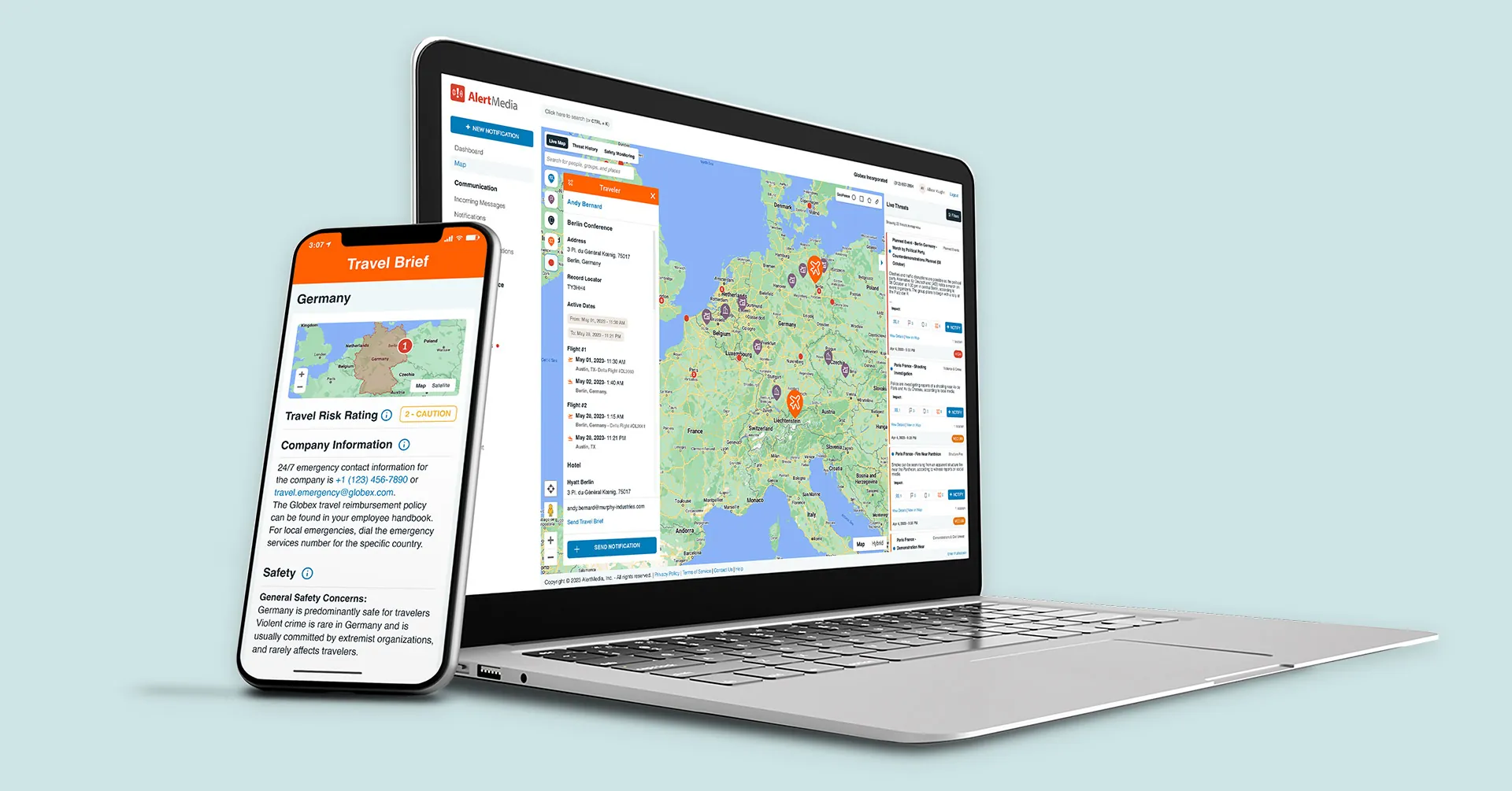
| Prepare travelers before they leave | Travel Briefs deliver expert-curated, destination-specific safety information, including a 4-tier Travel Risk Rating, company-specific procedures, local culture and customs, and emergency contacts. |
| See where travelers are during a trip | Traveler monitoring combines itinerary-based tracking with optional mobile app location monitoring for dynamic visibility throughout the trip. |
| Get ahead of emerging threats | Localized threat alerts automatically notify impacted travelers or safety staff the moment a relevant threat appears near an active or upcoming travel location. |
| Reach travelers and let them request help | Two-way communication lets travel safety teams engage any traveler instantly and lets travelers request help at any time. |
| Demonstrate program value over time | Simple, robust reporting tracks past, active, and upcoming trips so safety teams can keep a pulse on travel activity and report on outcomes. |
Analyst-verified, not just automated
AlertMedia’s Travel Briefs are curated by travel security analysts with backgrounds spanning military intelligence, global security operations centers, private security, and national news media. That human review is what separates a usable briefing from a raw data feed, and it’s a meaningful part of what travelers and admins are actually paying for when they calculate program ROI.
Organizations using AlertMedia for travel risk management protect employees traveling in 320+ countries. One customer, ETS, reported that automatic itinerary syncing removed the manual burden of tracking staff traveling globally:
“We have a lot of people who travel around the globe, and it’s very comforting for them and for me to know that when their itinerary is created, it’s automatically loaded into AlertMedia.” —Tim Mathews, Executive Director.
Keep your travelers out of harm's way with AlertMedia's Travel Risk Management.
Frequently Asked Questions
- What is the ROI of travel risk management programs? The ROI comes primarily from avoided incident costs, reduced manual workload for security and HR teams, and stronger duty of care compliance. Organizations typically see the clearest return when comparing the ongoing cost of a program against the financial, operational, and reputational cost of even one unmanaged travel incident.
- How is travel risk management different from a travel management system (TMS)? A travel management system handles bookings, expenses, and logistics. Travel risk management focuses on traveler safety: monitoring destination risk, briefing travelers, and alerting them to threats. The two are complementary, and travel risk management programs typically integrate with existing TMS data rather than replacing it.
- What capabilities should a travel risk management program include to maximize ROI? Look for integrated travel data syncing, destination-specific pre-trip briefings, a standardized risk rating scale, real-time traveler monitoring, localized threat alerting, two-way communication, and ongoing reporting. Programs missing automation in any of these areas tend to shift cost back onto manual staff time.
- Who is responsible for travel risk management within an organization? Ownership typically sits with corporate security or business continuity and operational resilience teams, often with HR involved as a secondary stakeholder for duty of care and employee communication. Larger organizations may have a dedicated travel safety function within security.
- How does travel risk management reduce the workload on lean security teams? Automating itinerary syncing, briefing delivery, and threat alerting removes the manual tracking work that otherwise falls on security staff as travel volume grows. This lets a small team maintain coverage across a much larger traveling population without adding headcount.
- How does human-curated intelligence change what a travel risk program can deliver? Raw threat data requires interpretation before it’s useful to a traveler. Programs that route destination information through trained analysts, rather than delivering unfiltered feeds, produce briefings travelers can act on directly, which improves both safety outcomes and traveler adoption.
- How does AlertMedia’s travel risk management program work? AlertMedia syncs traveler itineraries automatically, delivers analyst-curated Travel Briefs ahead of each trip, monitors traveler location and destination risk in real time, sends localized threat alerts, and supports two-way communication so travelers can request help at any time, all from the same platform used for an organization’s broader risk intelligence and response program.
Travel Risk Management Key Feature Guide
Explore how AlertMedia can help keep your travelers informed and out of harm’s way.