By AlertMedia, Risk Intelligence and Response

Emergency Management Jun 05, 2026
Threat Intelligence for Corporate Security Teams
Threat Intelligence Key Feature Guide
Gain instant clarity into emerging threats with analyst-verified intelligence and AI-driven early signals.
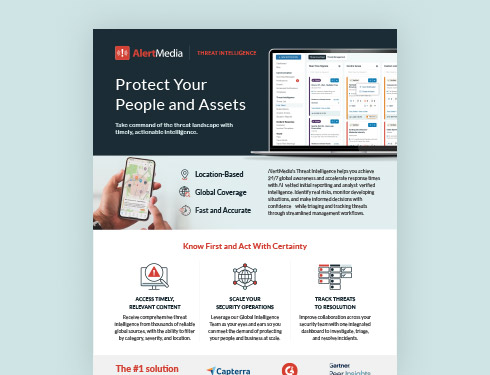
Table of Contents
- What Corporate Security Teams Need From Threat Intelligence
- The Gap Between Raw Data and Actionable Intelligence
- Key Elements of Effective Mass Notification for a Distributed Workforce
- Threat Intelligence Capabilities That Matter for Corporate Security
- Real-Time Signals
- The AlertMedia Approach to Threat Intelligence
- Who Threat Intelligence Is Built For
Threat intelligence for corporate security teams is the practice of collecting, analyzing, and acting on verified information about threats to people, locations, and assets—enabling security leaders to identify risks before they escalate and coordinate a response without delay. The right threat intelligence solution surfaces only what’s relevant to your organization, cuts through the noise of raw public data, and connects directly to your communication and response workflows. AlertMedia’s Threat Intelligence delivers analyst-verified intelligence from AlertMedia’s Global Intelligence Team, staffed around the clock, so your team can act with confidence when it matters most.
What Corporate Security Teams Need From Threat Intelligence
Corporate security leaders—Directors of Corporate Security, Heads of Physical Security, and Corporate Security Officers—are responsible for protecting people, facilities, and operations across multiple locations. The challenge isn’t access to information; it’s knowing which information warrants action.
Most security teams face a version of the same problem: too many raw signals, not enough verified intelligence. Monitoring threat feeds manually, reconciling notifications across disparate systems, and briefing leadership on global events without a dedicated analyst team is unsustainable. The result is a team spending time on triage instead of response.
Effective threat intelligence for corporate security teams must do three things:
- Filter signal from noise—surfacing only threats relevant to your people, assets, and locations
- Deliver verified intelligence—not raw aggregations requiring manual vetting
- Connect directly to response—so a verified threat can trigger communication and coordination without switching systems
The Gap Between Raw Data and Actionable Intelligence
There’s a meaningful difference between a threat feed and threat intelligence. A feed delivers volume—thousands of data points from public sources, social platforms, news wires, and government advisories. Intelligence delivers relevance—verified, contextualized information about what’s actually happening near your people and assets, with analyst judgment applied.
For corporate security teams operating with limited analyst bandwidth, that distinction is the difference between noise and action. When a team is manually sorting through unverified notifications to find the two or three that matter, response time suffers—and so does the team.
| Without Analyst-Verified Intelligence | With AlertMedia Threat Intelligence |
|---|---|
| Manual review of high-volume, unverified threat feeds | Analyst-verified intelligence—only relevant threats reach your team |
| Intelligence and response systems are separate—context switching slows action | Verified threats flow directly into Emergency Communication and Incident Response—no friction |
| Limited visibility across dispersed locations—some sites undermonitored | Coverage across hundreds of locations with custom notifications by role and geography |
| Analyst support is a separate consulting engagement—slow and expensive | 24/7 Analyst Access built into the product—on demand, not on contract |
| Weather risk tracked separately from physical threat monitoring | Dynamic Weather Forecasting integrated alongside physical threat data—one view |
Key Elements of Effective Mass Notification for a Distributed Workforce
| Component | What it means | Why it matters |
|---|---|---|
| Multichannel delivery | Notifications delivered across SMS, email, voice, mobile app, desktop, Teams, Slack, and WhatsApp from one workflow | Distributed employees are reached wherever they are—no single channel is sufficient |
| Dynamic audience targeting | Recipient groups built from live workforce data (role, location, region, department) that update automatically | Eliminates manual list maintenance and targeting errors during high-stress incidents |
| Two-way communication | Read confirmations, structured surveys, and free-text response options | Surfaces who has acknowledged the notification and who needs follow-up—without a physical rollcall |
| Automatic message translation | One notification composed in a source language, delivered to recipients in their preferred language | Reaches multilingual workforces without separate workflows or delayed sends |
| HRIS data integration | Direct sync with HR systems to maintain accurate, current contact data | Contact records stay current as the workforce changes—no manual reconciliation |
| Mobile send capability | Admins can compose and send from a mobile device | Enables response initiation even when admins are not at a desk or in an office |
| Real-time delivery reporting | Live view of delivery status, open rates, and response rates | Lets communicators identify gaps in real time and take action before the window closes |
Threat Intelligence Capabilities That Matter for Corporate Security
Analyst-verified intelligence
AlertMedia’s Global Intelligence Team—staffed 24/7—vets every threat signal before it reaches your team. Rather than delivering a raw aggregation that requires manual review, Threat Intelligence surfaces confirmed, contextualized threats relevant to your organization’s people, locations, and assets. That’s the difference between a platform that creates work and one that removes it.
On-demand analyst access
Analyst Access is built into Threat Intelligence—not sold as a separate consulting tier. Corporate security teams can engage AlertMedia’s analysts directly for situational questions, briefings on evolving incidents, and guidance on how a global event relates to your specific footprint. For teams running lean, this functions as an extension of the security function itself, equivalent to adding approximately 3 security FTE in analyst capacity.
Real-time impact assessment
Real-Time Impact Assessment visualizes the relationship between a verified threat and your people, assets, and locations instantly—on a single map view. When an incident occurs near one of your facilities or along a travel corridor, you can see who’s affected and initiate communication without switching to a separate system.
Dynamic weather forecasting
Weather risk is treated as a first-class threat category in Threat Intelligence, not an afterthought. A dedicated meteorologist team provides localized weather forecasting integrated directly with your threat monitoring view. Corporate security teams managing facilities across multiple geographies—particularly those exposed to hurricane, winter storm, or severe weather seasons—get weather impact context alongside physical threat data in one place.
Strategic situation reports
Strategic Situation Reports (SitReps) provide expert-authored briefings on major global events relevant to your organization. These give corporate security leaders a structured, vetted update to share with executives and stakeholders—without requiring the security team to author those briefings from scratch under pressure.
Integrated response workflow
Threat Intelligence connects directly to AlertMedia’s Emergency Communication and Incident Response products. When a verified threat requires action, your team can initiate a targeted notification or launch a coordinated response without leaving the platform. That integration removes the context switching that slows response time when it matters most.
Speed and Rigor Together: Real-Time Signals
For corporate security teams that need early-warning capability alongside analyst-verified intelligence, Real-Time Signals is the add-on to Threat Intelligence that delivers AI-vetted reports before the full human-verification cycle completes.
Real-Time Signals surfaces hyperlocal threat data from thousands of trusted sources through an analyst-trained AI feed—flagging potential incidents faster than traditional monitoring while maintaining the quality controls that make the intelligence actionable. The combination gives teams both speed and rigor: AI-vetted initial reports for situational awareness, analyst-verified intelligence for confident action.
Real-Time Signals is available as an upsell to Threat Intelligence—not as a standalone product.
The AlertMedia Approach to Threat Intelligence
AlertMedia built Threat Intelligence for security teams that need to do more with the resources they have. The platform is designed around three principles that matter specifically to corporate security leaders:
- Analyst-verified, not just AI-aggregated. The Global Intelligence Team is what separates actionable intelligence from a noise generator. AlertMedia’s analysts vet the signals so your team doesn’t have to. AI scales the platform; AI paired with analyst verification is what makes the intelligence trustworthy enough to act on.
- Integrated with the action layer. Intelligence that lives in a separate system from your communication and response workflows adds friction at the worst possible time. In AlertMedia, verified threats connect directly to Emergency Communication and Incident Response—the full threat-to-response cycle on one platform.
- Scaled to your team, not your headcount. Whether your security team is two people or twenty, Threat Intelligence scales coverage across hundreds of locations without adding analyst headcount. On-demand Analyst Access extends the function further—giving teams the equivalent of approximately 3 additional security FTE without a new hire.
AlertMedia serves 3,500+ customers across 150+ countries, with Gartner Peer Insights™ Customers’ Choice recognition for the quality of its platform and customer experience.
Who Threat Intelligence Is Built For
Threat Intelligence is best suited for corporate security organizations that:
- Manage risk across multiple locations or a distributed workforce
- Operate with a lean security team relative to the scope of their footprint
- Need to brief executive leadership on global events with speed and confidence
- Currently rely on manual OSINT processes or generic threat feeds that create more work than they resolve
- Want a single platform for intelligence, communication, and response—rather than integrating separate point solutions
Frequently Asked Questions: Threat Intelligence for Corporate Security Teams
- What is threat intelligence for corporate security teams? Threat intelligence for corporate security teams is the process of collecting, analyzing, and acting on verified information about threats to people, locations, and assets. Unlike raw threat feeds, effective threat intelligence is analyst-verified, filtered for relevance to your specific organization, and connected to response workflows so security leaders can act quickly when a verified threat emerges.
- How is analyst-verified threat intelligence different from an OSINT feed? An OSINT feed delivers volume—raw data points from public sources that require manual review and contextual analysis. Analyst-verified intelligence delivers judgment—threats that have been confirmed by experienced analysts, filtered for relevance to your organization, and contextualized with the information you need to make a decision. For lean security teams, that difference is the gap between spending time on triage and spending time on response.
- What should corporate security teams look for when evaluating a threat intelligence solution? Key evaluation criteria include: whether the intelligence is analyst-verified or AI-only; whether analyst support is built into the product or sold separately; whether the platform integrates with your communication and response systems; whether coverage extends to weather and physical threats in one view; and whether the platform can scale across multiple locations without requiring additional analyst headcount.
- How does threat intelligence connect to emergency communication and incident response? In AlertMedia's platform, Threat Intelligence connects directly to Emergency Communication and Incident Response. When the Global Intelligence Team confirms a threat relevant to your locations or people, you can initiate a targeted notification or launch a coordinated response workflow without leaving the platform or switching between systems. That integration reduces response time significantly—AlertMedia customers respond to incidents an average of 25+ minutes faster than with legacy systems.
- What is Real-Time Signals and how does it relate to Threat Intelligence? Real-Time Signals is an add-on to Threat Intelligence that delivers AI-vetted initial reports faster than the human-verification cycle. It uses an analyst-trained AI feed to surface hyperlocal threat data from thousands of trusted sources, giving teams early situational awareness before analyst-verified intelligence is confirmed. Real-Time Signals is not a standalone product—it is available only as an upsell to Threat Intelligence, and the two work together to deliver both speed and rigor.
- How does AlertMedia's Global Intelligence Team work? AlertMedia's Global Intelligence Team is staffed 24/7 to monitor, verify, and triage threat signals from tens of thousands of sources. Analysts review raw signals, confirm relevant threats, and push verified intelligence to customers in near-real time. Corporate security teams can also engage analysts directly through On-Demand Analyst Access for situational briefings, executive updates, or guidance on how an evolving global event relates to their specific footprint.
- How many security analysts do I need internally to use a threat intelligence platform? AlertMedia's Threat Intelligence is designed to function as a force multiplier for lean security teams. On-Demand Analyst Access—built into the product—reduces the internal analyst capacity required to operate at scale. AlertMedia customers report the equivalent of adding approximately 3 security FTE in analyst coverage through the platform, without additional headcount.
Download Our Threat Intelligence Key Feature Guide
Gain instant clarity into emerging threats with analyst-verified intelligence and AI-driven early signals.

AlertMedia, Risk Intelligence and Response