
By AlertMedia, Risk Intelligence and Response

Safety and Security Jul 28, 2026
Social Media Intelligence Tools for Corporate Security
Social Intelligence Key Feature Guide
Track trends, sentiment, and narratives online so you can proactively protect your people and organization.
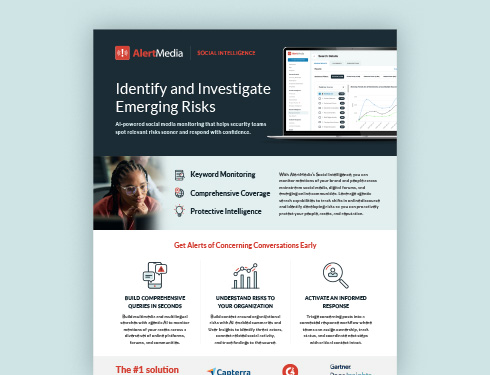
Table of Contents
- Why Corporate Security Teams Need More Than Social Listening
- The Challenges Corporate Security Teams Face
- What to Look for in Social Media Intelligence Tools for Corporate Security
- How AlertMedia Helps Corporate Security Teams Scale Monitoring
- What Corporate Security Teams Can Achieve With AlertMedia
- How Social Media Intelligence Supports a Proactive Security Program
Social media intelligence tools for corporate security help teams detect, investigate, and respond to emerging risks across online sources. Unlike platforms designed primarily for brand monitoring or campaign analysis, security-focused tools help teams identify conversations that may affect employees, executives, facilities, events, and business operations.
For corporate security leaders, the challenge is not simply collecting more mentions. It is finding the small number of signals that may indicate a developing physical security threat—and doing so across a fragmented mix of mainstream social platforms, fringe forums, and dark web sources.
AlertMedia Social Intelligence brings these capabilities together in one solution. Agentic AI search helps teams build complex, multimedia, and multilingual searches without advanced Boolean expertise. Alert subscriptions surface relevant activity as it develops. AI-powered sentiment analysis and narrative tracking provide context about how conversations are changing over time. When a potential threat requires action, teams can move directly into AlertMedia Incident Response and Emergency Communication workflows.
Social Intelligence Key Feature Guide
Track trends, sentiment, and narratives online so you can proactively protect your people and organization.
Why Corporate Security Teams Need More Than Social Listening
Most social listening platforms are built for marketing teams. They help organizations measure brand awareness, track campaign performance, and analyze consumer sentiment.
Corporate security teams have a different objective. They need to identify online activity that may signal a threat to people, places, or operations.
That distinction changes what teams should expect from a social media intelligence tool. A security-focused platform should help analysts:
- Monitor a broad range of online sources
- Build targeted searches without extensive query-writing expertise
- Detect shifts in tone or narrative
- Identify individuals or conversations that warrant investigation
- Receive alerts without continuously watching a dashboard
- Move a confirmed threat into an established response workflow
Without these capabilities, security teams may spend hours searching individual platforms, reviewing irrelevant mentions, and manually connecting online activity with physical-world risk.
The Challenges Corporate Security Teams Face
Corporate security teams are often responsible for monitoring a large and dispersed risk environment with limited analyst resources. A small intelligence team may need to watch hundreds of facilities, executives, events, and business activities across multiple regions.
Relevant conversations can emerge almost anywhere. A threat may begin on a mainstream social platform, move into a fringe community, and intensify across several sources. Searching each environment manually makes it difficult to maintain consistent coverage.
Teams may also face technical barriers. Building effective Boolean queries across multiple languages, content types, and platforms requires specialized expertise. Even when analysts find relevant activity, they must still determine whether it represents a meaningful security concern or background noise.
The right social media intelligence tools help teams expand their coverage without requiring them to expand their workforce at the same rate.
What to Look for in Social Media Intelligence Tools for Corporate Security
Corporate security leaders should evaluate tools based on how well they support the team’s actual intelligence and response workflow—not simply on how many mentions they collect.
| Corporate security challenge | Capability to look for | Practical outcome |
| A small intelligence team performs manual searches across multiple platforms. | Agentic AI search and an AI-Assisted Search Builder. | Broader monitoring without requiring advanced Boolean expertise. |
| Relevant activity can appear across mainstream and hard-to-monitor sources. | Coverage across social platforms, fringe forums, and dark web sources. | Greater visibility into where security-relevant conversations may originate. |
| Analysts struggle to determine which conversations deserve attention. | AI-powered sentiment analysis and narrative tracking. | More context about tone, escalation, and changes in a conversation. |
| Staff must repeatedly check dashboards for new activity. | Configurable alert subscriptions. | Timely notification when monitored topics or conditions produce relevant results. |
| A person of concern must be investigated across disconnected accounts or sources. | People of interest exploration with direct source links. | A more connected view of an individual’s relevant public online activity. |
| Confirmed threats must be transferred into a different response platform. | Integration with Incident Response and Emergency Communication. | A more direct path from investigation to coordinated action. |
Broad and relevant source coverage
Threats do not always emerge on the largest or easiest-to-search platforms. Corporate security teams should look for tools that monitor mainstream social media as well as fringe forums and dark web sources.
Broad coverage helps teams investigate risks across the environments where relevant conversations may begin, spread, or escalate. It also reduces the need to use separate tools for different source types.
AlertMedia Social Intelligence analyzes more than 15 million records each day across more than 65 social platforms, fringe forums, and dark web sources.
Search without advanced Boolean expertise
Traditional social media monitoring often depends on analysts manually constructing detailed Boolean searches. These queries can become difficult to manage when they must account for alternative spellings, multiple languages, images, video, slang, and changing narratives.
AlertMedia’s agentic AI search and AI-Assisted Search Builder help teams create comprehensive, multimedia, and multilingual searches using natural-language inputs. This allows analysts to build and refine monitoring queries without writing every Boolean condition manually.
The technology does not replace analyst judgment. It helps analysts spend less time constructing searches and more time reviewing and investigating relevant results.
Sentiment and narrative analysis
A high mention count does not necessarily indicate a security threat. A smaller conversation that becomes increasingly hostile or specific may be more important than a large volume of neutral commentary.
AI-powered sentiment analysis helps teams evaluate the tone associated with monitored topics. Narrative tracking provides additional context by showing how conversations, themes, and language develop over time.
These capabilities can help analysts recognize escalation patterns and prioritize conversations that warrant closer review. Sentiment should be treated as one investigative signal—not as a standalone determination that a threat is credible.
Automated alert subscriptions
A social intelligence platform should not require analysts to continuously monitor a dashboard for updates.
Alert subscriptions allow teams to receive notifications when saved searches identify relevant activity. This helps a lean intelligence team maintain broader awareness while continuing to focus on other security responsibilities.
Well-configured alerts can support a more proactive workflow by bringing potential concerns to the team’s attention as they emerge rather than after an analyst performs a manual search.
People of interest exploration
Corporate security and executive protection teams may need to investigate an individual whose online activity has raised concern. The challenge is often connecting related profiles, posts, narratives, and source material without losing the original context.
People of interest exploration helps analysts review connected social activity and follow direct links to original sources. This gives investigators a more organized starting point while allowing them to evaluate the underlying evidence themselves.
Teams should continue to apply established investigative, privacy, legal, and escalation procedures when assessing any individual.
Integration with security response workflows
Finding a potential threat is only the beginning. Security teams also need a clear way to evaluate the risk, coordinate stakeholders, communicate with affected employees, and document the response.
AlertMedia Social Intelligence integrates with Incident Response and Emergency Communication. When analysts identify a credible concern, they can move from monitoring and investigation into a coordinated response without rebuilding the context in a separate system.
This connection helps reduce friction between intelligence and action.
Social Intelligence Key Feature Guide
How AlertMedia Helps Corporate Security Teams Scale Monitoring
For a small or distributed security team, scalable monitoring does not mean reviewing every post from every source. It means using technology to expand coverage, surface relevant activity, and help analysts focus their attention where human judgment is most valuable.
A typical workflow may look like this:
- A security analyst creates a search for an executive, facility, event, or emerging risk using the AI-Assisted Search Builder.
- Social Intelligence monitors relevant activity across supported social platforms, fringe forums, and dark web sources.
- Sentiment analysis and narrative tracking help the analyst understand how the conversation is developing.
- An alert subscription notifies the team when relevant new activity is identified.
- The analyst follows direct source links and investigates the underlying content.
- If the concern warrants action, the team initiates an Incident Response workflow or sends targeted communications through AlertMedia.
This approach helps analysts reduce repetitive search work while maintaining responsibility for interpretation, validation, and escalation.
What Corporate Security Teams Can Achieve With AlertMedia
| Without an integrated social intelligence platform | With AlertMedia Social Intelligence |
| Analysts search platforms individually and rebuild similar queries across sources. | Agentic AI search supports comprehensive, multimedia, and multilingual query creation. |
| Coverage is concentrated on easily searchable mainstream platforms. | Monitoring extends across social media, fringe forums, and dark web sources. |
| Teams rely heavily on raw mention counts. | Sentiment analysis and narrative tracking add context about how conversations are changing. |
| Analysts must repeatedly check for updates. | Alert subscriptions surface relevant new activity. |
| Investigations and response occur in separate systems. | Social Intelligence connects with Incident Response and Emergency Communication. |
With the right capabilities in place, corporate security teams can:
- Expand monitoring across a larger risk environment
- Reduce time spent manually constructing and repeating searches
- Identify conversations that may warrant investigation
- Better understand how tone and narratives are developing
- Receive alerts about relevant online activity
- Investigate people or topics using direct links to original sources
- Move more efficiently from threat identification to response
As Roger Garate, Business Continuity Manager at the Leukemia & Lymphoma Society, explains:
“Our people are our primary asset. We’re focused on reducing business risk through resilience—and AlertMedia allows us to take a proactive approach to monitoring threats.”
Frequently Asked Questions
- What should corporate security teams look for in social media intelligence tools? Corporate security teams should look for social media intelligence tools that support threat detection and investigation rather than only brand or campaign analysis. Important capabilities include broad source coverage, flexible search tools, sentiment and narrative analysis, automated alerts, direct links to original sources, and integration with incident response and communication workflows.
- How are social media intelligence tools different from generic social listening software? Generic social listening software is typically designed to track brand mentions, audience sentiment, and marketing performance. Social media intelligence tools for corporate security are designed to help teams identify and investigate online activity that may indicate risks to people, facilities, events, or operations. Security-focused platforms may also cover fringe forums and dark web sources, support people-of-interest investigations, and connect findings with response workflows.
- Can social media intelligence tools integrate with incident response workflows? Yes. AlertMedia Social Intelligence integrates with AlertMedia Incident Response and Emergency Communication. When a security team confirms that online activity requires action, it can move into a coordinated response workflow without transferring the information into an unrelated platform.
- Do social media intelligence tools require Boolean search expertise? Some platforms rely heavily on manually constructed Boolean searches. AlertMedia’s AI-Assisted Search Builder uses agentic AI to help teams build multimedia and multilingual searches without requiring advanced Boolean expertise. Analysts can use the generated search as a starting point and refine it based on the organization, asset, event, person, or risk being monitored.
- How can a small corporate security team monitor social media at scale? A small team can expand its monitoring capacity by using AI-assisted search, alert subscriptions, sentiment analysis, and narrative tracking to identify activity that may deserve attention. This reduces the need to manually search every platform or review every mention. Technology can help surface and organize relevant information, while security professionals remain responsible for investigating the content and deciding whether action is necessary.
- What role does AI play in social media threat intelligence? AI can help teams construct searches, process large volumes of online activity, analyze sentiment, track narratives, and surface potentially relevant results. It can make monitoring more efficient, but it does not independently determine whether a threat is credible. Corporate security analysts should verify source material, assess context, and apply established investigative and escalation procedures before taking action.
Social Intelligence Key Feature Guide
Track trends, sentiment, and narratives online so you can proactively protect your people and organization.

AlertMedia, Risk Intelligence and Response


More Articles You May Be Interested In
-

 Safety and SecuritySocial Media Brand Protection: A Strategic Guide for Enterprise Risk Leaders
 -
 Emergency ManagementSocial Media Misinformation: A Growing Threat to Business Operations
 -
 Safety and SecuritySocial Media Threat Monitoring for Executive Security: From Online Threats to Real-World Risk
How Social Media Intelligence Supports a Proactive Security Program
Social media intelligence is most useful when it is part of a broader threat intelligence and response program.
Online activity may provide an early indication of planned protests, threats against an executive, hostility surrounding an event, risks to a facility, or narratives that could develop into physical-world concerns. However, individual posts and sentiment scores do not automatically establish that a threat is credible.
Security teams still need analysts to assess source reliability, intent, specificity, proximity, and other contextual factors. Social intelligence provides information and investigative support; trained professionals determine how that information should influence security decisions.
When online monitoring is connected with threat intelligence, incident management, and employee communication, teams can move more effectively from initial awareness to investigation and, when appropriate, coordinated response.