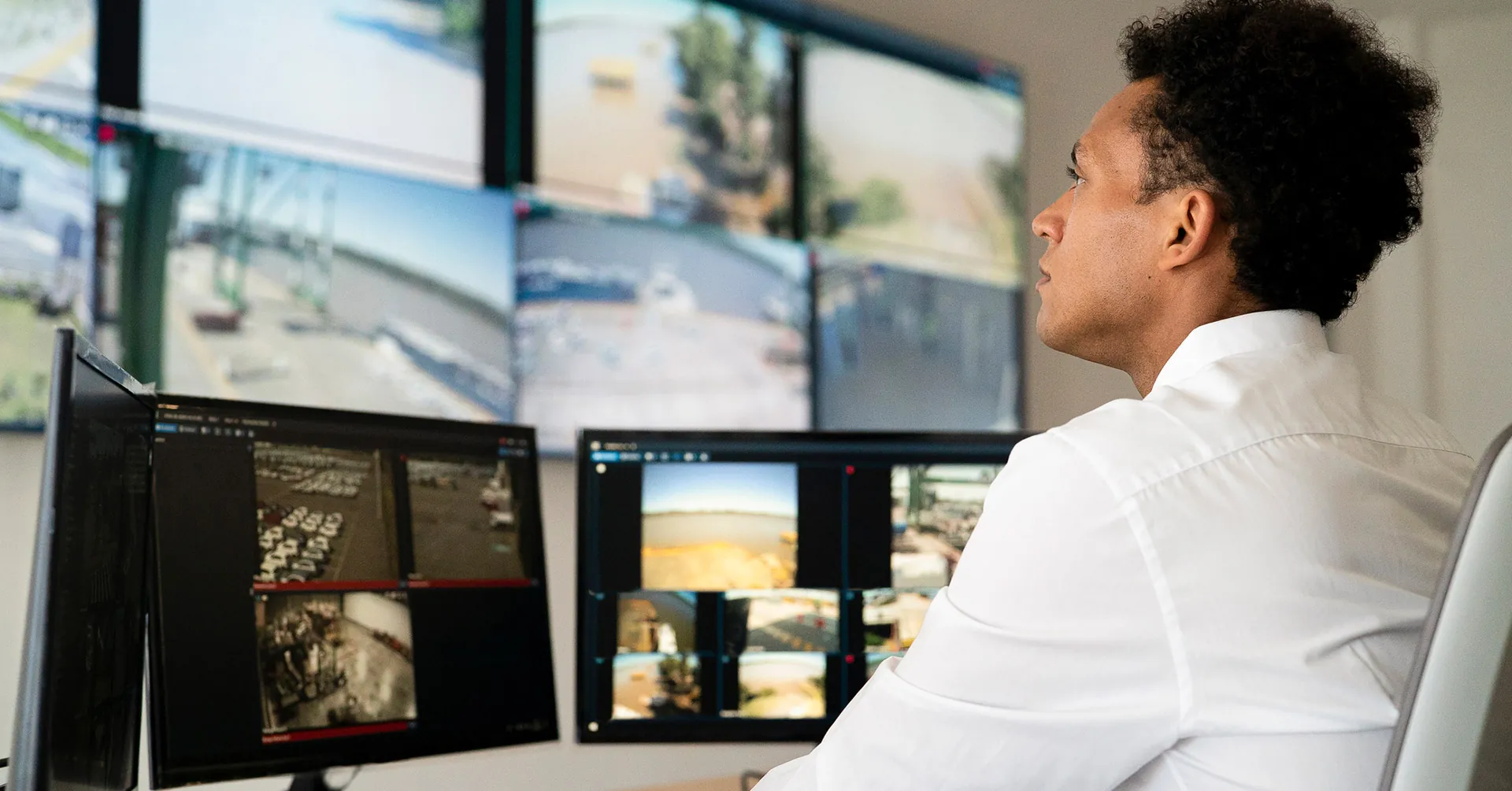
From AI to distributed risk, see the physical security trends shaping 2026 and what they mean for your strategy.

Safety and Security Apr 30, 2026
Beyond Cameras and Access Control: 7 Physical Security Trends Shaping 2026
The Security Maturity Benchmark Report
Explore new data on the program maturity factors separating resilient security teams from reactive ones.
In the early 2020s, retailers faced a new kind of threat that no standard physical security plan could address. Dozens of people would arrive at a single location, overwhelm staff by sheer numbers, and walk out with merchandise in minutes.
What made this possible? Social media.
In the past, coordinating a group that large required extensive time, planning, and visibility—barriers that limited how often these incidents occurred. Today, organizing a retail flash mob requires nothing more than a hashtag and a motivated following. The barrier to coordination is gone, and with it, the assumptions on which many security programs were built.
This shift reflects a broader reality. Risk does not stand still. As new tools become widely adopted, they introduce new ways for threats to take shape. As Ryan Schonfeld, CEO of AI-powered security software firm HiveWatch, put it during a recent episode of The Employee Safety Podcast, “Risk landscape is something that’s always been dynamic and will continue to evolve … things like social media that have the ability now to give anybody a platform create an increased risk profile for organizations.”
That’s the gap in how most organizations still think about security solutions. Much of the conversation stays focused on cameras, guards, and access control. In practice, what shapes your program today is far broader—how you identify risk earlier, connect systems, and align security with business priorities. That includes everything from coordination signals on social platforms to emerging disciplines like AI risk management.
The physical security trends shaping 2026 won’t come from hardware alone. They will come from how you respond to faster coordination, distributed risk, and a growing expectation that converged security operates as a core business function.
The Security Maturity Benchmark Report
Explore new data on the factors separating resilient security teams from reactive ones.
How Physical Security Is Shifting—From Reactive Monitoring to Proactive Resilience
When asked about physical security trends in 2026, Ryan Schonfeld put it simply: “Data is gold in security, and security has an incredible amount of untapped gold right now.”
Hear Ryan Schonfeld, Co-Founder and CEO of HiveWatch, explain how security leaders can adapt to today’s evolving risks.
Many industries sit on large volumes of underused data, and the physical security industry faces the same challenge. Access logs, video feeds, incident reports, and external signals all exist, and teams need a clear way to turn that information into direction.
The issue comes from interpreting data fast enough to act with precision. Modern programs require a clearer view of risk before incidents occur, as well as the ability to prioritize resources based on patterns, signals, and changing conditions. All the best upgrades in the world can not help when the ecosystem isn’t built to draw insights from them. Understanding where your program sits on that reactive-to-proactive spectrum starts with a security maturity model, which measures how well leadership, processes, and technology work together before a crisis tests them.
That’s why the most important industry trends in 2026 center on how security data is used. With the support of AI, organizations can connect inputs across systems, identify emerging risks earlier, and act with more precision. Predictive analytics supports this shift by turning fragmented data into something actionable. Physical security measures continue to improve through better insight, faster decisions, and a more complete understanding of where risk is built.
Here’s how that shift shows up across the seven trends shaping physical security in 2026:
- AI-driven threat intelligence: Uses AI to surface meaningful signals from large data sets so teams can focus on high-risk scenarios.
- Cyber-physical convergence: Aligns physical security platforms with IT and cybersecurity standards to improve visibility and coordination.
- Unified security operations: Breaks down silos so systems, teams, and data work together instead of in isolation.
- Duty of care as a business priority: Positions employee safety as a leadership responsibility tied to risk, compliance, and organizational performance.
- Security for a distributed workforce: Expands programs to protect employees across locations, travel, and remote environments.
- Identity-first access control systems: Focuses on verifying people, not just securing entry points, through credentials and biometric systems.
- AI-augmented monitoring: Enhances surveillance with automation and analytics that improve detection without increasing manual workloadnd analytics that improve detection without increasing manual workload.
1. AI-driven Threat Intelligence Helps Teams Demystify Security Data
Much of the untapped data Ryan Schonfeld referenced stems from a familiar problem. Security teams have access to large volumes of data but struggle to make meaningful sense of it.
That’s starting to change. AI-powered threat intelligence can process terabytes of data across systems, filter out noise, and surface the risks that require attention. This allows security professionals to focus on decision-making instead of sorting through false alarms.
As Ryan explained “Not to overstate AI’s capabilities, but it does have capabilities to be a force multiplier within security teams … scanning data and coming up with a consolidated system understanding of all that data—that’s a very practical use case.”
This has direct implications for the scalability of corporate executive protection. Programs no longer rely only on real-time response. They can identify patterns across travel, communications, and external signals earlier, which allows protection resources to be deployed with more precision.
These advancements are a necessity given that many of the threats organizations face today are AI-driven themselves.
In fact, Allianz Risk Barometer 2026: Identifying the Top Global Business Risks identified artificial intelligence as the second most relevant global risk for 2026, outranked only by cyber incidents. The report notes that cyber incidents again rank as the top global risk, followed by the closely linked risk of artificial intelligence, which climbed from No. 10 the year before. Both now rank among the top five risks across nearly every region and industry analyzed.
AI-driven threat intelligence helps security teams keep pace with this rapid growth and tackle the threats before they come.
2. Security Convergence Lags Across the Physical Security Industry
Security convergence has been a goal for more than a decade, but few organizations have fully achieved it. Bringing physical and cybersecurity teams together requires more than alignment on paper. These functions often sit in different parts of the business, use different systems, and operate with different priorities. Breaking down those silos takes time and coordination.
Cybersecurity has made more progress here because it relies on shared standards. Frameworks like the National Institute of Standards and Technology Cybersecurity Framework and the International Organization for Standardization ISO/IEC 27001 standard give organizations a common model for how systems should connect, share data, and respond to threats. That level of consistency has not carried over to physical security.
As Schonfeld noted, “The cybersecurity industry really did a very good job of creating openness and APIs between different systems … physical security hasn’t seen that yet.”
To help close that gap, ASIS International, a global organization that develops standards and guidance for security professionals, has developed resources that promote convergence across teams, systems, and processes. Their standards and research focus on:
- Enterprise Security Risk Management (ESRM) frameworks that align security decisions with business risk and executive priorities
- Security convergence research reports that examine how organizations bring physical security and cybersecurity functions together
- Guidance on integrating physical and cyber risk into a single program with shared visibility and accountability.
The gap between connected systems and siloed ones is what drives the next shift.
Get The Security Maturity Benchmark Report
3. Unified Operations Break Down Silos Across Security Systems
Most organizations don’t set out to build fragmented security programs. It happens over time. A new risk appears, a team is assigned to solve it, and a tool is put in place to address that specific issue. As Ryan Schonfeld explained, each new problem often leads to one or two additional point solutions. Over time, those decisions stack, and the environment becomes harder to manage.
This shows up across physical security controls. Access control, video, incident reporting, and alerting systems all generate useful data, but that data stays separated. Each piece exists, but without connection, teams lack a full picture of what is happening and how to respond.
Unified security operations bring these elements together by connecting systems, standardizing data, and aligning workflows. When events are linked across systems, teams can assess impact faster and respond with context instead of reacting to isolated alerts.
This is where crisis communication and mass notification become part of security operations. They sit inside the incident response workflow and activate based on real-time inputs from across the system. For example:
| Access control alert | Video confirmation | Mass notification activation | Cross-functional coordination | Ongoing updates |
|
|
|
|
|
This level of coordination turns individual signals into a structured response. It also reinforces physical security awareness by ensuring employees receive timely, relevant information during an incident.
When systems, teams, and communication workflows operate together, security programs gain a clearer view of risk and a more controlled way to respond.
4. Duty Of Care As A Board-Level Mandate
Duty of care now sits inside business and governance discussions. It ties directly to regulatory requirements, insurance exposure, ESG commitments, and investor scrutiny. Employee safety shapes how organizations are evaluated, insured, and held accountable. That shift brings security into decision-making at the highest level.
The legal foundation is clear. The Occupational Safety and Health Administration General Duty Clause requires employers to provide a workplace free from recognized hazards. That obligation extends beyond physical sites. It covers how organizations assess risk, document decisions, and respond to incidents across their workforce. A workplace violence prevention plan supports that responsibility. Employee communications reinforce it. Documented risk assessments provide accountability.
This is where security leaders need to adjust how they operate. As Ryan Schonfeld explained during his interview, security leaders need to act as business leaders first. The focus shifts to business impact. Which risks disrupt operations? Which risks affect employees? Which risks create financial exposure? Those answers drive security strategies and investment decisions.
He also notes that many security professionals miss opportunities to influence decision-making because they frame discussions in security terms. Business language carries more weight. Cost, liability, and operational impact drive action at the leadership level.
Duty of care defines how security programs are evaluated. It connects employee safety to governance, regulatory requirements, and business performance. The takeaway is direct. Security leaders who tie their programs to business outcomes gain influence.
5. Protecting End Users Beyond the Traditional Security Perimeter
The definition of a business perimeter has changed. Remote work, travel, and multi-site operations are now standard. That shift expands what physical security has to cover and introduces risks that traditional programs were not built to address.
A recent case shows how far that shift goes. North Korean operatives secured remote roles at hundreds of U.S. companies, gained access to corporate systems, and generated more than $17 million before the scheme was uncovered. The exposure came from how work is structured now. The risk came through identity, access, and location outside controlled environments.
As Ryan Schonfeld explained, security operations no longer focus on a single location. Teams now support a workforce spread across regions, time zones, and environments. Incidents also take different forms. A medical emergency, regional disruption, or local event can disrupt operations and require a coordinated response.
This shift changes how organizations approach physical security assessment. Risk depends on where employees are, how they work, and what they can access. It also increases the importance of social media threat monitoring, since many relevant signals sit outside internal systems.
To support a distributed and hybrid workforce, security programs need to account for a wider range of scenarios:
- Travel risk management: Track employee movement and assess regional risk factors before and during travel
- Lone worker support: Provide check-in processes and escalation paths for employees working without direct oversight
- Remote environment awareness: Account for home offices, shared spaces, and unsecured locations as part of risk planning
- Multi-site coordination: Maintain visibility across offices, facilities, and remote teams to understand impact during incidents
- International workforce considerations: Monitor geopolitical and regional risks that may affect employees abroad
- Cross-functional response: Align security with HR, communications, and operations to coordinate response across locations
6. Identity-First Access Strengthens Security Technology and Access Control
The conversation around physical security often starts with hardware. Cameras and badge readers still play a role, since traditional security tools capture events after access has already been granted. But trends are shifting toward identity as the primary access parameter.
Identity-first access focuses on who is requesting access and whether that request should be approved in that moment. Modern security technology uses multi-factor authentication. It uses mobile credentials and biometrics such as facial recognition to verify identity with greater precision. This allows organizations to adjust access in real time based on risk and avoid relying on static permissions.
This approach becomes more important as environments grow more complex. Data centers require strict control over access. Healthcare facilities and other high-risk locations require the same level of control.
Employees, contractors, and third-party providers move between sites, systems, and roles throughout the day. Identity-first access allows organizations to track and validate those movements across physical and digital environments. It helps reduce exposure to cyber threats and cyberattacks by tying access to a verified identity. This creates a more consistent experience for end users and maintains stronger control over access.
Regulatory requirements shape how these systems are implemented. The General Data Protection Regulation sets expectations for how biometric data is collected and stored. The EU AI Act adds oversight for how that data is used. These rules apply across industries, including healthcare and other sectors that handle sensitive information. Organizations need clear policies, strong data protection practices, and accountability when deploying identity-based systems. Identity-first access is a shift in how organizations manage access, reduce risk, and meet regulatory requirements across physical and digital environments.
7. AI-Augmented Video Advances Video Surveillance and Analytics
Video surveillance still plays a central role in threat detection, but its purpose has changed. It no longer just captures footage for review after an incident. With AI-driven video analytics, surveillance systems can process live video feeds, identify unusual behavior, and flag potential security breaches as they happen. That shift reduces the need for constant on-site monitoring and allows teams to respond faster when something looks off.
This is where Internet of Things (IoT) enabled devices and edge processing come into play. Cameras, sensors, and other connected devices now act as part of a broader security infrastructure. Instead of sending every video feed to a central system, edge processing analyzes data at the source. That reduces delays and helps security teams act on potential threats in real time. It also supports more scalable remote monitoring across multiple locations without overwhelming centralized systems.
These capabilities extend into more autonomous forms of monitoring. Security systems can trigger alerts based on behavior, track movement across locations, and support patrol-like functions that once required manual oversight.
As Ryan Schonfeld explained, AI acts as a force multiplier by helping teams make sense of large volumes of data and focus on what matters. Video becomes one input among many. It feeds into a connected system alongside access control and mobile credentials. It also supports broader security operations.
Adoption continues to grow as organizations look to improve coverage without increasing headcount. Research from the Security Industry Association points to rising use of video analytics across surveillance systems, especially as companies expand cloud-based security and remote monitoring capabilities. AI-augmented video now sits alongside other new technologies as a standard part of modern physical security systems.
Security Leaders’ Priorities and Decision-Making For 2026
The trends shaping physical security point to a clear shift in how programs need to operate. Programs now center on connection. Risk, operations, and technology work together as one system.
As Schonfeld put it, organizations need to “embrace technology, break down silos, align your priorities with the business, and keep iterating.” That mindset carries through in how teams move forward. It starts with understanding where things stand today. It then moves into building stronger connections across systems and teams.
A gap analysis helps ground that process. It highlights where visibility is limited. It shows where systems operate in isolation. It also reveals where response efforts lose speed or clarity. From there, progress comes through steady improvements. Some changes happen quickly, such as connecting systems or refining response workflows. Others take more time, including unified operations, stronger governance, and better use of data.
These steps move security programs toward a more connected structure. The result is a program that adapts, improves, and supports the business over time.
The Security Maturity Benchmark Report
Explore new data on the factors separating resilient security teams from reactive ones.

AlertMedia, Risk Intelligence and Response