By AlertMedia, Risk Intelligence and Response

Safety and Security Nov 03, 2026
Real-Time Brand Monitoring Dashboard for Security and Communications Teams
Social Intelligence Key Feature Guide
Track trends, sentiment, and narratives online so you can proactively protect your people and organization.
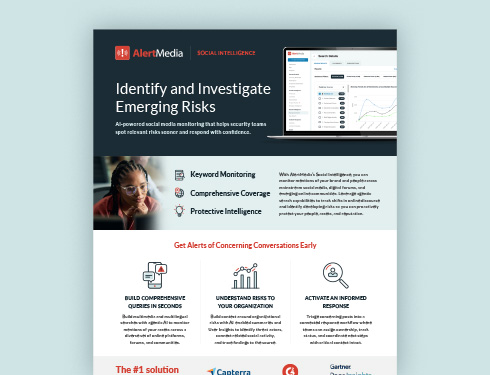
Table of Contents
- Why Brand Monitoring Matters to Security and Incident Response Teams
- What a Real-Time Brand Monitoring Dashboard Should Show
- Brand Monitoring for Security Compared With Generic Social Listening
- How AlertMedia Social Intelligence Supports Brand Monitoring
- How Security and Communications Teams Share One View
- A Brand Monitoring Workflow in Practice
A real-time brand monitoring dashboard gives security and communications teams a single view of what people are saying about the organization online—mentions, sentiment, and emerging narratives—updated as conversations develop. Used well, it helps teams spot boycotts, leaks, and disinformation campaigns early, while there is still time to prepare a response. This page explains why brand risk matters to security teams, what a real-time brand monitoring dashboard should show, and how security-focused software supports it.
Social Intelligence Key Feature Guide
Track trends, sentiment, and narratives online so you can proactively protect your people and organization.
Why Brand Monitoring Matters to Security and Incident Response Teams
Reputation issues can become operational incidents. A boycott can affect a retail location, a leak can raise questions about security, and a disinformation campaign can put executives or employees at the center of a fast-moving story.
These situations usually begin online, often in places a team is not already watching. When monitoring is split across platforms and separate systems, security and communications teams learn about issues late and assemble the picture by hand.
A shared, real-time view helps corporate security leaders and communications partners see the same information at the same time and decide together how to respond.
What a Real-Time Brand Monitoring Dashboard Should Show
The right view helps a team understand what is happening and decide what to do next, not just count mentions. Look for these elements.
| Element | What it shows | Why it matters |
| Mentions across sources | Posts about your brand, people, and locations across mainstream platforms and fringe communities. | Issues often start outside the largest platforms. |
| Sentiment trends | How the emotional tone of conversations changes over time. | A shift in tone can signal a developing issue before volume rises. |
| Narrative tracking | The themes and storylines forming around the organization. | Teams can see what is spreading, not only how much. |
| Notifications | Messages when monitored topics meet your criteria. | Analysts do not have to watch a screen all day. |
| Source detail | Direct links to the original posts. | Teams can verify before they respond. |
| Path to response | A connection to incident coordination and communication. | Insight leads to action without re-entering information. |
Download This Free Guide to Explore Social Intelligence
Brand Monitoring for Security Compared With Generic Social Listening
Generic social listening software is typically built for marketing teams. It measures campaign performance and audience sentiment. A security-focused real-time brand monitoring dashboard serves a different purpose.
| Consideration | Generic social listening | Security-focused brand monitoring |
| Primary goal | Measure marketing performance. | Identify risks to people, brand, and operations. |
| Source coverage | Mainstream social platforms. | Mainstream platforms plus fringe forums and dark web sources. |
| What it surfaces | Campaign engagement and audience trends. | Boycotts, leaks, disinformation campaigns, and other emerging risks. |
| Next step | Report to marketing. | Escalate into incident response and communication. |
How AlertMedia Social Intelligence Supports Brand Monitoring
Social Intelligence helps brand, security, and communications teams stay ahead of emerging threats and reputation shifts. It brings monitoring, context, and response together on AlertMedia’s unified risk intelligence and response platform.
| What teams need | How AlertMedia helps |
| Monitor brand terms in real time | AI Query Builder uses a natural-language chat interface to generate comprehensive, multilingual queries for your brand, people, locations, and assets. |
| See sentiment and narratives change | AI-powered Sentiment Analysis and narrative tracking visualize how conversations about your brand shift over time. |
| Get notified early | Alert subscriptions notify the team when criteria are met. |
| Understand themes quickly | AI Summary generates summaries of post content to surface trends, insights, and recommended actions. |
| Narrow to what matters | Filter by sentiment, source, tone, platform, and user, with direct source links to the original content. |
| Cover where issues start | Monitoring spans more than 65 social platforms, fringe forums, and dark web sources, including images, videos, and podcasts. |
| Respond with coordination | Findings move into Incident Response and Emergency Communication on the same platform. |
Social Intelligence analyzes more than 15 million records each day using 12 proprietary large language models for sentiment analysis and thematic categorization, and it works on publicly available content with no covert collection.
AI paired with analyst verification
AI scales the platform; AI paired with analyst verification is what makes the intelligence trustworthy enough to act on. When a brand issue overlaps with a physical threat, Threat Intelligence adds analyst-verified intelligence from AlertMedia’s Global Intelligence Team, so teams can separate online noise from risks that need action.
More than 3,500 organizations in over 150 countries rely on AlertMedia, which has been named a Gartner Peer Insights™ Customers’ Choice.
How Security and Communications Teams Share One View
That shared picture also shortens handoffs. Instead of forwarding screenshots and links, the analyst who sees a developing issue can share the underlying search, the sentiment trend, and the direct source links, and leaders can decide quickly whether the situation needs a response plan.
A Brand Monitoring Workflow in Practice
Consider a scenario in which a rumor about the organization begins on a fringe forum. A typical workflow looks like this:
- An analyst creates a search for the organization, its leaders, and its locations with AI Query Builder.
- Social Intelligence monitors the relevant sources, and an alert subscription notifies the team when activity matches.
- Sentiment Analysis and narrative tracking show how the conversation is developing.
- The analyst follows direct source links, verifies the content, and shares the findings with communications and security leaders.
- If action is needed, the team starts an Incident Response workflow and sends targeted messages through Emergency Communication.
Frequently Asked Questions
- What is a real-time brand monitoring dashboard? A real-time brand monitoring dashboard is a single view of mentions, sentiment, and narratives about an organization across online sources, updated as conversations develop. For security and communications teams, it helps identify boycotts, leaks, and disinformation campaigns early.
- How is brand monitoring for security different from social listening for marketing? Social listening for marketing measures campaign performance and audience sentiment. Brand monitoring for security looks for risks to people, brand, and operations, covers fringe forums and dark web sources, and connects findings to incident response and communication.
- What brand risks can monitoring surface? Monitoring can help teams see potential boycotts, leaks, and disinformation campaigns as they begin to form. Early awareness gives security and communications leaders time to verify information, prepare a response, and coordinate across the organization.
- Can I get notifications when sentiment shifts? Yes. AlertMedia Social Intelligence includes alert subscriptions that notify the team when monitored topics meet your criteria. Sentiment Analysis and narrative tracking add context about how tone and themes are changing.
- Which sources does brand monitoring cover? AlertMedia Social Intelligence monitors more than 65 social platforms, fringe forums, and dark web sources, including images, videos, and podcasts. Broad coverage helps teams see where issues begin, not only where they spread.
- How does brand monitoring connect to incident response? When a brand issue needs action, teams can move from monitoring into AlertMedia Incident Response and Emergency Communication workflows on the same platform. That keeps context intact and helps teams coordinate security, communications, and leadership.
- What role does AI play in brand monitoring? AI helps build searches, analyze sentiment, track narratives, and summarize key themes so teams can review less noise. People verify the source and decide how to respond. AlertMedia pairs AI with analyst verification in its intelligence workflows.
Social Intelligence Key Feature Guide
Track trends, sentiment, and narratives online so you can proactively protect your people and organization.
AlertMedia, Risk Intelligence and Response