
Is your security program built to respond under pressure? Learn how to assess your maturity level and identify the gaps holding your team back.

Safety and Security Jun 30, 2026
What Is a Security Maturity Model—And What Does It Say About Your Program?
The Security Maturity Benchmark Report
Explore new data on the program maturity factors separating resilient security teams from reactive ones.
Most security leaders know whether they have tools, plans, and people in place. But that does not always mean those pieces work together under pressure or align with the organization’s risk appetite. AlertMedia’s 2026 Security Maturity Benchmark Report found that 92% of organizations have experienced at least one direct consequence tied to security readiness gaps. These consequences range from higher long-term costs and employee burnout to reputational strain and missed early warnings.
That is where a security maturity model helps. Instead of looking at one part of the program in isolation, it measures how well your organization performs across the dimensions that determine resilience: leadership, staffing, processes, technology, and measurement.
By knowing where your program stands today, you can identify the gaps that keep your team reactive and build a clearer roadmap toward a more proactive, resilient security posture.
The Security Maturity Benchmark Report
Explore new data on the factors separating resilient security teams from reactive ones.
What a Security Maturity Model Actually Measures
A security maturity model is a practical way to evaluate how well your organization is protected, how effectively it supports threat detection, and how prepared your team is to respond when something goes wrong. It helps organizations evaluate whether their security program is built to perform under pressure.
Models vary by organization and framework. The AlertMedia Security Maturity Model measures maturity across five dimensions:
- Leadership
- Staffing
- Processes
- Technology
- Measurement

Together, these dimensions show whether a security program can detect threats early, coordinate a response, communicate during incidents, and recover with limited disruption.
Other models only look at a narrower part of that picture. The National Institute of Standards and Technology Cybersecurity Framework (NIST CSF), for example, helps organizations organize cyber risk management around core outcomes such as identifying assets, protecting systems, detecting threats, responding to incidents, and recovering operations. Cybersecurity Maturity Model Certification (CMMC) is more compliance-focused, especially for organizations that work with the U.S. Department of Defense.
These models often address technical practices such as vulnerability management, penetration testing, least privilege access, and secure DevOps workflows. Those practices matter, but they do not show whether the whole organization is ready to respond when a threat affects people, facilities, or business operations.
That broader view matters because physical and digital risks increasingly overlap, and converged security is increasingly becoming an operational necessity. Access control systems depend on digital infrastructure. Remote employees may be affected by severe weather or civil unrest. Security teams may need to reach employees during a cyber-enabled physical threat. A broader security maturity framework connects these risks to global risk management, emergency communication, and operational resilience.
The Three Tiers of Security Program Maturity
The tiers of security program maturity are similar to the stages of business maturity. Some organizations are still building the foundations. Others have documented processes and partial integration. The most mature programs have leadership alignment, specialized resources, integrated technology, and measurement practices that support continuous improvement.
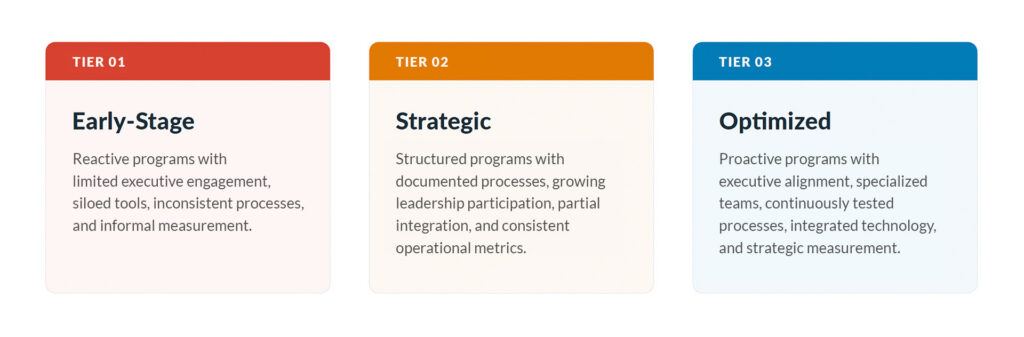
AlertMedia’s Security Maturity Benchmark Report groups organizations into three tiers: Early-Stage, Strategic, and Optimized.
Early-Stage
Early-Stage security programs are largely reactive. They often rely on informal processes, disconnected tools, and limited executive engagement, which makes it harder to coordinate when a serious incident occurs.
This does not always mean the organization is new. An Early-Stage program can exist in a growing company, a business going through major change, or an organization where security responsibilities have expanded faster than the team’s resources.
The risk is that these programs may look functional during routine operations but break down under pressure. AlertMedia’s report found that 63% of Early-Stage organizations would not respond quickly enough to a serious security incident.
Strategic
Strategic security programs have moved beyond informal response. These organizations usually have documented processes and more structured leadership involvement. They may also have partial technology integration and operational metrics that help track day-to-day performance.
At this stage, the foundation is in place, but the program may not be fully connected across the business. A chief information security officer (CISO) or security leader may take part in planning, while formal executive oversight is still developing. Teams may also conduct threat modeling or align parts of the program with the industry frameworks. The challenge is that those efforts may still sit apart from physical security, business continuity, and crisis response.
That separation matters most for organizations with distributed teams, high-risk operations, or critical infrastructures to protect. Technology may support response without giving leaders a centralized view of people, facilities, and active threats. Metrics may show activity without making the connection to business outcomes clear.
Strategic programs sit in the middle of the maturity curve. They are stronger than reactive programs, but still working to become more consistent, proactive, and measurable.
Optimized
Optimized security programs are more proactive, executive-aligned, and continuously tested. They have the structure to prepare before incidents escalate, not just respond after disruption begins.
At this level, security functions no longer operate as separate workstreams. Physical security connects with crisis response. Identity and access management supports both cyber and workplace protection. Cyber risk programs feed into the same readiness picture as employee safety and business continuity.
Teams may still use specialized frameworks to assess specific parts of the environment, but those efforts support the broader security maturity framework instead of standing apart from it.
The difference shows up in how teams spend their time. Optimized organizations are nearly twice as likely as Early-Stage organizations to spend most of their time proactively preparing for incidents rather than reacting to them once they are already underway.
That is the goal of security maturity: moving the organization left of boom, where teams can anticipate, prepare, and coordinate before disruption escalates.
| Early-Stage | Strategic | Optimized |
| Reactive programs with limited executive engagement, siloed tools, inconsistent processes, and informal measurement. | Structured programs with documented processes, growing leadership participation, partial integration, and consistent operational metrics. | Proactive programs with executive alignment, specialized teams, continuously tested processes, integrated technology, and strategic measurement. |
The Five Dimensions That Determine Your Tier
Chad Bosquez, Head of Physical Security at Chime, joined The Employee Safety Podcast to discuss what it takes to build and improve a security program. His experience moving from law enforcement into corporate security, then building programs at high-growth technology companies, offers a practical view of how maturity develops over time.
The five dimensions below determine where an organization falls on the maturity curve.
Leadership
Leadership is the force multiplier behind security maturity.
A security program can have strong plans and capable people, but without executive support, it will struggle to gain funding, influence behavior, and scale across the business. AlertMedia’s report found that only 50% of organizations have formal executive-level oversight for security.
That lack of ownership shows up elsewhere. When security is not connected to leadership priorities, it is harder to secure resources, build accountability, or make preparedness part of the business culture.
Bosquez emphasized the importance of understanding the organization before trying to change how people behave. “If you don’t know the culture, if you’re not talking to people, talking to exec leaders… you’re not going to get buy-in,” he said.
That buy-in matters because security measures often affect how employees move through the workplace, travel, report concerns, or respond during emergencies. Leaders need to understand the “why” behind those measures before they can reinforce them across the organization.
Staffing
Security maturity is also shaped by staffing structure.
A mature program has the roles, coverage, and specialization needed to match the organization’s risk profile. AlertMedia’s report found that 59% of security teams are understaffed, while 64% say they are expected to do more with fewer resources. The gap is widest among less mature programs: 75% of Early-Stage organizations report understaffing, compared with 44% of Optimized organizations.
Chad Bosquez faced that challenge while building Chime’s physical security program. “I didn’t have a lot of resources,” he said, so he started by using contracted security services to support office security while he built out the broader program. Over time, that included mass communications, travel security, threat response processes, and a more structured security presence.
That is the staffing maturity point: teams need enough coverage to handle today’s work while still building tomorrow’s capability. Understaffing limits the time available to test response procedures, train employees, analyze threats, and improve processes. It can also create single points of failure when one person owns too many critical functions.
Mature programs define roles and responsibilities clearly. They build specialized capabilities where needed and make sure security operations can continue when key people are unavailable.
Processes
A plan that has not been tested is not the same as a plan that works.
Processes determine how consistently an organization responds when an incident occurs. This includes the incident response plan, escalation paths, emergency communication procedures, after-action reviews, and tabletop exercises.
The maturity gap is clear. According to AlertMedia’s report, 89% of Optimized organizations continuously refine and test processes against benchmarks, compared with only 8% of Early-Stage organizations.
Chad Bosquez takes that same approach at Chime. He said he regularly assesses the security program, usually every six months, to ask what has changed, what gaps need to close, and what new tools could help the team operate better. That rhythm keeps process improvement tied to current risks instead of letting plans sit untouched.
That matters during real incidents. When severe weather affected remote employees, Chime’s mass communication system helped the team identify who was in the impacted area, check on employees, and coordinate support. The process worked because the organization had already built the communication structure to act quickly.
A documented business continuity plan may satisfy a compliance requirement, but response readiness comes from practice. Teams need to know who makes decisions, how information moves, which channels to use, and how to adjust when an incident does not follow the script.
Mature programs treat testing as a regular operating practice. They review what worked, assign owners for needed fixes, and update the plan before the next disruption.
Technology
Technology is a major driver of security maturity, but more tools do not automatically create a stronger program.
The real maturity indicator is integration. Security teams need systems that can share information, surface threats in one place, and trigger the right response without adding manual work. During an incident, that can mean identifying who is affected, sending targeted messages, tracking responses, and giving leaders a shared view of what is happening.
AlertMedia’s report found that 98% of organizations rely on tools or intelligence sources to detect emerging threats, yet only 31% operate a centralized, highly automated security ecosystem. At the same time, 93% of security leaders report at least one gap in their current security technology suite.
Chad Bosquez described that value in practical terms when discussing how Chime supports remote employees. By connecting employee location data with mass communication capabilities, his team could identify employees in the path of severe weather, contact them quickly, and coordinate support through the people team.
That is what mature technology should do. It should reduce blind spots, speed up decisions, and make responses easier to coordinate. Fragmented systems have the opposite effect. They force teams to piece together information manually, which slows response when timing matters most.
Optimized organizations are 3.5 times more likely to operate proactively because their technology supports faster detection, stronger coordination, and clearer communication. The goal is a connected ecosystem that helps security teams act sooner and with better information.
Measurement
Measurement is what turns security maturity from a concept into enterprise security risk management practice.
Without clear metrics, security leaders may know where they are struggling, but they cannot always prove it, benchmark it, or show progress over time. That makes it harder to gain executive support and prioritize improvements.
Mature programs measure security performance in business terms. They track response speed, communication effectiveness, testing results, staffing capacity, technology gaps, and readiness indicators. They also benchmark against peers to understand whether their program is behind, on pace, or ahead of similar organizations.
Bosquez recommends security leaders “use your technology, benchmark, talk to folks, and measure your performance,” including engagement with employees and leadership to ask whether current practices are working.
That kind of measurement closes the gap between security activity and business value. It gives leaders the data they need to make the case for budget, staffing, new technology, and process improvements.
How to Assess Where Your Program Stands Today
A security maturity assessment helps organizations determine where they fall across the five dimensions and what needs to improve first.
Bosquez starts with a simple stakeholder question: “What keeps you up at night?”
From there, security leaders can dig into more specific concerns. Do employees feel safe entering the office? Do travelers know what to do if something happens on the road? Can the organization reach remote employees during severe weather? Are executives worried about workplace threats, access control, or gaps in communication?
A maturity self-assessment should look at several core areas:
- Whether leadership has formal oversight and accountability for security
- Whether staffing levels and specializations match the organization’s risk profile
- Whether incident response processes are documented, tested, and updated
- Whether security technologies are integrated or siloed
- Whether the team tracks performance against benchmarks and business goals
It should also examine how the team spends its time. Mature programs spend more time preparing for incidents than reacting to them. Less mature programs often stay stuck in response mode, moving from one urgent issue to the next without enough time to improve the system.
To see how your organization stands today, take AlertMedia’s Security Maturity Self-Assessment and get personalized recommendations. The assessment helps teams evaluate their readiness across the five core dimensions of security maturity, identify the areas most in need of improvement, and compare their results against peer benchmarks from the Security Maturity Benchmark Report. With that clearer view, leaders can move beyond a general sense of what is working or falling short and start prioritizing the investments, processes, and capabilities that will make their programs more resilient.
Get The Security Maturity Benchmark Report
Common Barriers to Moving Up the Maturity Spectrum
The barriers to improving security maturity usually mirror the five dimensions of the model. Programs get stuck when leadership, staffing, processes, technology, or measurement practices are not strong or integrated enough to support the next stage of growth.
Leadership and staffing gaps
Many teams are trying to mature while operating under resource pressure. AlertMedia’s report found that 64% of security leaders say their teams are expected to do more with fewer resources.
That pressure can keep teams reactive. When security leaders are buried in daily response, they have less time to build stakeholder relationships, strengthen governance, test plans, or make the business case for additional support.
Moving up the curve requires more than asking for additional budget. It requires connecting security outcomes to business outcomes, including employee safety, operational continuity, reputation, and financial risk.
Siloed technology
Technology gaps are one of the clearest barriers to maturity. With 93% of security leaders reporting at least one gap in their technology suite, many organizations are still trying to coordinate response across disconnected tools.
A fragmented system makes it harder to detect threats early, communicate quickly, and understand who is affected. It can also create duplicate work and delay decisions when time matters most.
Mature programs focus on integration before expansion. They look for ways to connect threat intelligence, emergency communication plans, access control, employee location data, and response workflows into a more unified operating model.
Paper compliance
Some organizations have plans that look complete but have not been tested in realistic conditions.
A policy can satisfy a requirement and still fail during an incident. A healthcare organization, for example, may have Health Insurance Portability and Accountability Act (HIPAA) procedures for protecting sensitive information. But during a workplace threat, facility evacuation, or emergency notification, the team still needs to know who can send updates, what information can be shared, and how to communicate quickly without exposing protected details.
The same issue can appear in technical environments. A data center outage or cyber-physical incident may involve systems managed through Infrastructure as Code (IaC), which helps teams apply controls consistently. That consistency matters, but it does not answer the operational questions that come up during response. Who confirms the outage? Who notifies affected employees? Who escalates to leadership? Who decides when the site is safe to reopen?
The solution is to move from documentation review to response validation. Start with a realistic scenario, then run a tabletop exercise with the teams that would actually be involved. The exercise should test the decisions and handoffs that matter most during a disruption, from employee communication to legal review to security operations.
After the exercise, use the findings to update the incident response plan, revise message templates, correct outdated contacts, and assign owners for each fix.
A tabletop exercise only improves maturity when the organization turns the findings into action.
Lack of measurement
You cannot improve what you cannot see.
Without measurement, security leaders may struggle to identify which gaps matter most or show how improvements reduce risk. Benchmarking also becomes difficult when teams have no clear way to compare their maturity against similar organizations.
That is where a structured maturity assessment can help. A Capability Maturity Model (CMM), for example, gives teams a way to score how developed a process is and track improvement over time. For a broader security program, that same idea can help leaders measure whether their processes are documented, tested, repeatable, and tied to business outcomes.
Bosquez noted that he regularly assesses his program, typically every six months, to identify new technologies, challenges, and gaps that need attention. That kind of regular review helps security leaders keep maturity moving instead of waiting for a major incident to reveal weaknesses.
Progress in one dimension often supports progress in others. Stronger measurement gives leaders better data to justify investment. Better leadership support can improve staffing. Better staffing gives teams more time to test processes and refine response plans. Integrated technology can make responses faster and easier to measure.
Security maturity builds through repeated assessment, targeted improvements, and regular testing. Each improvement makes the program more resilient and gives leaders a stronger foundation for the next stage of growth.
Frequently Asked Questions
- What is a security maturity model? A security maturity model is a framework for evaluating how effectively an organization’s security program is built across key dimensions such as leadership, staffing, processes, technology, and measurement. It helps security leaders identify gaps, benchmark performance, and prioritize improvements.
- What are the levels of security maturity? The AlertMedia Security Maturity Model includes three security maturity levels: Early-Stage, Strategic, and Optimized. Early-Stage programs are mostly reactive, Strategic programs have documented processes and growing integration, and Optimized programs are proactive, executive-aligned, and continuously tested.
- How is a security maturity model different from a cybersecurity maturity model? A cybersecurity maturity model focuses on cyber risk, technical controls, governance, and compliance. A security maturity model takes a broader view of organizational readiness, including physical security, emergency communication, incident response, workforce safety, business continuity, and performance measurement.
- How often should you assess your organization’s security maturity? Organizations should assess security maturity at least annually, but many mature programs review their readiness more frequently. A six-month risk assessment cycle can help teams identify new threats, technology needs, process gaps, and resource constraints before they become larger problems.
- What are the five dimensions of security maturity? The five dimensions of security maturity are leadership, staffing, processes, technology, and measurement. These dimensions determine whether a security program can anticipate threats, coordinate response, communicate clearly, and recover from disruption.
- How do you improve security maturity? Improving security maturity starts with a security maturity assessment. Identify gaps across the five dimensions, prioritize the areas creating the most risk, and build a roadmap for improvement. Common steps include strengthening executive oversight, addressing staffing gaps, testing incident response plans, integrating technology, and measuring performance against benchmarks.
- What’s the difference between a security maturity model and a security maturity assessment? A security maturity model is the framework used to evaluate a program. A security maturity assessment is the process of applying that framework to determine where the organization stands today and what needs to improve.
- How does security maturity affect incident response? Security maturity affects incident response by determining how quickly and effectively an organization can detect threats, notify affected people, coordinate teams, and recover. Mature programs are more likely to test processes, integrate technology, and communicate clearly during incidents
- What does a proactive security program look like? A proactive security program spends more time preparing for incidents than reacting to them. It has executive support, clear roles and responsibilities, tested processes, integrated technology, and performance metrics that help the organization improve over time.
The Security Maturity Benchmark Report
Explore new data on the factors separating resilient security teams from reactive ones.

AlertMedia, Risk Intelligence and Response