
By AlertMedia, Risk Intelligence and Response

Emergency Management Jun 12, 2026
Threat Intel Platform for Executive Protection Teams
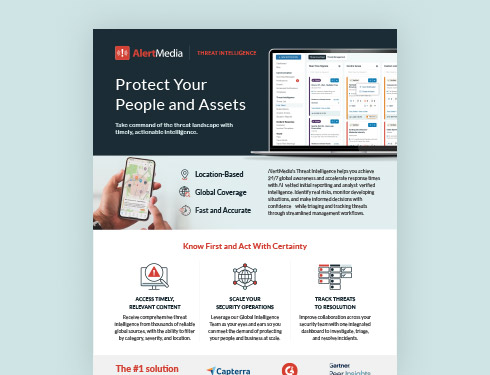
Threat Intelligence Key Feature Guide
Gain instant clarity into emerging threats with analyst-verified intelligence and AI-driven early signals.
Executive protection teams need more than a generic threat feed. A threat intel platform for executive protection teams surfaces analyst-verified, principal-specific intelligence—covering travel routes, geopolitical exposure, public appearances, and hyperlocal risk near the people they protect. AlertMedia’s unified risk intelligence and response platform brings that intelligence together with travel risk monitoring, emergency communication, and one-touch emergency assistance in a single system, so EP teams can detect threats earlier, act faster, and protect high-profile individuals wherever they are.
The Intelligence Gap Most EP Teams Are Working Around
Executive protection programs face a coordination problem that technology can solve—but only if the right technology is in place. Most EP teams piece together their workflow from systems that were not designed to work together: a commercial threat feed here, a manual OSINT process there, a separate communication system for reaching the principal, and a spreadsheet tracking travel itineraries.
The result is a workflow full of friction. Intelligence that arrives late. Threat context that has to be manually correlated with a principal’s location. Communication that depends on someone remembering to call the right people in the right order. And a small team—often one or two dedicated analysts supporting a principal roster that spans multiple continents—doing work that should be automated.
The intelligence gap is not usually a sourcing problem. Most EP teams have access to threat data. The problem is that the data is disconnected from the action layer. Knowing that a threat is developing near a principal’s hotel is only useful if it triggers an immediate, coordinated response—not a series of phone calls.
A purpose-built threat intel platform for executive protection teams solves this by unifying intelligence, travel visibility, communication, and emergency response in one place.
What Executive Protection Teams Actually Need From a Threat Intel Platform
Analyst-verified intelligence, not just aggregated feeds
Volume is not the same as value. EP teams do not need more raw data—they need verified intelligence that has been assessed by a human analyst and confirmed as relevant before it reaches the team. The difference between an AI-aggregated feed and analyst-verified intelligence is the difference between signal and noise.
A platform built for executive protection should surface threats that have been assessed for credibility, severity, and proximity to principals. That means human analysts who understand the context, not just an algorithm that flags keywords.
Early warning capability for hyperlocal threats
Speed matters in executive protection. The window between an emerging threat and a principal’s exposure can be very short—particularly during travel, public appearances, and visits to high-risk locations.
Early warning capability means the platform is surfacing relevant threat signals before a situation fully develops, not after. For EP teams, that lead time is the difference between a proactive route change and a reactive evacuation.
Real-time visibility into principal locations and travel
Threat intelligence without location context is incomplete. An EP platform needs to connect threat data to where principals actually are—live location, confirmed itinerary, and upcoming travel commitments—so the team can assess exposure in real time.
Direct action capability—not just monitoring
Monitoring alone is not enough. When a threat is confirmed, the team needs to communicate immediately, coordinate a response workflow, and provide direct emergency assistance to the principal. Switching between systems at that moment creates delay that EP programs cannot afford.
A threat intel platform built for executive protection integrates the response layer—emergency communication, incident workflows, and panic capability—directly into the intelligence environment.
How AlertMedia’s Platform Supports Executive Protection Programs
AlertMedia’s unified risk intelligence and response platform is purpose-suited to executive protection because it connects the four things EP teams need—intelligence, travel visibility, coordinated response, and emergency assistance—into one system. Security teams responsible for protecting executives report responding 25+ minutes faster when intelligence and communication are unified rather than fragmented.
Detect: Analyst-verified intelligence and early warning signals
Analyst-verified Threat Intelligence—AlertMedia’s Global Intelligence Team monitors threats 24/7 and vets every relevant signal before it reaches the EP team. That human verification layer is what makes the intelligence actionable—not just a feed to scroll through. Custom threat notifications by role and location ensure the right analyst or security lead sees the right intelligence at the right time.
Real-Time Signals—For EP teams that need the earliest possible warning, Real-Time Signals is an AI-vetted add-on to Threat Intelligence that surfaces hyperlocal threat signals before the full analyst verification cycle completes. It delivers AI-Vetted Initial Reports and a customizable live feed from thousands of trusted sources, giving EP teams both speed and rigor: early signals from Real-Time Signals, confirmed intelligence from the analyst team.
Analyst Access—AlertMedia’s Analyst Access capability gives EP teams on-demand access to AlertMedia’s intelligence analysts—24 hours a day, seven days a week. For lean EP teams without a full Global Security Operations Center, Analyst Access functions as an intelligence augmentation layer. Customers report value equivalent to adding approximately three additional security staff to the team.
Strategic Situation Reports (SitReps)—Before a principal travels to a new city or region, EP teams can receive expert-authored SitReps briefing them on the current threat environment, active incidents, and security considerations for that location.
Real-Time Impact Assessment—AlertMedia’s Visual Intelligence feature visualizes the relationship between active threats and principal locations on a single map view. EP teams see instantly which threats are proximate to which principals, without manually correlating a threat feed against a separate itinerary tracker.
Safeguard: Travel risk monitoring and pre-trip intelligence
Travel Briefs—AlertMedia automatically generates Travel Briefs for executive destinations—custom, mobile-accessible summaries of active threats, travel risk ratings, and security considerations for the locations on a principal’s itinerary. EP team members and the executives themselves can access Travel Briefs from the AlertMedia mobile app before and during travel.
Real-time travel location monitoring—AlertMedia syncs travel itinerary bookings and live mobile location data, giving EP teams continuous visibility into where principals are and where they are going. Travel risk ratings flag high-risk destinations before the principal departs, not after arrival.
24/7 traveler assistance—When an executive needs direct support during travel, AlertMedia’s mobile app connects them to a dedicated internal support line or medical and travel assistance provider. EP teams can configure the contact workflow to match their program’s specific structure.
Accelerate: Response workflows and two-way communication
Streamlined response workflows—When a threat is confirmed, AlertMedia’s Incident Response product provides customizable task lists and response workflows so every member of the security team knows their role, their sequence, and their escalation path. Workflows are configured in advance for common EP scenarios—travel disruptions, acts of violence, natural disasters, and other incident types—so the team is executing a tested plan, not improvising.
Two-way multichannel communication—AlertMedia’s Emergency Communication product delivers notifications to principals, security team members, and stakeholders across SMS, email, voice, mobile app, desktop, and collaboration platforms. Two-way communication—with read confirmations, survey responses, and free-text replies—gives the EP team real-time confirmation that the principal has received and acknowledged the message.
Unified platform, no context switching—AlertMedia’s Threat Intelligence feeds directly into Emergency Communication and Incident Response. When the team needs to act on a verified threat, the workflow stays inside the same system—no exports, no API calls, no switching between platforms while the incident is developing.
Assist: One-click emergency capability for principals
One-Touch Distress Signal—AlertMedia’s One-Touch Distress Signal gives every principal a hardware-free panic capability on their existing mobile device. A discreet, single-touch signal alerts the EP team, triggers AlertMedia’s 24/7/365 monitoring team, and initiates a pre-configured response workflow—without requiring the principal to carry dedicated hardware.
Real-time geolocation—When a One-Touch Distress Signal is activated, AlertMedia transmits the principal’s GPS location to the security team and, where applicable, to first responders. The EP team knows where to go.
Custom action plans—AlertMedia’s monitoring team follows scenario-specific workflows configured by the EP program. When a distress signal fires, the response is not improvised—it follows a plan the team built and tested.
Before and After: How AlertMedia Changes the EP Workflow
| Workflow step | Without AlertMedia | Without AlertMedia |
| Threat monitoring | Manual OSINT review across multiple feeds; no analyst verification | Analyst-verified Threat Intelligence with 24/7 Global Intelligence Team coverage |
| Early warning | Dependent on analyst checking feeds at intervals | Real-Time Signals delivers AI-vetted hyperlocal signals continuously |
| Principal location visibility | Spreadsheet-tracked itineraries; no live location | Synced itinerary bookings and live mobile location in one map view |
| Pre-trip intelligence | Manual research; inconsistent depth and format | Automated Travel Briefs with active threat context and travel risk ratings |
| Incident communication | Phone tree or separate communication system | Two-way multichannel Emergency Communication integrated with the threat layer |
| Response coordination | Ad hoc task assignment via calls and messages | Pre-built Incident Response workflows with task lists and escalation paths |
| Principal emergency assistance | Hardware panic device or phone call | One-Touch Distress Signal from the principal’s existing mobile device |
| Post-incident reporting | Manual compilation from multiple systems | Unified analytics and action logs in AlertMedia |
Why EP Teams Choose AlertMedia
Analyst verification is not optional for executive protection.
A raw threat feed creates work; verified intelligence enables action. AlertMedia’s Global Intelligence Team vets every relevant signal before it reaches the EP team, so the team is acting on confirmed information—not triaging noise.
Speed and rigor together.
Real-Time Signals delivers early, AI-vetted threat signals. Threat Intelligence delivers analyst-confirmed intelligence. EP teams get both layers in one platform—early warning when seconds matter, and verified context when precision matters.
The response layer is built in.
AlertMedia is not a monitoring-only platform. Incident Response, Emergency Communication, and Employee Safety Monitoring are part of the same system. The distance between detecting a threat and acting on it is a workflow, not a phone call.
Designed for lean teams.
Analyst Access means EP programs without a full Global Security Operations Center have 24/7 analyst support available on demand. The platform is built to scale a small team’s coverage across multiple principals and locations without scaling headcount.
Enterprise-grade security and compliance.
AlertMedia is SOC2 Type II certified, ISO 27001 certified, and compliant with GDPR and CCPA. The platform is designed for organizations where data security is a non-negotiable requirement.
AlertMedia serves 3,500+ organizations across 150+ countries and has been recognized as a Gartner Peer Insights™ Customers’ Choice for multiple consecutive years.
Frequently Asked Questions
- What is a threat intel platform for executive protection teams? A threat intel platform for executive protection teams is a software system that aggregates, analyzes, and delivers threat intelligence relevant to high-profile individuals—principals—who require active protection. Unlike general workforce risk platforms, a purpose-built EP threat intel platform connects principal-specific intelligence with travel visibility, emergency communication, and direct emergency assistance capability. AlertMedia's unified risk intelligence and response platform delivers all of these in one system.
- How does AlertMedia's Threat Intelligence help EP teams monitor risks to principals? AlertMedia's Threat Intelligence product monitors threats across thousands of sources and routes every relevant signal through the Global Intelligence Team for analyst verification before it reaches the EP team. Custom threat notifications can be configured by principal location, travel itinerary, and risk type, so the team receives only the intelligence that is relevant to the people they protect.
- What is Analyst Access, and why does it matter for executive protection? Analyst Access is AlertMedia's on-demand capability for EP and security teams to consult directly with AlertMedia's intelligence analysts, available 24 hours a day, seven days a week. For EP programs without a full Global Security Operations Center, Analyst Access functions as an intelligence augmentation layer—providing expert context on developing situations, regional threat assessments, and incident-specific analysis. Customers report value equivalent to adding approximately three additional security staff to the team.
- What is Real-Time Signals, and how does it help EP teams get earlier warnings? Real-Time Signals is an AI-vetted add-on to AlertMedia's Threat Intelligence product. It surfaces hyperlocal, early-warning threat signals from thousands of trusted sources before the full analyst verification cycle completes. For executive protection teams, this means the earliest possible signal when a threat is emerging near a principal's location—with analyst-verified confirmation to follow.
- How does AlertMedia support principal travel safety? AlertMedia's Travel Risk Management capabilities provide EP teams with synced itinerary tracking, live principal location monitoring, automated Travel Briefs for each destination, and travel risk ratings that flag high-risk locations before the principal departs. During travel, EP teams have continuous visibility into where the principal is and what threats are active in the area.
- What is a Travel Brief? A Travel Brief is an automated, custom intelligence summary for a specific destination, generated by AlertMedia and accessible from the mobile app. Travel Briefs include active threats in the area, travel risk ratings, and security considerations relevant to the principal's itinerary. EP teams and the principals themselves can access Travel Briefs before and during travel.
- What is the One-Touch Distress Signal? The One-Touch Distress Signal is a hardware-free emergency capability built into AlertMedia's mobile app. A single discreet touch from the principal's existing mobile device alerts the EP team, activates AlertMedia's 24/7/365 monitoring team, and initiates a pre-configured response workflow. The principal does not need to carry dedicated panic hardware—their existing phone becomes the safety device.
- How does AlertMedia integrate threat intelligence with incident response? AlertMedia's Threat Intelligence product feeds directly into Incident Response and Emergency Communication within the same platform. When a verified threat requires action, the EP team can initiate a response workflow, assign tasks, and send multichannel notifications to the principal and relevant stakeholders without leaving the AlertMedia platform. There are no exports, no API calls, and no system switching during an active incident.
- Is AlertMedia suitable for small EP teams without a full GSOC? Yes. AlertMedia is specifically designed to scale security coverage without scaling headcount. Analyst Access provides 24/7 on-demand analyst support for teams that do not have a full Global Security Operations Center. Automated Travel Briefs, Real-Time Signals, and pre-built response workflows reduce the manual workload on small teams, and the unified platform eliminates the coordination overhead of managing multiple disconnected systems.
Download Our Threat Intelligence Key Feature Guide
Gain instant clarity into emerging threats with analyst-verified intelligence and AI-driven early signals.

AlertMedia, Risk Intelligence and Response