

Best Enterprise Notification Systems for 2026
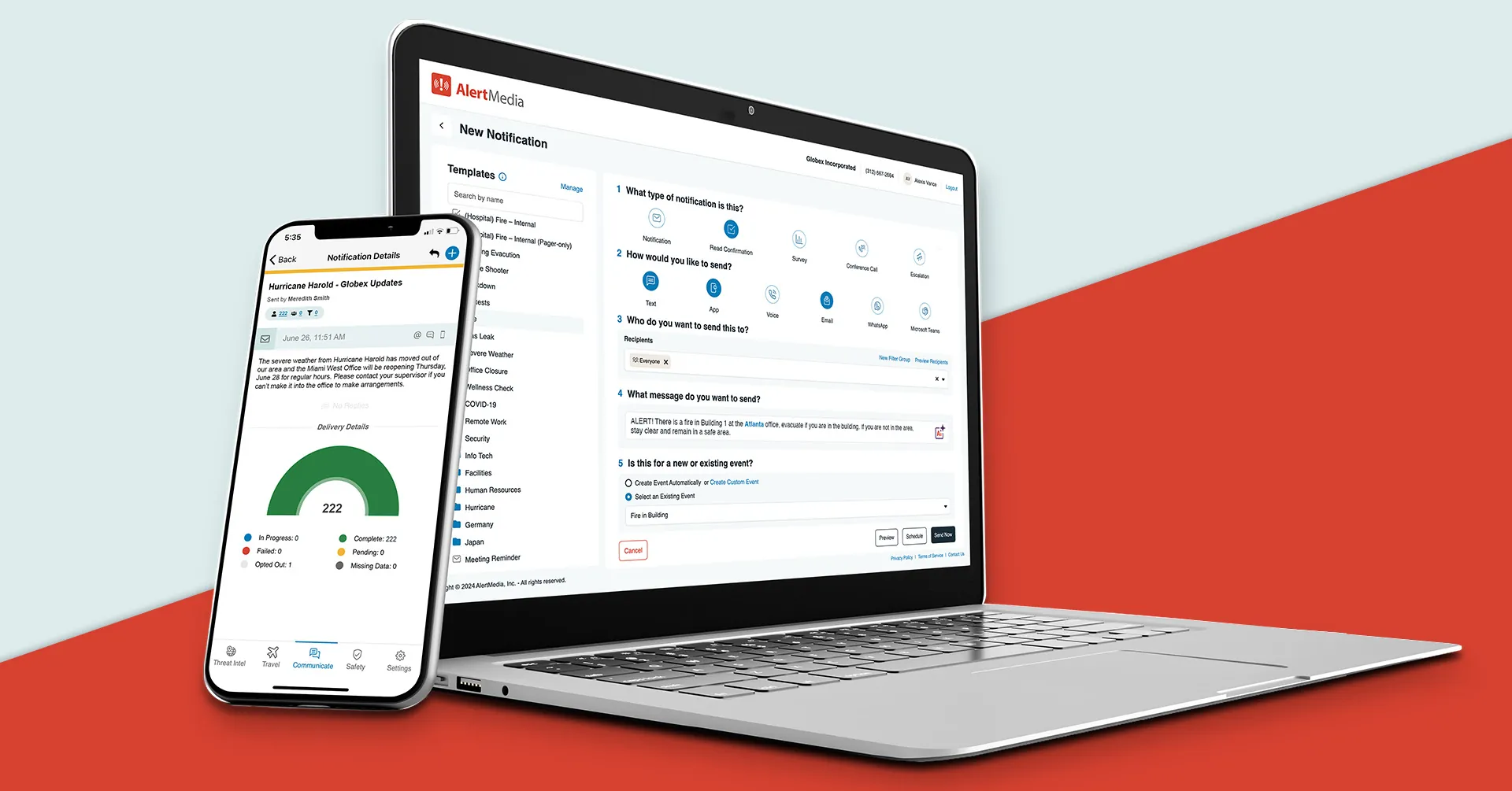
An enterprise notification system helps large organizations communicate quickly, consistently, and at scale during emergencies and critical operational disruptions. For enterprises with distributed workforces, layered approval structures, and complex risk profiles, notification also means maintaining operational control when conditions change fast.
Whether responding to severe weather, IT outages, security incidents, or facility disruptions, enterprise teams need systems that support redundancy, governance, and high-volume delivery without slowing decision-making. This page compares enterprise notification system features and capabilities across leading platforms, focusing on enterprise readiness rather than basic alerting.
What Is an Enterprise Notification System?
An enterprise notification system is a software platform that delivers time-sensitive messages across multiple channels to large, diverse audiences, reliably, quickly, and with administrative control. Organizations use enterprise notification systems to reach employees at scale during emergencies, IT outages, and daily operational events. While often associated with emergencies, enterprise-grade systems are also used for operational updates, workforce coordination, and business continuity communications.
Compared to basic mass notification tools, enterprise notification systems are built to support scale, complexity, and organizational structure. The features and capabilities below distinguish enterprise-grade platforms from simpler alerting tools.
Typical characteristics include:
- Multichannel message delivery (SMS, voice, email, mobile app, desktop)
- High-volume sending with delivery redundancy
- Role-based permissions and approval workflows
- Targeted messaging by location, role, or dynamic criteria
- Support for global and multilingual workforces
- Audit logs and reporting for compliance and post-incident review
- Integrations with HR, IT, and security systems
In practice, enterprise notification systems support emergency communication, business continuity, and operational resilience. The most effective platforms work under pressure, when speed, accuracy, and accountability matter most.
Who uses these systems?
Enterprise notification systems are commonly used by organizations with distributed teams, regulated environments, or high operational risk. These platforms help security, IT, and HR teams notify employees quickly during emergencies, outages, and other critical events.
They are most often deployed by:
- Large enterprises with multiple locations or regions
- Global organizations managing international workforces
- Security, business continuity, and crisis management teams
- Operations and facilities leaders responsible for site safety
- IT teams managing outages and system disruptions
- HR and people operations teams coordinating workforce updates
In many organizations, ownership spans multiple functions, with governance shared across security, IT, and HR. AlertMedia’s mass notification system supports this shared ownership with role-based permissions and customizable workflows for each team.
ROI and the Enterprise Business Case
For enterprise buyers, the value of an enterprise notification system extends beyond speed. ROI is driven by reduced disruption, improved coordination, and lower risk exposure during critical events.
Key business benefits include:
- Faster incident response through immediate, targeted communication
- Reduced downtime during operational or IT disruptions
- Improved employee safety and duty-of-care compliance
- Consistent messaging across regions and departments
- Fewer manual communication processes during crises
- Clear audit trails for regulatory and internal review
At scale, communication failures often create secondary impacts—confusion, duplicated work, or delayed decisions. Enterprise notification systems help reduce those downstream costs by ensuring the right people receive the right information at the right time.
Core Capabilities Corporate Buyers Need
Enterprise buyers evaluating notification platforms should look beyond basic alerting and focus on operational fit at scale.
Core capabilities typically include:
- Multichannel delivery with automatic failover
- High-throughput sending for large recipient volumes
- Role-based access controls and admin permissions
- Approval workflows for regulated environments
- Dynamic grouping by location, role, or real-time data
- Two-way messaging for confirmations and status checks
- Integrations with HRIS, IAM, and IT systems
- Reporting, logs, and delivery analytics
- Mobile and desktop accessibility
- 24/7 Support for both emergency and day-to-day operational use
At enterprise scale, edge cases are no longer rare. Systems must perform consistently across regions, time zones, and use cases, which is why comparing enterprise notification system features and capabilities matters before you commit to a vendor.
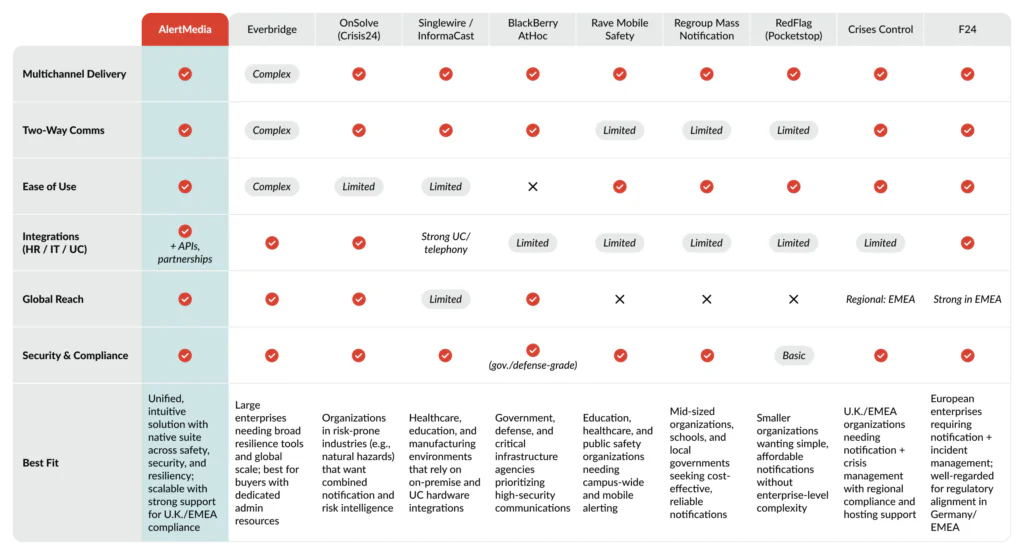
Comparison Overview of Leading Enterprise Notification Systems
Enterprise notification vendors generally fall into two tiers based on scale, complexity, and use-case focus.
Tier 1 Core Providers:
These platforms are commonly used by large enterprises and regulated organizations. Tier 1 systems typically offer deeper functionality, greater administrative control, and broader incident support than tier 2 systems—though, often at the cost of added complexity.
- AlertMedia — Enterprise-ready risk intelligence, response, and incident communication platform focused on speed, usability, and reliable delivery across both emergencies and operational events.
- Everbridge — Critical event management platform with various modules and global reach.
- OnSolve (Crisis24) — Notification and risk intelligence platform often paired with security services.
- Singlewire / InformaCast — On-premise and network-based notification system commonly used in campus environments.
- BlackBerry AtHoc — Secure enterprise notification system frequently used in regulated and government-adjacent organizations.
Tier 2 Specialized & Regional Providers:
These options are frequently used by smaller organizations or public-sector teams with narrower requirements. They can be effective for straightforward alerting but may have limitations at enterprise scale.
- Rave Mobile Safety — Public-sector-focused notification platform with enterprise extensions.
- Regroup Mass Notification — Flexible notification tool often used by mid-sized organizations.
- RedFlag (Pocketstop) — Simple alerting solution with mobile-first design.
- Crises Control — U.K.-based notification platform focused on crisis communications.
- F24 — European-headquartered platform combining notification with business continuity tooling.
Overall, the vendors address different organizational priorities. The following sections examine their capabilities, constraints, and best-fit scenarios.
Top Enterprise Notification Systems in 2026
Our analysis incorporates insights from analyst research, technology review sites, and customer feedback to present an impartial overview of the top enterprise notification systems on the market. For added clarity, providers are organized into two tiers.
Tier 1: Core providers
Tier 1 vendors represent the platforms most commonly evaluated by large enterprises. They offer the scale, integrations, and reliability that larger and more complex organizations often require. These providers are designed to support diverse use cases, from multinationals with global operations to mid-market organizations that want enterprise-grade functionality with room to grow.
Below, we highlight each Tier 1 provider’s strengths, limitations, and best-fit scenarios.
AlertMedia
How does AlertMedia support enterprise communications?
AlertMedia is designed to help enterprise organizations communicate quickly and confidently during emergencies and operational disruptions. Its intuitive, cloud-based platform enables teams across security, operations, HR, and IT to send targeted, multichannel notifications without complex setup or extensive training. AlertMedia supports SMS, voice, email, mobile push notifications, desktop alerts, and integrations with collaboration tools like Microsoft Teams and Slack, helping ensure messages reach employees wherever they’re working.
Unlike platforms assembled through multiple acquisitions, AlertMedia was built as a unified enterprise notification system. That architectural consistency reduces administrative overhead, simplifies governance, and improves reliability during high-pressure events. AlertMedia delivers enterprise notification, threat intelligence, social media intelligence, incident response workflows, and employee safety monitoring within a unified platform, reducing vendor sprawl and simplifying enterprise oversight. For global enterprises, AlertMedia’s infrastructure and regional compliance support make it a scalable option for reliable communication without unnecessary complexity. Enterprises that require deeper business continuity tooling can extend AlertMedia through APIs and integrations alongside existing systems. AlertMedia Analytics extends that same unified-platform advantage to reporting—giving enterprise administrators a single view of delivery rates, response times, and adoption across regions, departments, and business units, without exporting data to spreadsheets for executive reporting.
Everbridge
How does Everbridge support enterprise communications?
On its critical event management platform, Everbridge offers enterprise notification, along with risk monitoring, IT incident response, and public warning systems. Its global reach and broad feature set appeal to multinational enterprises and public-sector organizations with complex operational and regulatory needs.
However, that breadth comes with added complexity. Customers frequently report longer deployment timelines, higher administrative overhead, and the need for dedicated resources to manage the platform effectively. Pricing is also typically higher than many alternatives, with certain capabilities gated behind additional modules or services.
OnSolve (Crisis24)
How does OnSolve support enterprise communications?
Now part of Crisis24, OnSolve combines enterprise notification with risk intelligence and incident management, enabling threat monitoring and communication during evolving situations. OnSolve emphasizes intelligence-driven alerting for security-focused enterprises operating in high-risk environments. Enterprises focused primarily on streamlined internal communication may find more direct value in platforms designed specifically for enterprise alerting.
Because the platform has grown through acquisitions, some users describe the experience as less unified across modules. Third-party feedback also points to variability in usability and support, with deployments and configuration often taking longer than more streamlined platforms, particularly at enterprise scale.
Singlewire / InformaCast
How does Singlewire support enterprise communications?
Singlewire’s InformaCast platform is best known for on-premise and hybrid notification, especially in healthcare, manufacturing, and campus-style environments. It integrates with IP phones, speakers, digital signage, and other physical devices, allowing organizations to reach people through both digital and on-site channels.
InformaCast is frequently tied to Cisco-based phone systems and hardware integrations, which can limit flexibility for cloud-first or globally distributed enterprises. While effective in contained environments, it may not scale as seamlessly for organizations with large remote or international workforces.
BlackBerry AtHoc
How does AtHoc support enterprise communications?
BlackBerry AtHoc is widely used by government agencies and highly regulated organizations that prioritize secure, controlled communication. The platform emphasizes compliance, centralized administration, and reliability in high-security environments, making it a longstanding option for defense and critical infrastructure sectors.
For commercial enterprises, however, AtHoc’s government-oriented design can feel rigid. Users often cite more complex workflows and a less modern user experience compared to cloud-native enterprise notification platforms.
Other Notable Enterprise Notification Providers
Tier 2: Specialized and regional platforms
Tier 2 vendors play an important role in the enterprise notification landscape, particularly for organizations with narrower requirements, budget constraints, or regional needs. While these platforms may not offer the breadth or scale of tier 1 systems, they can be effective in specific contexts.
The following profiles outline where these systems stand out and where they may fall short compared to broader platforms.
Rave Mobile Safety
Best for education, healthcare, and public-sector organizations with strong life-safety requirements. Rave offers campus alerting, mobile safety apps, and panic button functionality, but it may lack the scalability and governance depth required by large enterprises.
Regroup Mass Notification
Best for schools, municipalities, and mid-sized organizations seeking straightforward alerting. Regroup focuses on reliable message delivery but does not offer the broader incident or intelligence capabilities common in enterprise-grade platforms.
RedFlag (Pocketstop)
Best for smaller organizations needing simple, cost-conscious notification. While easy to deploy, RedFlag has limited integrations and scalability for complex enterprise environments.
Crises Control
Best for U.K.- and EMEA-based organizations looking for notification and basic crisis workflows. Crises Control emphasizes regional compliance and mobile-first communication, with more limited adoption outside Europe.
F24
Best for European enterprises combining notification with incident management. Based in Germany, F24 is recognized for regulatory alignment across EMEA, with its brand presence and adoption concentrated in Europe rather than globally.
How to Choose the Right Enterprise Notification System
Enterprise buyers should evaluate platforms based on operational reality, not just feature lists.
Key considerations include:
- Ability to send high-volume messages reliably
- Administrative controls and role-based access
- Ease of use during high-stress incidents
- Integration with enterprise HR and IT systems
- Support for global and multilingual teams
- Reporting and audit requirements
- Flexibility for both emergency and non-emergency use
- Time-to-value and deployment complexity
Choosing a tool is easy—operationalizing it across the enterprise is harder.
Common Implementation Challenges
Even mature organizations face challenges when deploying enterprise notification systems:
- Aligning ownership across security, IT, and HR
- Preventing alert fatigue through better targeting
- Maintaining accurate contact and group data
- Training administrators across regions
- Balancing governance with speed during incidents
Planning for these challenges early improves adoption and long-term effectiveness.
Frequently Asked Questions
What is an enterprise notification system?
An enterprise notification system is a platform that allows large organizations to send time-sensitive messages across multiple channels to targeted audiences. Unlike basic alerting tools, enterprise systems are built to support scale, governance, integrations, and reliable delivery during critical events and operational disruptions.
How is an enterprise notification system different from a mass notification system?
Mass notification systems focus primarily on sending alerts at scale. Enterprise notification systems include additional capabilities such as role-based access controls, approval workflows, integrations with enterprise systems, and reporting needed to operate reliably in complex organizations.
Are enterprise notification systems used only for emergencies?
No. While emergencies are a core use case, many enterprises also use these systems for IT outages, facility closures, travel disruptions, and workforce updates. Using one platform for both emergency and operational communications helps reduce confusion and improve adoption.
How do enterprise notification systems ensure messages are delivered?
Most enterprise platforms use multichannel delivery—such as SMS, voice, email, mobile push, and desktop alerts—to increase reach. They also include retries, failover mechanisms, and delivery reporting so teams can see who received and acknowledged messages.
Can enterprise notification systems support global organizations?
Many enterprise notification systems support international messaging, time zones, and multilingual communication. Capabilities vary by vendor, so global enterprises should evaluate regional coverage, local compliance requirements, and delivery reliability in the countries where they operate.
Who typically owns an enterprise notification system internally?
Ownership often sits with security, business continuity, or risk teams, but day-to-day use commonly spans HR, IT, operations, and facilities. In large organizations, governance is usually shared across functions to balance speed, accuracy, and oversight.
How do enterprises reduce alert fatigue?
Organizations reduce alert fatigue through better targeting, role-based groups, and clear policies around when notifications are sent. Enterprise systems that support dynamic groups and two-way communication help ensure messages are relevant and actionable.
What integrations should enterprises look for?
Common integrations include HR systems for contact data, identity and access management tools, collaboration platforms like Microsoft Teams or Slack, and IT service management systems. These integrations help keep data current and streamline workflows during incidents.
How long does it take to implement an enterprise notification system?
Implementation timelines vary widely based on platform complexity, integrations, and organizational readiness. Some systems can be deployed quickly for basic notification, while others require longer setup for governance, integrations, and training.
How do enterprises build a business case for an enterprise notification system?
Business cases typically focus on reducing downtime, improving employee safety, and limiting operational risk during disruptions. Clear communication during incidents also helps prevent secondary impacts such as confusion, duplicated work, and delayed decision-making.