By AlertMedia, Risk Intelligence and Response

Safety and Security Sep 02, 2026
What Is a Travel Risk Planning System With Social Intelligence Monitoring Capabilities?
Travel Risk Management Key Feature Guide
Explore how AlertMedia can help keep your travelers informed and out of harm’s way.
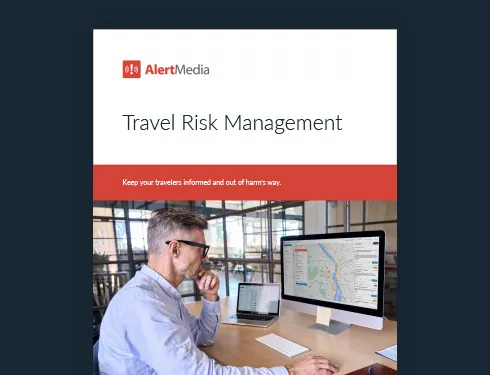
Table of Contents
- Why a Travel Risk Planning System With Social Intelligence Monitoring Matters
- Key Components of a Travel Risk Planning System With Social Intelligence Monitoring
- How a Travel Risk Planning System With Social Intelligence Monitoring Works
- Best Practices for Travel Risk Planning
- Common Challenges and How to Address Them
- How AlertMedia Approaches Travel Risk Planning and Social Intelligence Monitoring
A travel risk planning system with social intelligence monitoring capabilities combines destination-based travel risk management with visibility into online conversations, sentiment, and narratives that could affect an organization’s people, brand, or operations. It helps corporate security and business continuity teams protect traveling employees by tracking itineraries and destination-specific threats, while separately monitoring social platforms, forums, and other online sources for emerging risks at home or near travel destinations. For organizations with employees on the road, this pairing matters because travel exposes people to risks that itinerary data alone can miss. This page explains how each capability works, why organizations use them together, the key components to look for, and how AlertMedia approaches both within its unified risk intelligence and response platform.
Travel Risk Management Key Feature Guide
Explore how AlertMedia can help keep your travelers informed and out of harm’s way.
Why a Travel Risk Planning System With Social Intelligence Monitoring Matters
Stronger duty of care
Documenting a defensible duty-of-care program means more than tracking flights and hotels. Pairing destination-based risk data with visibility into online sentiment gives security teams a fuller record of what they knew, when they knew it, and how they responded.
Full visibility beyond the itinerary
Itinerary data and critical information on protests and emerging risks inform a team where a traveler is supposed to be and what threats that location may have. Social and online monitoring surfaces conversations, protests, and emerging narratives that itinerary data was never designed to catch, filling a real gap in most travel risk programs.
Faster, more informed response
When a destination-specific alert and an online-sourced social signal both point toward the same emerging risk, especially if those risks include threats of violence or aggressive chatter, a team can act with more confidence and less delay than either signal would provide alone.
A force multiplier for lean teams
Most travel safety teams are small relative to the number of destinations and travelers they cover. AI-assisted monitoring across both travel and online sources helps a lean team keep pace without adding headcount.
Key Components of a Travel Risk Planning System With Social Intelligence Monitoring
The table below describes what this combined capability set should include at the category level, independent of any specific vendor.
| Component | What It Means | Why It Matters |
| Destination-based risk assessment | Ratings that quantify the relative risk of a travel destination based on ongoing threat monitoring | Helps teams flag high-risk trips before they happen |
| Traveler location monitoring | Visibility into where employees are during active and upcoming trips | Enables faster outreach when a threat affects a specific destination |
| Pre-trip preparation | Curated Travel Briefs covering safety conditions, local culture, and emergency contacts | Prepares travelers to make informed decisions on the ground |
| Localized threat alerts | Automatic notifications tied to a traveler’s active or upcoming location | Keeps travelers and safety teams ahead of destination-specific risks |
| Two-way communication | Direct, two-way messaging that lets safety teams send updates and travelers request help or confirm their status | Helps teams reach affected travelers quickly and verify who is safe as conditions change |
| Social and online monitoring | Tracking of public sentiment, narratives, and emerging risk signals across social platforms and forums | Surfaces reputational and situational risks that itinerary data doesn’t capture |
| AI-powered analysis and automation | AI that filters, categorizes, and summarizes large volumes of online and threat data | Lets lean teams cover more ground without more headcount |
| Human-verified intelligence | Analyst review layered on top of automated signals | Builds the confidence needed to act on what surfaces |
Keep your travelers out of harm's way with AlertMedia's Travel Risk Management.
How a Travel Risk Planning System With Social Intelligence Monitoring Works
1. Monitor
Track employee itineraries and destination conditions continuously, and, as a separate workstream, monitor public online conversations—and even use intel from Threat Briefs to inform queries—to keep an eye on narratives that could affect travelers, executives, or the business.
2. Verify
AI filters and categorizes incoming signals from both destination-based threat intelligence feeds and from online social monitoring; analysts review flagged items in each workstream before anything reaches a response team.
3. Assess impact
Compare active and upcoming trips against verified destination risk ratings, and weigh any credible online-sourced signals, to determine who might be affected and how urgently.
4. Coordinate the response
Loop in the right stakeholders — a travel safety team responding to a destination alert, or a security team investigating an online narrative — and align on next steps.
5. Communicate
Reach affected travelers directly through two-way communication, and add custom information alongside Travel Briefs or advisories as conditions change.
6. Resolve and report
Document the response and use what was learned to refine destination risk ratings or monitoring parameters going forward.
Best Practices for Travel Risk Planning
- Define a single source of truth for destination risk ratings before a trip is booked.
- Sync traveler, itinerary, and location data continuously across every active trip.
- Monitor social platforms and forums for narratives that could affect travelers or destinations, even when no itinerary-based risk has been flagged.
- Build pre-deployed response plans for high-frequency travel risk scenarios.
- Use two-way communication to confirm a traveler’s status quickly during an incident.
- Segment travelers by destination, risk tier, and role for faster outreach.
- Test travel risk response plans through tabletop exercises before peak travel seasons.
- Treat duty of care as a continuous program, not a per-trip checklist.
Common Challenges and How to Address Them
| Challenge | Why It Happens | How to Address It |
| Travel risk and online monitoring live in separate tools | Teams often adopt travel and social monitoring solutions from different vendors at different times | Run both capabilities on one platform so every team works from a consistent view of active risk |
| Distributed and traveling employees fall outside standard coverage | Traditional risk monitoring is built around fixed office locations with missing, unsupported, or broken TRM or HRIS integration | Extend monitoring to wherever the itinerary places an employee, updated in real time |
| Alert fatigue from unfiltered online monitoring | Broad keyword searches surface high volumes of low-relevance content | Use AI-assisted search and analyst review to filter for what’s actually relevant |
| Response plans live in documents, not workflows | Static and siloed travel risk plans are hard to execute under time pressure | Build response steps directly into the platform travelers and safety teams already use |
How AlertMedia Approaches Travel Risk Planning and Social Intelligence Monitoring
AlertMedia is the industry’s only unified risk intelligence and response platform. For travel risk planning specifically, that means Travel Risk Management and Social Intelligence live on the same platform and the same admin experience. Security and business continuity teams get destination-based travel risk management and intelligence, and social monitoring side-by-side, both backed by AI and analyst verification, without stitching together point solutions from different vendors.
| Platform Need | How AlertMedia Helps |
| Track traveler locations and destination risk | Travel Risk Management syncs itineraries automatically, applies a 4-tier Travel Risk Rating (1-Normal through 4-Suspend), and sends Localized Threat Alerts to travelers or safety staff |
| Prepare travelers ahead of a trip | Expert-curated Travel Briefs cover safety tips, weather, company-specific information, local culture, and emergency contacts for hundreds of tracked destinations |
| Reach travelers during an incident | Two-Way Communication lets travelers request help at any time and lets safety teams notify affected employees across channels |
| Monitor online conversations and sentiment | Social Intelligence uses agentic AI search to track mentions across 60+ social platforms, fringe forums, and dark web sources, surfacing sentiment shifts and emerging narratives |
| Visualize risk geographically | Visual Intelligence, a platform feature, maps traveler locations and threat data together for shared situational awareness |
| Verify what surfaces | Both capabilities pair AI-driven filtering with human review — analyst-verified alerts and briefs for Travel Risk Management, and analyst-reviewable AI summaries for Social Intelligence |
AI across the platform
AI is built into both capabilities, not as a single feature but as the connective tissue that helps a small team cover more ground. In AlertMedia’s Travel Risk Management integration with Threat Intelligence, AI-vetted signals help destination risk information move quickly; in Social Intelligence, agentic AI builds complex search queries from plain language, and proprietary large language models power sentiment and thematic analysis.
The defining choice in how AlertMedia uses AI: AI scales the platform, and AI paired with analyst verification is what makes the intelligence trustworthy enough to act on.
Platform features
Beyond Travel Risk Management and Social Intelligence, Visual Intelligence gives every team a shared map view of travelers and threats, and Analyst Access provides 24/7 expert support when a team needs additional context on a destination or an emerging online narrative.
More than 3,500 organizations across 150+ countries rely on AlertMedia’s platform, with customers reporting response times 25+ minutes faster and force-multiplier value equivalent to adding roughly three security FTE. AlertMedia has been named a Gartner Peer Insights™ Customers’ Choice.
Frequently Asked Questions
- What is a travel risk planning system with social intelligence monitoring capabilities? A travel risk planning system with social intelligence monitoring capabilities pairs destination-based travel risk management — itinerary syncing, traveler tracking, and localized threat alerts — with monitoring of social media, forums, and other online sources for sentiment and emerging narratives. Together, these capabilities give security and business continuity teams a fuller picture of the risks traveling employees face, from destination-specific threats to online conversations that could affect a trip, an event, or the organization's reputation.
- How is travel risk management different from social intelligence monitoring? Travel risk management focuses on the traveler: syncing itineraries, tracking locations, and delivering destination-specific briefings and alerts. Social intelligence monitoring focuses on public online activity: tracking sentiment, narratives, and mentions across social platforms, forums, and the dark web. They answer different questions — where is my traveler and what's the risk at their destination, versus what is being said online that could affect my people or brand — and work best as complementary capabilities.
- What capabilities should a travel risk planning system include? At minimum, a travel risk planning system should include automatic itinerary syncing, destination-based risk ratings, pre-trip briefings, localized threat alerts, and two-way communication with travelers. Organizations that also want visibility into online sentiment and emerging narratives should look for social and online monitoring as a complementary capability, ideally on the same platform so both teams can work from a consistent view of active risk.
- Who uses travel risk management and social intelligence monitoring? Corporate security teams typically own travel risk management and social intelligence monitoring as part of a broader program to protect traveling employees, executives, and brand reputation. Business continuity and operational resilience teams also rely on both capabilities to document duty of care, anticipate disruptions to travel-dependent operations, and coordinate a response when a destination-specific or online-sourced risk affects the business.
- Does travel risk management software connect directly to social intelligence monitoring data? Not automatically. Travel Risk Management and Social Intelligence are separate, purpose-built capabilities that live on the same unified platform, but they don't share a live data feed today. In practice, a security team can use Travel Risk Management to track itineraries and destination risk, and separately use Social Intelligence to monitor online sentiment and narratives, both from the same admin experience, without one system automatically triggering action in the other.
- What role does AI play in travel risk planning and social intelligence monitoring? AI scales both capabilities. In travel risk management, AI-vetted signals help surface destination-specific threats quickly. In social intelligence monitoring, agentic AI builds complex search queries from plain language, and proprietary large language models power sentiment and thematic analysis. In both cases, AI paired with analyst verification is what makes the resulting intelligence trustworthy enough for a team to act on.
- How does social intelligence monitoring support travel risk decisions? Social intelligence monitoring gives travel safety teams visibility into public sentiment, protests, unrest, and other online narratives that could affect a destination, an event, or a traveling executive. While it doesn't feed directly into a traveler's itinerary today, a security team can reference social intelligence findings alongside destination risk ratings when deciding whether to adjust, delay, or reroute a trip.
- How does AlertMedia support duty of care for business travelers? AlertMedia helps organizations document a defensible duty-of-care program by combining automatic itinerary syncing, destination-based Travel Risk Ratings, expert-curated Travel Briefs, and Localized Threat Alerts, all supported by a travel security analyst team and reporting on past, active, and upcoming trips.
Travel Risk Management Key Feature Guide
Explore how AlertMedia can help keep your travelers informed and out of harm’s way.

AlertMedia, Risk Intelligence and Response


More Articles You May Be Interested In
-

 Safety and Security, Emergency Management20 Business Travel Safety Tips and Guidelines for Employees
 -
 Emergency Management, Safety and SecurityHow the ISO 31030 Framework Enhances Travel Safety and Business Resilience
 -
 Safety and SecurityLocation-Based Weather Alerts to Keep Traveling Employees Safe