By AlertMedia, Risk Intelligence and Response

Emergency Management Oct 20, 2026
AI for Incident Response and Emergency Communication ROI: A Guide for Security and Resilience Teams
Incident Response Key Feature Guide
Create a customized, crisis-ready framework to keep your organization running through any disruption.
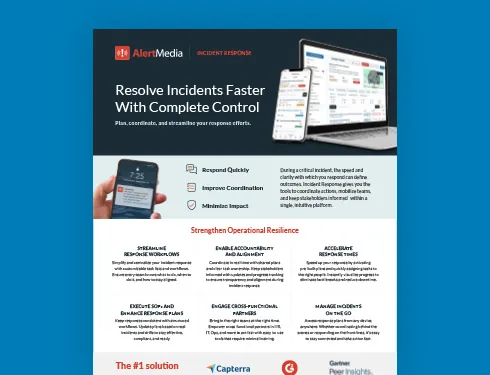
Table of Contents
- Why AI for Incident Response and Emergency Communication ROI Matters
- Key Components of Measuring AI Return in Incident Response and Emergency Communication
- How to Measure the ROI of AI in Incident Response and Emergency Communication
- What Coordination Looks Like With AlertMedia
- Common Challenges and How to Address Them
- How AlertMedia Approaches AI in Incident Response and Emergency Communication
- AI across the platform
AI for incident response and emergency communication ROI is the measurable return an organization gets when AI takes on the time-consuming parts of planning, drafting, and translating during response. It helps security and resilience teams save planning and messaging time, speed up response, and reduce the training burden on administrators. For leaders building a budget case, it matters because most of the value shows up in time saved before and during an incident. This page explains why AI return matters, which components to measure, how to calculate it, and how organizations can strengthen the result.
Why AI for Incident Response and Emergency Communication ROI Matters
Faster plan creation and upkeep
Response plans lose value when they are slow to write or out of date. AI that produces a tailored first draft lets teams spend their time refining plans instead of starting from a blank page, which makes regular updates realistic.
Faster, clearer messages
During an incident, writing takes time that responders do not have. AI that drafts and edits messages in seconds helps senders reach the right audience quickly and with more confidence.
Broader reach across languages
Global workforces need messages in their preferred languages. Built-in translation removes a manual step and reduces the risk of confusion when clarity matters most.
Less administrator time and training
Software that is easy to learn costs less to adopt. When more people can build plans and send messages with minimal training, the response does not depend on a few specialists.
Audit-ready documentation
Reports generated from the same workflow reduce the time spent reconstructing what happened, which supports after-action reviews and compliance reporting.
Key Components of Measuring AI Return in Incident Response and Emergency Communication
Seven components shape a credible measurement approach. Each describes what any organization should expect, regardless of vendor.
| Component | What it means | Why it matters |
| Baseline measurement | Record how long planning, drafting, translating, and reporting take today. | Savings can only be shown against a starting point. |
| AI-powered drafting and automation | AI produces first drafts of plans and messages for people to refine. | This is where most time is saved. |
| Human review and verification | People review and approve AI output before it is used. | Quality and accountability stay with the team. |
| Response-time tracking | Measure the time from detection to the first message and to task assignment. | Faster response is the largest source of avoided cost. |
| Administrator time and training | Track the hours needed to train new users and maintain content. | Adoption cost affects total return. |
| Multilingual reach | Count the languages and audiences that can be reached without manual translation. | Reach reduces confusion and rework. |
| Reporting and documentation | Capture action logs and message history automatically. | Audit readiness has a measurable time cost. |
How to Measure the ROI of AI in Incident Response and Emergency Communication
1. Baseline your current effort
Document the hours your team spends building and updating plans, drafting and translating messages, training administrators, and writing reports after incidents.
2. Apply AI where drafting is slow, and keep people in the loop
Use AI to generate first drafts of plans and messages. Require human review so people stay accountable for what is approved and sent.
3. Track time and response outcomes
Measure the same activities again, along with the time to send the first message and assign the first task during incidents and exercises.
4. Convert time saved into value
Multiply hours saved by the loaded hourly cost of the people involved. Add the value your organization places on faster response, using figures from your own operations.
5. Compare against cost
A simple model is ROI = (value of time saved + value of faster response − cost of the software) ÷ cost of the software. Use your own inputs; do not rely on generic benchmarks.
6. Report and refine
Share results with leadership, review them after each incident or exercise, and adjust the model as usage grows.
What Coordination Looks Like With AlertMedia
| Current State | With AlertMedia |
| Response updates are scattered across calls, texts, and email threads. | A centralized Incident Page tracks the response in one place, accessible from any device. |
| Task ownership is unclear once multiple departments get involved. | Custom Task Assignment gives every task a clear, role-based owner. |
| Understanding what is affected relies on manual reports from the field. | Dynamic Impact Area Monitoring shows affected areas on a map, updated as conditions change. |
| Notifying affected employees is a separate step from managing the response. | Notifications run inside the same platform used to coordinate the incident. |
| Post-incident documentation means reconstructing what happened after the fact. | Post-Incident Reporting generates audit-ready records as part of the response workflow. |
Best Practices for Maximizing AI Return
- Measure a baseline before introducing AI so improvements are easy to demonstrate.
- Require human review of AI-generated plans and messages before they are approved or sent.
- Start with the plans and message types your team creates most often.
- Use templates and standard variables so AI drafts stay consistent with your processes.
- Train a broad group of administrators so response does not depend on a few specialists.
- Track response time during tabletop exercises as well as live incidents.
- Support multiple languages for global and multilingual workforces.
- Review results after every incident and update plans based on what you learn.
- Keep calculations grounded in your own inputs rather than industry averages.
Common Challenges and How to Address Them
| Challenge | Why it happens | How to address it |
| It is hard to isolate what AI changed. | Plans, messages, and incidents vary widely. | Compare the same tasks before and after, and use exercises for consistent scenarios. |
| AI drafts still need review. | Plans and messages carry organizational accountability. | Build review and approval into the workflow so oversight is part of the time budget. |
| Most value appears during infrequent incidents. | Major incidents are rare. | Measure planning, drafting, and training time continuously, and use exercises to simulate response. |
| Adoption varies by team. | Complex software limits who can participate. | Choose software that administrators can learn quickly and measure adoption. |
How AlertMedia Approaches AI in Incident Response and Emergency Communication
AlertMedia is a unified risk intelligence and response platform. AI is built into the workflows where teams spend the most time, inside Incident Response and Emergency Communication, so the return shows up in plans built, messages sent, and administrators trained.
| Platform need | How AlertMedia helps |
| Create and refresh response plans | AI Plan Builder in Incident Response creates a tailored response-plan first draft in minutes based on industry, team, and compliance requirements, so teams spend time refining rather than writing. |
| Draft and edit messages quickly | AI Composer in Emergency Communication drafts, edits, and translates messages in seconds. |
| Reach every language | Automatic Message Translation sends messages in each recipient’s preferred language from a single workflow. |
| Reuse proven workflows | Rapid Deployment Templates deploy pre-built, customizable response plans in one tap. |
| Coordinate the response | Incident Pages and Custom Task Assignment keep ownership and progress visible from any device. |
| Document and learn | Actionable Post-Incident Reporting produces audit-ready reports with action logs, sent messages, and resolution timelines. |
AI across the platform
AI appears across the platform as named, product-embedded capabilities: AI Plan Builder in Incident Response, AI Composer in Emergency Communication, AI Query Builder in Social Intelligence, and the AI-vetted layer of Real-Time Signals in Threat Intelligence. AI scales the platform; AI paired with analyst verification and human review is what makes the output trustworthy enough to act on.
Customers report responding 25+ minutes faster and training new administrators in about 20 minutes, with an 87% increase in administrator adoption. More than 3,500 organizations in over 150 countries rely on AlertMedia, which has been named a Gartner Peer Insights™ Customers’ Choice.
”AlertMedia helps us get our crisis response team together quickly when there's an incident so we can rapidly communicate important messages to thousands of people across email, text, phone, and more. That saves us a lot of time—it's a labor-saving solution.” —Matt McMahan, Sr. Manager of Business Continuity, Texas Roadhouse
Frequently Asked Questions
- What is AI for incident response and emergency communication ROI? The ROI of AI for incident response and emergency communication is the value gained from time saved in plan creation, message drafting, translation, training, and reporting, plus the value of faster response, compared with the cost of the software. It is calculated with your own inputs, such as hours saved and loaded hourly cost.
- How do you measure the return on AI-assisted response planning? Record how long plan creation and updates take today, then measure the same activities with AI-assisted drafting. Multiply hours saved by loaded hourly cost, add the value of faster response, and compare the total with the cost of the software.
- Where does AI save time in emergency communication? AI saves time in drafting, editing, and translating messages. Software like AlertMedia's AI Composer drafts and refines messages in seconds, and Automatic Message Translation sends them in each recipient's preferred language, which reduces manual work during an incident.
- What inputs do I need to build an ROI case? Gather the hours spent on plan creation, message drafting and translation, administrator training, and post-incident reporting, plus loaded hourly costs, the number of plans and incidents per year, and the languages supported. Use your own figures rather than industry averages.
- What role does AI play in incident response and emergency communication? AI generates first drafts of response plans and messages, translates content, and speeds up routine work. People review and approve the output. AlertMedia pairs AI with human review and, in intelligence workflows, analyst verification, so teams can act on the results with confidence.
- Who reviews AI-generated plans and messages? The team that owns the plan or message should review and approve it. AI provides a first draft, and the sender or plan owner stays accountable for the final version. Building review into the workflow keeps oversight part of the process.
- How long does it take to see value from AI in response workflows? Time savings from drafting and training appear as soon as teams start using the software for plans and messages. Response-time improvements are easiest to see during tabletop exercises and live incidents. Track both so results are visible to leadership early.
- Does AI reduce the need for tabletop exercises? No. AI helps teams create and refine plans faster, but exercises remain the best way to test them. Faster planning can free time for more frequent exercises, which also generate the response-time data needed to measure ROI.
Download Our Incident Response Key Feature Guide
Create a customized, crisis-ready framework to keep your organization running through any disruption.

AlertMedia, Risk Intelligence and Response