
By AlertMedia, Risk Intelligence and Response

Safety and Security Sep 01, 2026
What Is Business Travel Safety Management?
Travel Risk Management Key Feature Guide
Explore how AlertMedia can help keep your travelers informed and out of harm’s way.
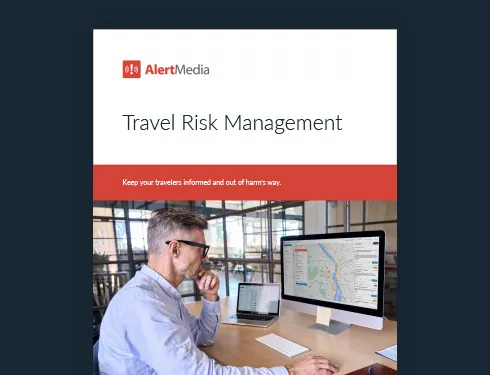
Table of Contents
Business travel safety management is the practice of protecting employees who travel for work by preparing them ahead of trips, monitoring their location and surrounding conditions, and alerting and supporting them if a threat emerges. It helps organizations fulfill their duty of care to traveling employees by giving security and HR teams continuous visibility into travel risk rather than relying on ad hoc, per-trip judgment calls. For organizations with any regular business travel, business travel safety management is important because unmanaged travel risk creates both a safety liability and a legal one. This page explains what the term covers, why it matters, the capabilities it typically includes, and how it relates to Travel Risk Management as a specific product category.
Travel Risk Management Key Feature Guide
Explore how AlertMedia can help keep your travelers informed and out of harm’s way.
Why Business Travel Safety Management Matters
Fulfilling a legal duty of care
Organizations have a legal and ethical obligation to take reasonable steps to protect employees while they travel, and a defined safety management practice turns that obligation into a documented, repeatable process.
Protecting business continuity
A traveling employee affected by a disruption can create operational impact well beyond their own safety, from missed commitments to broader response burden on the organization.
Supporting a global or dispersed workforce
As business travel spans more destinations and time zones, a structured safety management practice keeps protection consistent regardless of where an employee is traveling.
Building traveler confidence
Employees who trust that their organization will inform and support them during travel are more willing to take on travel as part of their role.
Key Components of Business Travel Safety Management
| Component | What It Means | Why It Matters |
| Traveler preparation | Destination-specific safety, cultural, and emergency information delivered before a trip | Turns travelers into informed participants in their own safety, not passive recipients |
| Risk rating | A consistent, scaled measure of destination risk | Gives travelers and approvers a shared, plain-language reference point |
| Traveler monitoring | Ongoing visibility into where employees are traveling | Keeps the safety team’s picture of active travel current, not a point-in-time snapshot |
| Threat alerting | Automatic, localized notifications when a threat emerges near a trip | Surfaces relevant risk without requiring manual, destination-by-destination checks |
| Two-way communication | A channel for travelers to request help and for staff to confirm status | Closes the loop when a traveler actually needs assistance |
| Reporting | A record of trips, preparation, and response actions | Supports duty-of-care documentation and program review |
How Business Travel Safety Management Works
1. Prepare
Equip travelers ahead of each trip with destination-specific safety, cultural, and emergency-contact information.
2. Monitor
Track active and upcoming trips continuously, syncing itinerary data so the safety team’s view stays current.
3. Assess
Score destination risk consistently so travelers and approvers share a common understanding of caution level.
4. Alert
Notify travelers and safety staff automatically when a threat emerges near an active or upcoming trip.
5. Respond
Give travelers a direct way to request help and give staff a way to confirm status during a disruption.
Best Practices for Business Travel Safety Management
- Treat travel safety as an ongoing program, not a one-time policy document.
- Prepare travelers proactively instead of leaving destination research to the traveler.
- Apply a consistent risk rating across every destination, not just high-profile ones.
- Sync itinerary data automatically rather than relying on manual reporting.
- Give travelers a direct channel to reach help, not just a way to receive alerts.
- Document preparation, alerts, and response actions for duty-of-care review.
Keep your travelers out of harm's way with AlertMedia's Travel Risk Management.
Common Challenges and How to Address Them
| Challenge | Why It Happens | How to Address It |
| Travel safety managed separately from core security operations | Travel programs often sit with HR or travel management rather than security | Integrate travel safety into the same platform used for broader risk monitoring |
| Inconsistent traveler preparation | No standardized briefing process across trips | Use a structured, expert-curated briefing delivered ahead of every trip |
| Delayed awareness of destination threats | Manual research doesn’t scale across a global travel footprint | Automate destination-based alerting tied to active itineraries |
| Difficulty proving duty-of-care compliance | Preparation and response records live in separate, informal systems | Centralize reporting on trips, preparation, and response actions |
How AlertMedia Approaches Business Travel Safety Management
AlertMedia is the industry’s only unified risk intelligence and response platform. AlertMedia’s Travel Risk Management is what this category includes in practice, bringing together five capability blocks in one integrated system.
| Platform Need | How AlertMedia Helps |
| Traveler preparation | Travel Briefs deliver analyst-curated destination intelligence before every trip |
| Consistent risk scoring | Travel Risk Ratings apply a 4-tier scale (Normal, Caution, Avoid, Suspend) across every destination |
| Ongoing visibility | Traveler Monitoring combines itinerary-based tracking with optional mobile app location monitoring |
| Automated alerting | Localized Threat Alerts notify travelers and staff automatically near active or upcoming trips |
| Direct traveler support | Two-Way Communication lets travelers request help at any time |
“If your people are traveling, you have a legal duty of care to make sure they stay safe.” — Delia Midamba, Head of Physical Security, Cloudflare
More than 3,500 organizations across 150+ countries use AlertMedia to manage travel risk as part of a unified risk intelligence and response platform.
Frequently Asked Questions
- What is business travel safety management? Business travel safety management is the practice of protecting traveling employees through preparation, monitoring, risk assessment, alerting, and response, so organizations can fulfill their duty of care consistently across every trip.
- Why do companies need a travel safety program? Companies need a travel safety program because unmanaged travel risk creates both a safety and legal liability, and a structured program replaces ad hoc, per-trip judgment with a documented, repeatable process.
- What's the difference between travel risk management and business travel safety management? Business travel safety management is the broader practice; Travel Risk Management is AlertMedia's specific product category that delivers it, combining Travel Briefs, Travel Risk Ratings, Traveler Monitoring, Localized Threat Alerts, and Two-Way Communication in one platform.
- Who is responsible for business travel safety management? Responsibility typically sits with corporate security and HR teams, often working together, since travel safety spans both physical security response and employee duty of care.
Travel Risk Management Key Feature Guide
Explore how AlertMedia can help keep your travelers informed and out of harm’s way.

AlertMedia, Risk Intelligence and Response


More Articles You May Be Interested In
-

 Safety and Security, Emergency Management20 Business Travel Safety Tips and Guidelines for Employees
 -
 Emergency Management, Safety and SecurityHow the ISO 31030 Framework Enhances Travel Safety and Business Resilience
 -
 Safety and SecurityLocation-Based Weather Alerts to Keep Traveling Employees Safe