In 1715, Great Britain’s Riot Act came into force with a simple rule: If 12 or more people gathered “unlawfully, riotously, and tumultuously,” an official could read them a short proclamation ordering them to disperse. Anyone still there an hour later was guilty of a felony punishable by death.
Parliament scrapped the law in England and Wales in 1967. The phrase outlived it. Today, to “read someone the riot act” simply means to give them a stern warning.
Now, new data is offering a stern warning of its own.
A busy quarter
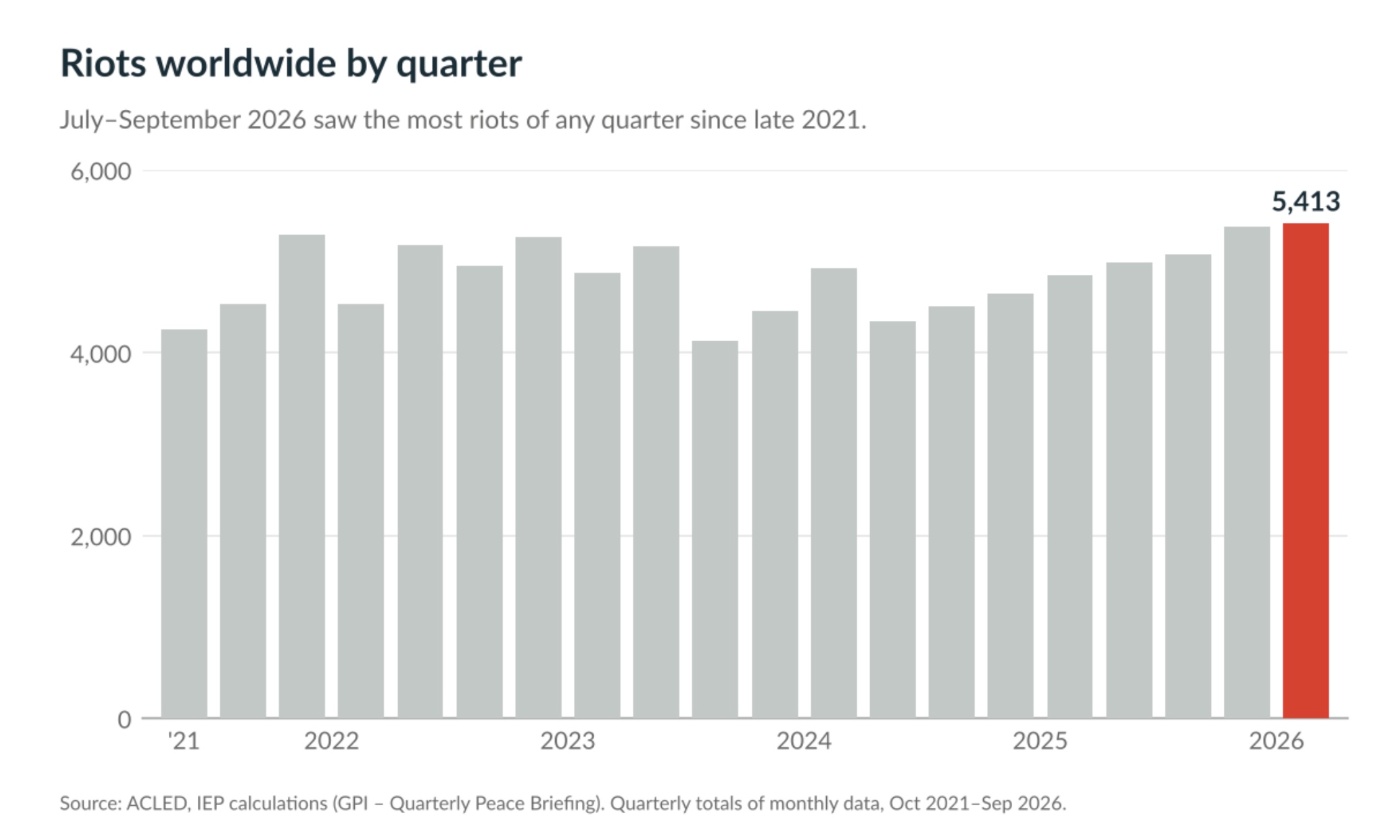
There were 5,413 riots worldwide from July to September, according to the Institute for Economics & Peace’s (IEP) latest Quarterly Peace Briefing. That’s the highest quarterly total since late 2021 and 11.7% more than the same quarter last year.
IEP, which draws its riot data from the Armed Conflict Location and Event Data project (ACLED), counts both mob violence and violent demonstrations as riots.
The Palestinian territories accounted for 1,707 riots, nearly a third of the global total. In France, riots more than tripled, from 55 to 178. Riot deaths were highest in Pakistan (95), Kenya (79), and India (46).
Fortunately, riot deaths fell 24.5% from the previous quarter, to 735. And the briefing’s other numbers moved the opposite way. Conflict deaths fell 52.2% from a year earlier, and terrorism deaths hit their lowest level of any quarter since late 2021.
In other words, fewer people are dying in wars and terror attacks. More are taking to the streets.
From the street to the storefront
On August 27, a march on Indonesia’s parliament in Jakarta calling for a law to seize assets tied to corruption ended in clashes with police and overnight rioting. A police post and a motorcycle were set on fire, and police later named 48 suspects. It came one year after riots in Jakarta and other cities left 11 people dead and led to more than 3,000 arrests.
The momentum didn’t stop when the quarter ended. On October 17, protests in France over rising living costs and declining public services spiraled into the worst riots in years. Limoges’ city hall was set ablaze. In Paris, rioters smashed banks and ransacked stores. Prime Minister Sébastien Lecornu said about 1,200 people had been arrested and more than 150 police officers injured.
More than 3,000 shops are estimated to have been damaged or looted that weekend.
“Despite a relatively calm night on Monday, the reckoning from France’s worst bout of violence in years is set to continue,” said Jess Middleton, Senior Europe Analyst at Verisk Maplecroft.
The cost of unrest
Most protests never turn violent. Verisk Maplecroft estimates that about 90% stay peaceful, and fewer than 1% directly damage private property.
But the ones that do can be costly. Insured losses from strikes, riots, and civil commotion climbed from negligible levels in 2013 to more than $8 billion between 2020 and 2024, according to reinsurance broker Howden Re. France’s 2023 riots alone generated roughly €1 billion in insured losses.
“It’s fair to say that the SRCC [strikes, riots, and civil commotion] risk landscape has fundamentally changed,” said Torbjorn Soltvedt, Associate Director of Political Violence at Verisk Maplecroft.
Why you should care: Riots almost never start with a business in mind. But businesses sit where riots happen: downtown offices near government buildings, storefronts on main streets, and the transit hubs your employees pass through on the way home.
Know which of your facilities and people are near likely flashpoints, such as government buildings, campuses, and major public squares. Track planned demonstrations, since many unfold on a known date. And decide ahead of time who makes the call to close early or shift to remote work and how you’ll reach employees fast, including those traveling abroad.
If your plan has gaps, this civil unrest preparedness playbook is a good place to start.
|