On August 27, 1883, the eruption of Krakatoa was so powerful that the atmospheric pressure waves it generated circled the globe several times. Barometers from Europe to North America recorded the disturbance, providing one of the earliest demonstrations that a natural disaster could be detected thousands of miles from where it occurred. More than a century later, the technology has changed dramatically. Instead of scientific instruments measuring changes in air pressure, billions of smartphones are quietly listening for the first signs of an earthquake. Last week’s earthquakes in Venezuela showed just how valuable that evolution has become.
Your phone became part of the warning system
When two powerful earthquakes struck northern Venezuela, millions of Android users received an alert before the strongest shaking arrived. For some, the warning lasted only a few seconds. That may not sound like much, but it was enough time to move away from heavy furniture, step off a ladder, or stop an activity that could quickly become dangerous. Most importantly, it gave people a chance to act on one of the most effective earthquake safety practices: Drop, Cover, and Hold On.
Google didn’t predict the earthquake (that’s impossible). What it did was arguably more impressive.
Every modern Android phone contains an accelerometer, the same sensor that rotates your screen when you tilt your device. Google uses those sensors to detect fast-moving primary seismic waves, known as P-waves, which arrive before the slower and more destructive secondary waves. When enough nearby phones detect the same motion at nearly the same time, anonymized data is sent to Google’s servers. The system confirms that an earthquake is underway and quickly sends alerts to people expected to experience significant shaking. Because digital communications travel much faster than seismic waves, the notification can arrive before the strongest shaking does.
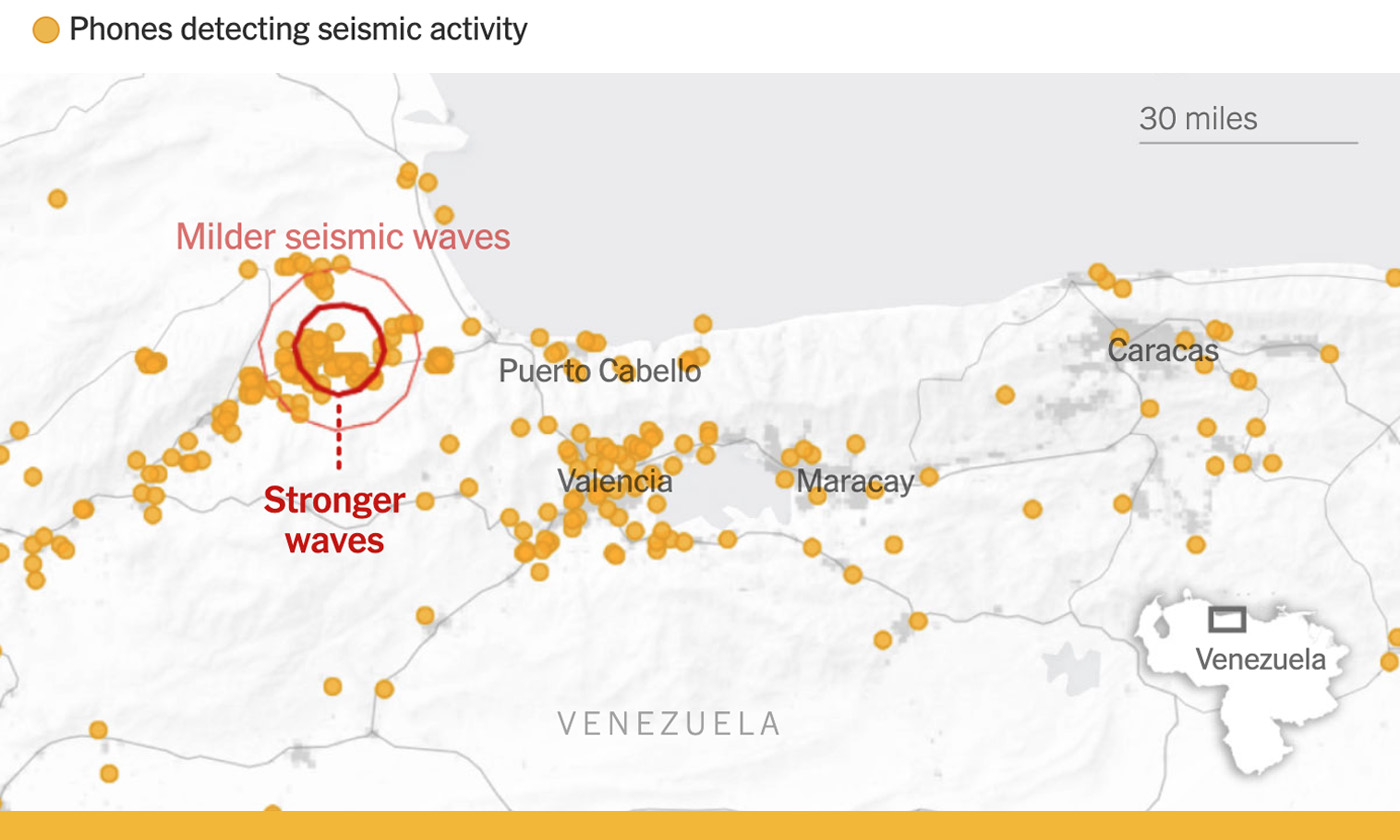
This approach is particularly important in countries like Venezuela, where a nationwide earthquake early warning network does not exist. Instead of relying solely on thousands of dedicated seismic stations, Google’s system can use the smartphones people already carry every day, bringing earthquake warnings to places that have never had them before. Since launching in 2021, Google’s Android Earthquake Alerts System has expanded to nearly 100 countries and regions, detecting more than 18,000 earthquakes and issuing over 2,000 public alerts.
Seconds still matter
Emergency managers have long understood that even a few seconds can save lives. They can allow surgeons to pause delicate procedures, factory workers to stop dangerous equipment, train operators to begin emergency braking, and individuals to get under sturdy furniture before the strongest shaking begins.
The Venezuela earthquakes offered one of the clearest demonstrations yet of how consumer technology is becoming part of emergency response. In regions without dedicated seismic sensor networks, Google’s earthquake alerts rely entirely on crowdsourced smartphone data to detect earthquakes and distribute warnings. The success of the alerts in Venezuela has renewed discussion about expanding similar capabilities to other earthquake-prone regions that lack traditional early warning infrastructure.
Why you should care: Receiving an alert matters only if people know what to do when it appears. Organizations operating in earthquake-prone regions should regularly review earthquake response procedures, communication plans, and employee training. Businesses with traveling employees should also understand where earthquake alerts are available and ensure workers know how those notifications function on their devices. Technology can provide a few precious seconds of warning. Preparation determines whether those seconds matter.
Use these Earthquake Communication Templates to communicate faster and reduce confusion when every second counts. |
.jpg?hash=131363)