In 1978, the Citicorp Center in Midtown Manhattan became the focus of one of the greatest engineering close calls in modern history. After a structural engineering student questioned the building’s design, engineers quietly discovered that quartering winds (conditions not fully accounted for during construction) could theoretically bring the skyscraper down. Under the cover of night, crews welded steel plates throughout the building while emergency evacuation plans were prepared in secret in case a major storm struck before repairs were complete. The public didn’t learn how close New York had come to disaster until years later.
Nearly five decades later, another Manhattan high-rise has put structural safety back in the spotlight. Only this time, the concerns aren’t theoretical.
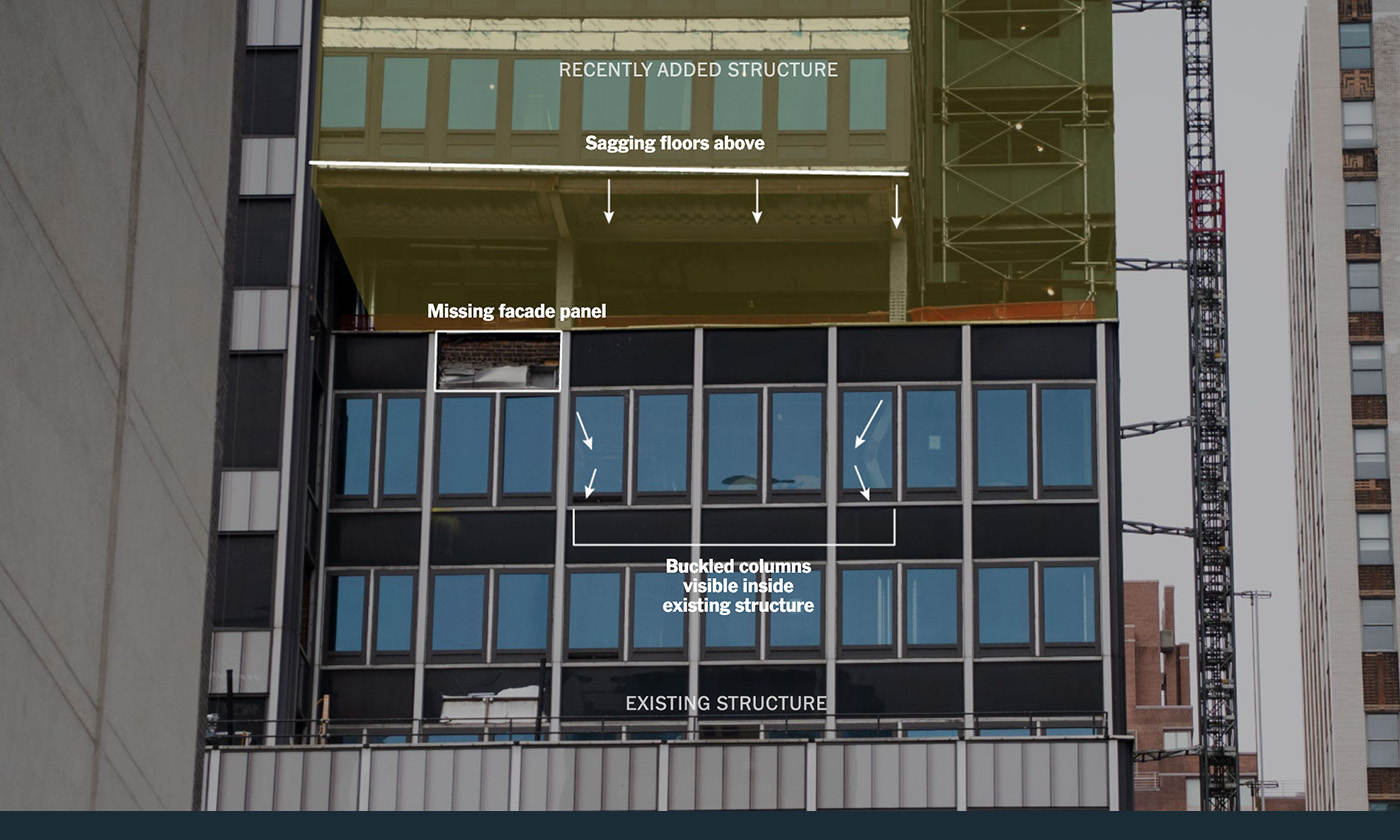
At the time of this writing, emergency crews continue working to stabilize the former Pfizer headquarters at 235 East 42nd Street, where two structural columns buckled during an office-to-residential conversion project. The damage caused several floors to sag, triggered a large emergency response, forced evacuations of neighboring buildings, and shut down multiple blocks in one of Manhattan’s busiest business districts. Fortunately, no injuries have been reported.
The building is one of New York City’s largest office-to-residential conversion projects, transforming the former Pfizer headquarters into roughly 1,600 apartments. The redevelopment also involves expanding part of the existing structure by adding new floors above a shorter section of the building, a complex engineering challenge that requires older structural elements to safely carry new loads. At the time of this writing, investigators have not identified the exact cause of the failure, but the developer has acknowledged that additional weight introduced during the redesign likely played a role. City officials stress that the investigation remains ongoing.
During an update on the response, New York City Mayor Zohran Mamdani summarized the challenge: “All of this is a reflection of the fact that our top priority right now is the safety of those who live in this area, the safety of those who work in this area.”
Why you should care: Business disruptions don’t always begin with hurricanes, cyberattacks, or acts of violence. Sometimes they start with a phone call about falling debris, a structural concern next door, or an unexpected evacuation order.
Organizations can’t prevent every incident unfolding around them, but they can prepare for how they’ll respond. Knowing where your people are, communicating quickly across multiple channels, identifying alternate worksites, and maintaining flexible continuity plans can dramatically reduce confusion when the unexpected closes streets, buildings, or entire neighborhoods. |