By AlertMedia, Risk Intelligence and Response

Safety and Security Oct 30, 2026
How to Monitor Social Media for Workplace Violence Warning Signs
Social Intelligence Key Feature Guide
Track trends, sentiment, and narratives online so you can proactively protect your people and organization.
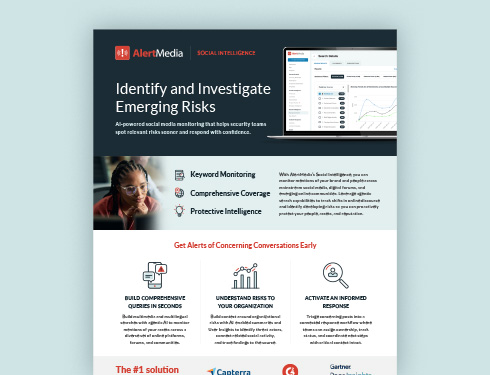
Knowing how to monitor social media for workplace violence warning signs starts with a repeatable process: define a clear scope, decide which warning signs matter, build focused searches, review results with a threat assessment team, and escalate verified concerns through your response plan. Monitoring does not predict behavior. It gives security, human resources, and safety teams earlier visibility into public posts that may deserve a closer look. This page walks through seven steps and the capabilities that make each one manageable for a lean team.
Social Intelligence Key Feature Guide
Track trends, sentiment, and narratives online so you can proactively protect your people and organization.
Why Social Media Monitoring Belongs in a Workplace Violence Prevention Program
Workplace violence prevention programs usually rely on reports from colleagues, managers, and employees. Public social media can add a complementary source, because people sometimes voice grievances, name targets, or describe plans online before anything happens at work.
For corporate security leaders, the challenge is capacity. Searching platforms one at a time, writing detailed queries, and reading through irrelevant posts takes hours that a small team may not have. Human resources and environmental health and safety (EHS) partners need a consistent process and a clear handoff, so concerns are reviewed the same way every time.
How to Monitor Social Media for Workplace Violence Warning Signs: Seven Steps
1. Define scope and purpose
Decide what you are monitoring for and where the boundaries are. Focus on publicly available posts that reference your organization, its locations, leaders, or workplace, and align scope with your existing HR, privacy, and security policies. Document the purpose so every reviewer works from the same definition.
2. Identify warning-sign categories
Agree on categories your threat assessment team will review. Common examples include statements of intent toward people or places, references to specific targets, times, or locations, mentions of weapons or planning, fixation on a grievance or an individual, and sharply escalating hostile language. Treat categories as prompts for review, not conclusions.
3. Build focused searches
Translate each category into searches that include your organization name, facility names, leader names, and relevant phrases. Account for variations in spelling, slang, and language. Natural-language query building can generate comprehensive, multilingual searches without advanced Boolean expertise.
4. Set alert subscriptions and a review rhythm
Save your searches and subscribe to notifications so the team learns about relevant activity without watching a screen. Assign a regular review time and a named backup so coverage continues when people are out.
5. Triage and verify
Review each result in context. Consider the source, the specificity of the statement, whether a target or location is named, and how the conversation is changing over time. Follow links to the original post and involve your threat assessment team before drawing conclusions.
6. Escalate through your response plan
When a concern is verified, move it into a defined path: notify the right stakeholders, document decisions, and activate your workplace violence response plan if needed. Pre-agreed escalation steps keep action fast and consistent.
7. Document and improve
Record what was found, what was decided, and what happened next. Review your searches and categories regularly, remove those that create noise, and update your plan based on what you learn.
Download This Free Guide to Explore Social Intelligence
What Social Media Monitoring Can and Cannot Do
Social media monitoring can surface public posts earlier, expand coverage beyond what manual searching allows, and give investigators direct links to original content. It cannot determine on its own whether a statement is credible or what someone intends to do.
A single post, a sentiment score, or a spike in mentions is one signal among many. Trained security professionals assess source reliability, specificity, and context, and decide how information should influence security decisions. The strongest programs keep monitoring as one input to a broader threat assessment process.
How AlertMedia Social Intelligence Supports Each Step
Social Intelligence helps security teams identify and investigate emerging risks across social platforms, fringe forums, and dark web sources, and then connects findings to response. The table maps each step of the process to the capability that supports it.
| Step | How AlertMedia helps |
| Build focused searches | AI Query Builder uses a natural-language chat interface to generate comprehensive, multilingual queries, with no Boolean expertise required. |
| Keep watch without watching a screen | Keyword Monitoring and alert subscriptions notify the team when criteria are met. |
| Add context to what is found | Sentiment Analysis, narrative tracking, and AI Summary show how conversations change over time and surface key themes. |
| Verify against the source | Direct source links trace every mention back to its origin so analysts can review the original content. |
| Escalate and respond | Incident Response supports workplace safety and security incidents, including workplace violence response plans, and Emergency Communication reaches the right people quickly. |
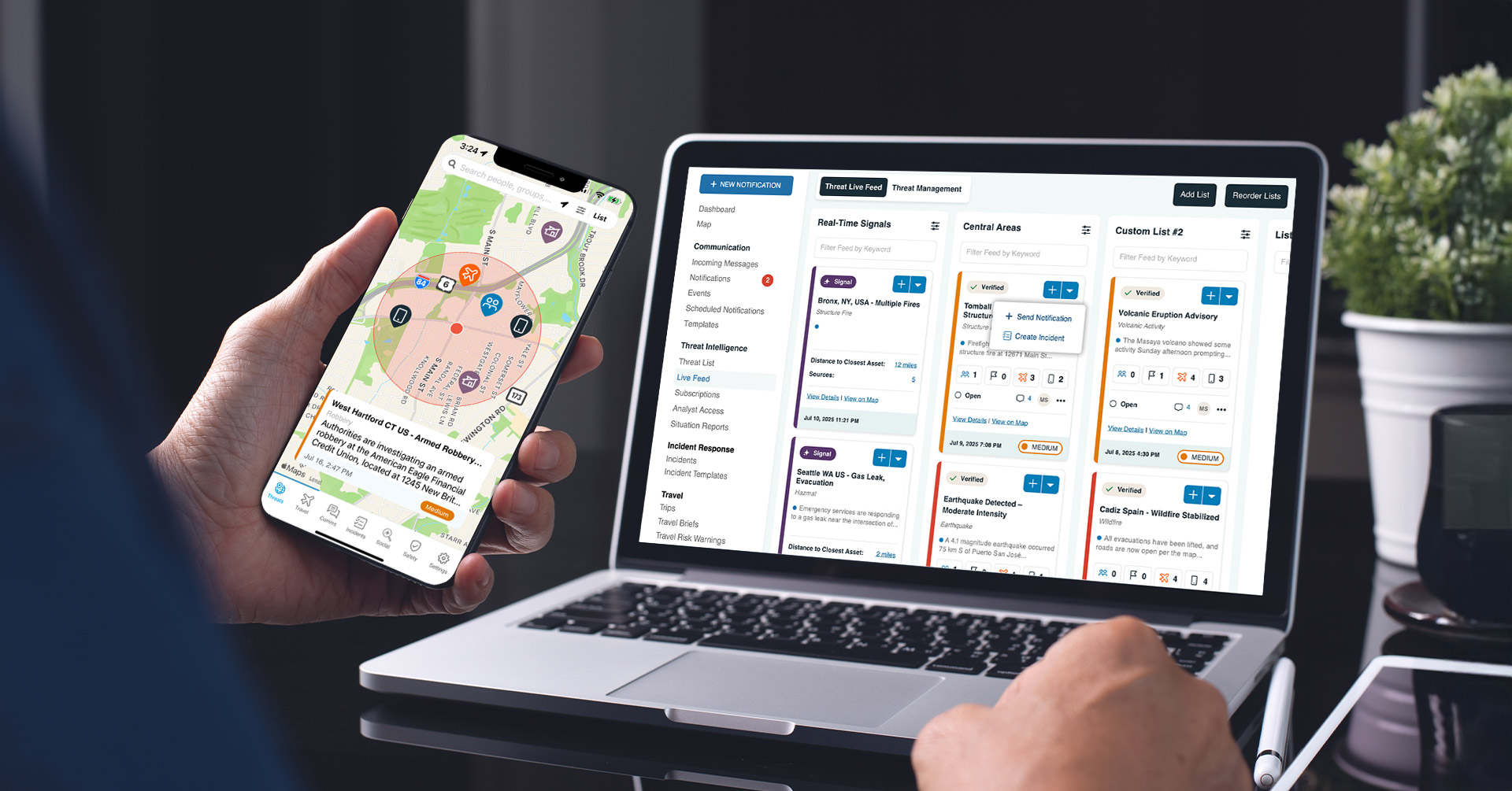
| Connect to verified threats | Threat Intelligence adds analyst-verified intelligence about threats near your locations, from AlertMedia’s Global Intelligence Team. |
Social Intelligence monitors more than 65 social platforms, fringe forums, and dark web sources and works on publicly available content with no covert collection.
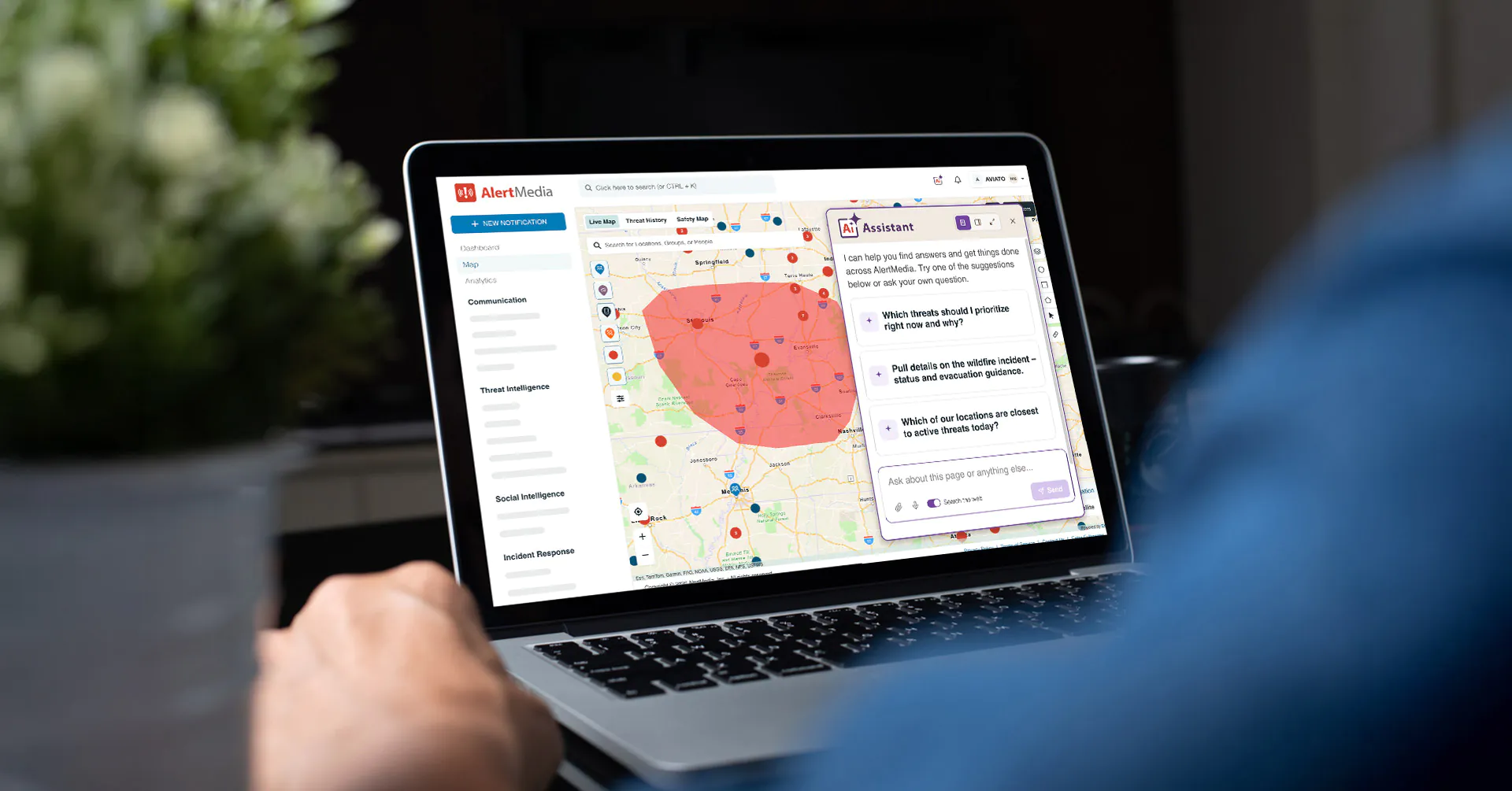
AI scales the platform; AI paired with analyst verification is what makes the intelligence trustworthy enough to act on. AI helps teams build searches and summarize results, and people on your threat assessment team decide what is credible and what to do.
More than 3,500 organizations in over 150 countries use AlertMedia to protect their people, and AlertMedia has been named a Gartner Peer Insights™ Customers’ Choice
“Our people are our primary asset. We’re focused on reducing business risk through resilience—and AlertMedia allows us to take a proactive approach to monitoring threats.”—Roger Garate, Business Continuity Manager, Leukemia and Lymphoma Society
Frequently Asked Questions
- How do you monitor social media for workplace violence warning signs? Define a clear scope, agree on warning-sign categories, build focused searches, subscribe to notifications, review results with a threat assessment team, and escalate verified concerns through your response plan. Monitoring supports a broader prevention program and does not predict behavior.
- What counts as a warning sign on social media? Common examples include statements of intent toward people or places, references to specific targets, times, or locations, mentions of weapons or planning, fixation on a grievance, and escalating hostile language. Each one is a prompt for review, not proof that violence will occur.
- Can employers monitor employees' personal social media? Rules and policies vary by location and organization, so teams typically define scope in policy before monitoring begins. Many focus on publicly available content that relates to the workplace, its people, and its operations, and follow their own HR, privacy, and security procedures.
- Who should review results: security, HR, or both? A cross-functional threat assessment team works best. Security leads monitoring and investigation, HR brings knowledge of workplace context and policy, and EHS or operations partners help with response planning. Agreeing on roles in advance keeps reviews consistent.
- How do you avoid false positives and bias? Use defined categories, review results in context, and verify against the original source before acting. Sentiment is one signal among many. Rotating reviewers and documenting decisions helps keep the process consistent and fair.
- What do you do when a warning sign is verified? Follow your pre-agreed escalation path: notify the right stakeholders, document the decision, and activate your response plan if needed. AlertMedia Incident Response and Emergency Communication support coordination and communication from the same platform.
- What role does AI play in monitoring social media for warning signs? AI helps build searches, process large volumes of posts, analyze sentiment, and summarize themes. It does not decide whether a concern is credible. People on the threat assessment team verify the source and decide how to respond.
Social Intelligence Key Feature Guide
Track trends, sentiment, and narratives online so you can proactively protect your people and organization.
AlertMedia, Risk Intelligence and Response